


Air balance certification proves your expertise in Testing, Adjusting, and Balancing (TAB) HVAC systems. It’s often a requirement for projects and ensures HVAC systems meet design and performance standards. Certified professionals are in demand due to their ability to improve energy efficiency (up to 20%) and ensure compliance with building codes.
Here’s what you need to know:
- What It Is: Certification validates skills in measuring, adjusting, and balancing airflow and water in HVAC systems.
- Why It Matters: Many commercial projects require certified reports, and certification enhances credibility and job prospects.
- Key Programs: AABC, NEBB, and TABB offer certifications with varying requirements for experience, exams, and ongoing education.
- How to Get Certified: Gain field experience, complete formal training, and pass exams. Requirements differ by program (e.g., AABC requires 8 years of experience or 4 with a degree).
- Tools Needed: Instruments like flow capture hoods, manometers, and tachometers are essential for TAB work.
Certification requires effort but opens doors to better opportunities and projects. If you’re in the HVAC field, it’s a step worth taking.
What Air Balance Certification Is and Why Contractors Need It
Definition of Air Balance Certification
Air balance certification demonstrates your expertise in Testing (measuring airflow and pressure), Adjusting (fine-tuning dampers, fans, and valves), and Balancing (ensuring air and water flows meet design specifications) for HVAC systems.
"The purpose of NEBB’s TAB certification program is to offer tangible proof of competent firms and professionals qualified in the proper methods and procedures for testing building systems for optimum performance." – NEBB
To achieve this certification, firms must meet several requirements: they need to operate continuously for at least 12 months, have calibrated tools like balancing hoods and manometers, and employ at least one Certified Professional or Test and Balance Engineer (TBE). For individual contractors, the path includes written and practical exams, 2–8 years of documented field experience depending on educational background, and ongoing education commitments. These rigorous standards ensure that only highly skilled professionals earn certification, making it a valuable credential.
Benefits of Air Balance Certification
Meeting these demanding certification standards opens the door to real business advantages. Certified professionals can help reduce energy costs by up to 20%, lower operating expenses, and extend the life of HVAC equipment.
In many areas, certified air balance reports are required for commercial HVAC installations, health department inspections in restaurants, and medical lab fume hood certifications. Large commercial building projects almost always require these reports to be completed by a certified, independent TAB professional. Employment opportunities for HVAC mechanics and installers are expected to grow 9% nationwide from 2023 to 2033, with Nevada leading at 15% growth. A 2022 workforce survey found that 93% of U.S. construction firms had unfilled hourly craft positions, including HVAC technicians. Additionally, more than 99% of project evaluations submitted to the AABC by engineers of record showed satisfaction with certified agency performance.
Certified TAB professionals are especially valuable because they not only identify equipment issues but also provide solutions, ensuring smoother project execution.
AABC TAB Talk: Fundamentals of Test, Adjust, & Balance for Engineers, Cx & Energy Providers
Main Air Balance Certification Programs
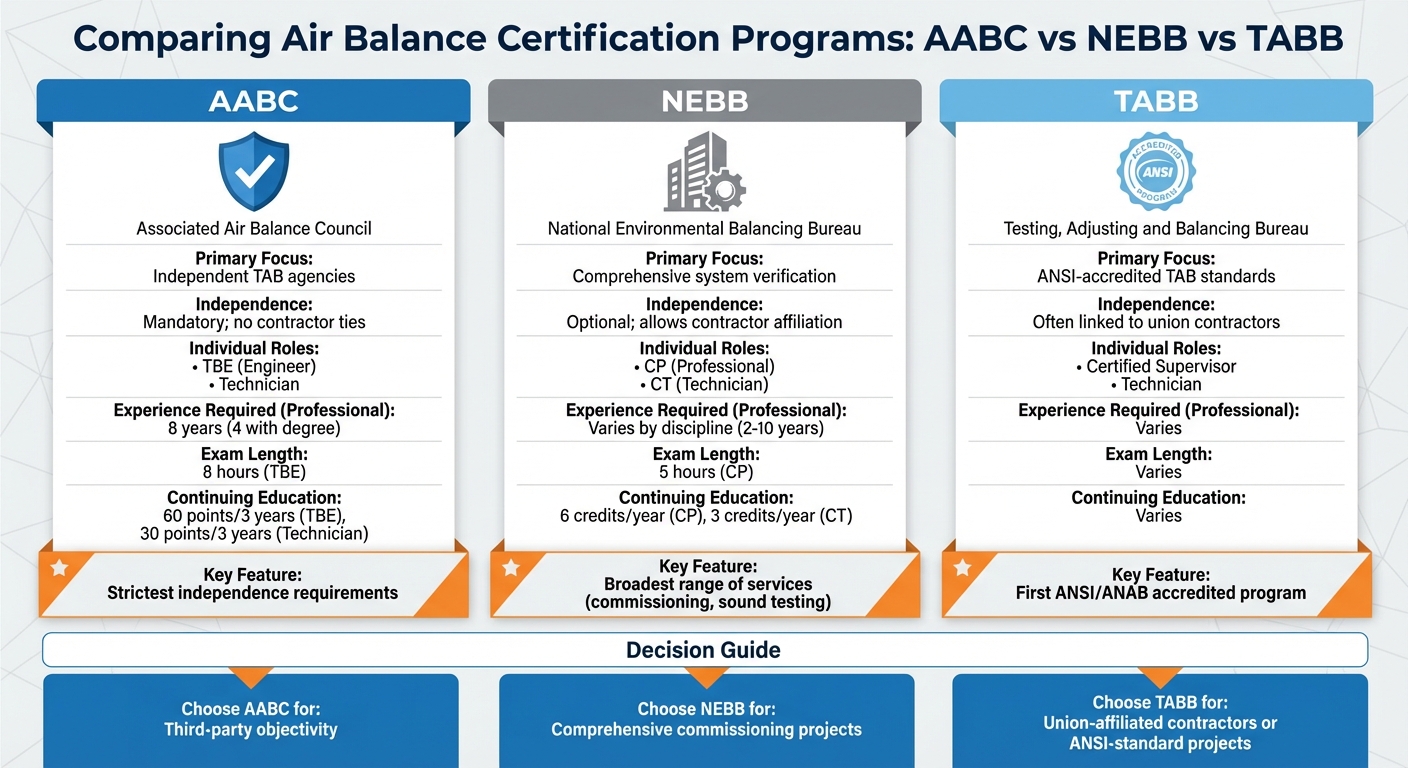
AABC vs NEBB vs TABB Air Balance Certification Comparison
In the U.S., three major organizations offer air balance certifications, each tailored to specific industry needs and professional goals. Choosing the right certification depends on your project requirements and career aspirations. Here’s a closer look at these programs to help you make an informed decision.
AABC Certification
The Associated Air Balance Council (AABC) emphasizes strict independence. Member firms must remain entirely separate from contractors, engineers, or manufacturers, ensuring unbiased testing and balancing services.
AABC offers certifications for two roles: Test and Balance Engineers (TBE) and Technicians. TBEs need eight years of experience – or four if they hold an engineering degree – and must pass an 8-hour exam covering topics like fan and pump laws, psychrometrics, heat transfer, and sound and vibration testing. Technicians require three years of experience, with at least one year at an AABC-certified agency. Certifications are valid only while employed by an AABC-certified firm.
To maintain certification, TBEs must earn 60 continuing education points every three years, while Technicians need 30 points during the same period. AABC members also benefit from a 20% discount on technical training programs.
NEBB TAB Certification
The National Environmental Balancing Bureau (NEBB) offers a broader range of services, including mechanical HVAC commissioning, sound and vibration testing, and building enclosure evaluations. Unlike AABC, NEBB allows member firms to have ties with contractors or engineers, enabling "self-testing" when contractors balance their own systems.
To qualify, firms must operate for at least 12 months and provide six endorsement letters from professionals like consulting engineers, architects, and building owners, as well as one from a contracting firm. Firms also need specific instruments as outlined in the NEBB TAB Procedural Standard.
NEBB certifies Certified Professionals (CP) and Certified Technicians (CT). The certification exam is a 5-hour closed-book test covering six core areas. Continuing education is required annually: CPs need 6 credits, while CTs require 3. This certification is ideal for projects that demand comprehensive services, such as system commissioning and sound testing.
TABB Certification
The Testing, Adjusting and Balancing Bureau (TABB) stands out as the first HVAC TAB certification program accredited by the American National Standards Institute (ANSI/ANAB). It adheres to standards set by the Sheet Metal and Air Conditioning Contractors’ National Association (SMACNA).
TABB certification often requires firms to be signatories to the Sheet Metal Workers’ (SMW) union.
| Feature | AABC | NEBB | TABB |
|---|---|---|---|
| Primary Focus | Independent TAB agencies | Comprehensive system verification | ANSI-accredited TAB standards |
| Independence | Mandatory; no contractor ties | Optional; allows contractor affiliation | Often linked to union contractors |
| Individual Roles | TBE (Engineer), Technician | CP (Professional), CT (Technician) | Certified Supervisor, Technician |
| Experience (Pro) | 8 years (4 with degree) | Varies by discipline | Varies |
| Exam Length | 8 hours (TBE) | 5 hours (CP) | Varies |
When deciding on a certification, consider your project’s needs and professional goals. AABC is the go-to for strict third-party objectivity, NEBB suits projects requiring extensive commissioning services, and TABB is a strong option for union-affiliated contractors or ANSI-standard projects.
How to Get Air Balance Certification
Earning air balance certification involves a mix of practical experience, formal training, and passing exams. While the specifics depend on the certification body you choose, all programs evaluate your technical skills and hands-on expertise.
Step 1: Gain Field Experience
Before pursuing certification, you’ll need to accumulate relevant field experience. The requirements vary depending on the organization:
- AABC (Associated Air Balance Council): Becoming a Test and Balance Engineer (TBE) requires 8 years of field experience (or 4 years if you hold a BS in Engineering). For technicians, 3 years of experience is required, including at least 1 year working at an AABC-certified agency.
- NEBB (National Environmental Balancing Bureau): Technicians need 4 years of field experience, which can be reduced to 2 years if you complete a qualifying course. For Certified Professional (CP) status, you’ll need an additional 2 to 4 years of supervisory experience, depending on your educational background. NEBB also requires at least 1,000 documented hours per year to meet its 4-year fieldwork requirement.
Your employer’s certification status matters too. AABC certifications are only valid if you’re employed by an approved member agency, and NEBB mandates that you work for a NEBB-certified or applicant firm. During this phase, you’ll need to master key concepts like psychrometrics, fan and pump laws, heat transfer, electrical systems, and the use of specialized instrumentation.
Step 2: Complete Formal Training
Once you’ve built a foundation of field experience, formal training helps deepen your technical knowledge and prepares you for certification exams. Training programs typically combine classroom learning with hands-on practice.
- EAB Training Center: Offers courses like TAB Fundamentals (35 hours: 20 classroom, 15 hands-on) and TAB Air & Water Systems (35 hours: 25 classroom, 10 practical). These programs cover topics such as psychrometrics, fan laws, duct leakage testing, and hydronic balancing.
- NTT Training: Provides a 2-day course titled "Balancing of Water and Air Systems", which costs $1,095 per participant and is NATE-approved. This course focuses on CFM calculations, kitchen ventilation, and chiller performance testing.
AABC members can take advantage of a 20% discount on EAB training programs and are encouraged to use the AABC National Standards and Technician Training Manual for exam preparation. Training often involves using specialized tools like flow capture hoods, digital manometers, tachometers, and ultrasonic flowmeters.
Step 3: Pass the Certification Exams
The final step is passing the required exams, which test your knowledge and practical skills:
- AABC: The TBE exam is an 8-hour written test covering air and hydronic balancing, fan and pump laws, psychrometrics, heat transfer, electrical systems, sound and vibration testing, and TAB project management. Exams are conducted at computer-based testing centers.
"The differences between AABC and other certifications I hold are extremely important, and ultimately are why we chose AABC as the premier certification to hold and provide." – Jon Sheppard, TBE at Atlantic Testing
- NEBB: Requires a 5-hour closed-book exam that covers six key domains. Additionally, NEBB includes a practical exam to assess your hands-on competency in testing and balancing procedures.
After certification, professionals must maintain their credentials through continuing education. AABC TBEs need 60 points every 3 years, while technicians require 30 points.
| Certification Level | Experience Required | Exam Duration | Continuing Education |
|---|---|---|---|
| AABC TBE (Engineer) | 8 Years (4 with degree) | 8 Hours | 60 points / 3 years |
| AABC Technician | 3 Years | Not Specified | 30 points / 3 years |
| NEBB Technician | 4 Years (or 2 w/ course) | Online exam | Ongoing professional education |
| NEBB Professional (CP) | 2–10 Years (varies by degree) | 5 Hours | Ongoing professional education |
Tools and Resources for Air Balance Certification
Once you’ve met the certification requirements, it’s time to gather the right tools and study materials to perform Testing, Adjusting, and Balancing (TAB) work accurately and effectively.
Essential Tools for TAB Work
To carry out precise air balance tasks, having the right instruments is non-negotiable. Here’s what you’ll need:
- Flow capture hoods: Measure air volume at diffusers.
- Digital manometers: Monitor duct pressure and air velocity.
- Ultrasonic flowmeters and hydro-data meters: Measure water flow and pressure in hydronic systems.
- Digital thermometers and psychrometers: Assess temperature and humidity.
- Clamp meters and multimeters: Perform electrical testing.
- Tachometers: Measure the rotational speed of fans and pumps (available in both contact and contactless types).
- Specialized tools: For advanced tasks, sound pressure meters, vibration measurement tools, and duct leakage kits are essential.
All instruments must meet strict calibration standards. Agencies like NEBB require local chapters to visually confirm that firms have the necessary TAB instruments and maintain a documented calibration schedule to ensure accuracy.
With these tools in hand, you’ll also want to sharpen your skills using the best training resources.
Training and Study Materials
Several key resources can help you deepen your understanding of TAB procedures:
- AABC National Standards and NEBB Procedural Standards for Testing, Adjusting, and Balancing of Environmental Systems provide foundational guidelines.
- The AABC Technician Training Manual includes helpful diagrams and review questions to guide you through mastering total system balance.
- Additional references like the Kahoe Test & Balance Field Manual, EAB Equation Quick Guide, and ACCA Manual B® offer further support for your studies.
AABC members enjoy added perks, such as discounts on training programs at the Engineered Air Balance Training Center. They also gain access to over 40 free continuing education opportunities annually through ACG and EMA. Plus, members can download a PDF bundle containing the AABC National Standards and Technician Training Manual – an impressive $180 value – at no additional cost.
Working with Air Balance Masters for Certification Support
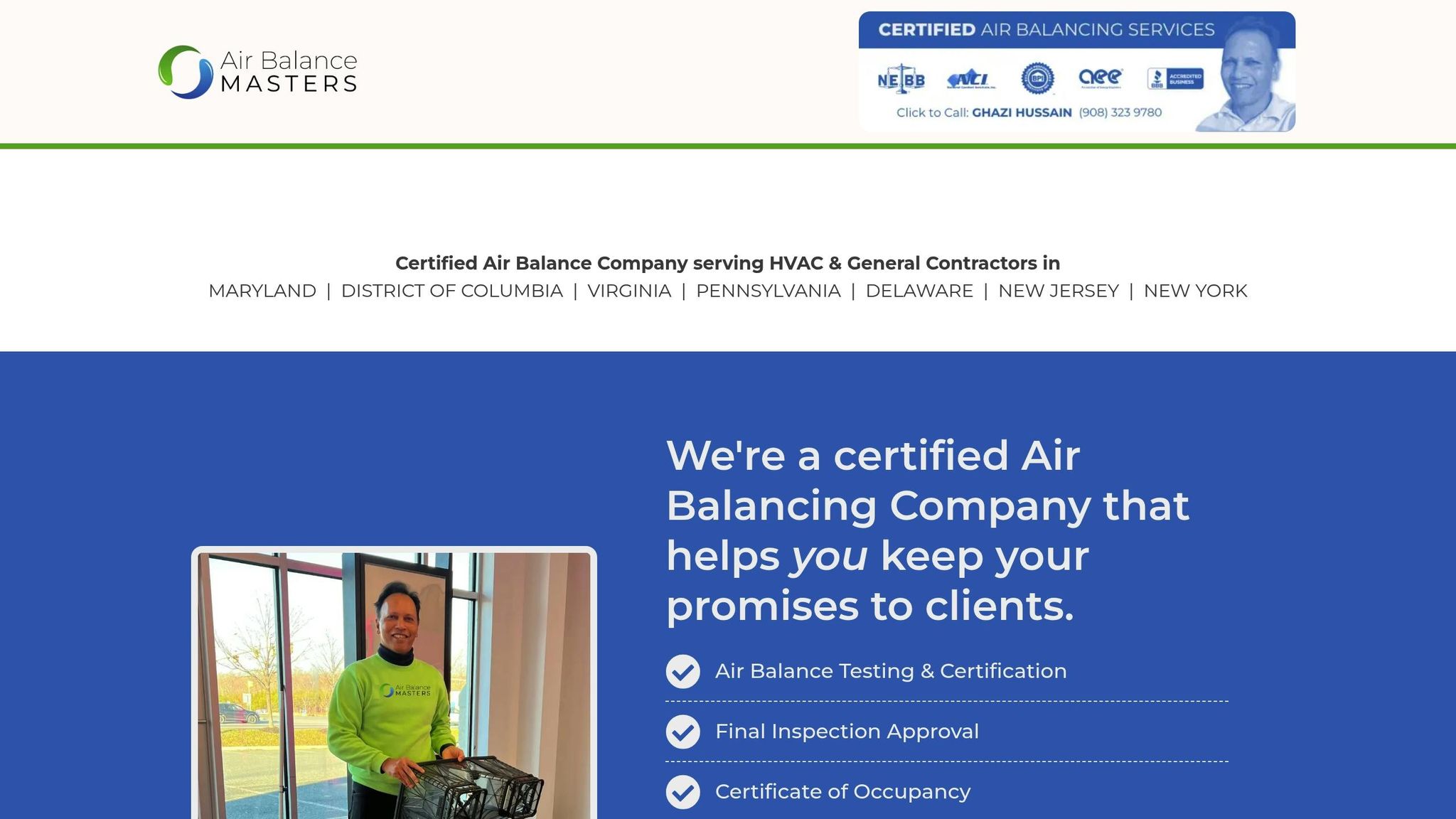
Services Offered by Air Balance Masters
Air Balance Masters offers Testing, Adjusting, and Balancing (TAB) services designed to help projects achieve certification compliance while ensuring smooth final inspections. Their expertise includes air balance testing, identifying deficiencies, and providing compliance support in line with industry standards. The certified reports they produce document HVAC system performance with precise, repeatable test data – critical for proving that systems meet design specifications and local building codes.
By identifying problems like airflow imbalances, pressure inconsistencies, or duct leakage early in the process, Air Balance Masters helps prevent costly project delays. Addressing these issues during the preliminary stages ensures mechanical problems are resolved well before final inspections. Their specialized offerings include duct leakage testing (DALT), control system verification, and hydronic flow balancing.
"Even the most efficiently designed and expertly built HVAC system cannot operate at optimal levels without a proper air balance."
Service Area and Experience
Air Balance Masters operates in MD, VA, PA, NJ, NY, DE, and DC. They bring extensive knowledge of regulatory compliance, helping projects secure inspection approvals and certificates of occupancy with confidence.
Is air balance certification worth it
As we’ve covered, air balance certification is a must-have for contractors aiming to stay competitive in the commercial HVAC industry. This certification not only confirms your expertise but also opens doors to financial and operational advantages, such as improved energy efficiency and ensuring systems perform as designed. The journey to certification – gaining hands-on experience, completing specialized training, and passing challenging exams – positions you as a trusted professional who can meet both design and regulatory standards.
Achieving certification requires dedication: extensive fieldwork, rigorous testing, and ongoing education to maintain your credentials. But the rewards are clear. Certification gives you access to high-value projects where it’s often a requirement and enhances your credibility, setting you apart from competitors who lack these qualifications.
"Training, education, and certification are essential to the development of competent test and balance personnel."
- AABC
These benefits become tangible with the right support. Air Balance Masters assists contractors through every step of the process, offering TAB services that ensure compliance with industry standards. Operating across MD, VA, PA, NJ, NY, DE, and DC, they help contractors navigate certification requirements, ensuring projects pass inspections and secure certificates of occupancy. Whether you’re pursuing AABC, NEBB, or TABB certification, partnering with seasoned professionals who use calibrated instruments and follow established procedures provides invaluable insights into the standards you’ll need to meet.
With building codes increasingly requiring proper testing and balancing for commercial properties, the demand for certified TAB professionals is on the rise. Contractors who pursue certification now position themselves to tap into this growing market, delivering value through improved energy efficiency, extended equipment life, and enhanced comfort – benefits clients notice and appreciate.
FAQs
What sets AABC, NEBB, and TABB certifications apart in air balancing?
To earn AABC certification, professionals need a minimum of 8 years of industry experience, must pass a detailed exam, and commit to ongoing professional education to keep their certification active.
NEBB certification involves intensive study, a demanding 5-hour exam, and strict adherence to industry standards, ensuring high levels of competence and compliance.
TABB certification focuses on a structured and standardized approach, blending technical training with precise procedures for HVAC testing and balancing.
While each certification has its own strengths, they all share a common focus: promoting professionalism and upholding best practices in air balancing.
How does earning an air balance certification benefit my career as an HVAC contractor?
Earning an air balance certification can be a game-changer for your career. It demonstrates your expertise in ensuring HVAC systems run efficiently and meet industry standards, making you a go-to professional for clients who value top-notch service.
With this certification, you can unlock access to better-paying projects and more competitive opportunities. It also boosts your reputation, helping you stand out in a crowded market and positioning you for steady career advancement over time.
What are the essential tools needed for effective Testing, Adjusting, and Balancing (TAB) work?
To carry out effective Testing, Adjusting, and Balancing (TAB) tasks, having the right tools is essential. You’ll need airflow measurement devices such as digital manometers, anemometers, flow capture hoods, and ultrasonic flowmeters to assess air movement accurately. For electrical tasks, clamp meters and multimeters are must-haves. Temperature and humidity measurements require thermometers and psychrometers, while tools for adjusting dampers and vents ensure proper airflow control. Instruments tailored for testing pressure, velocity, and sound levels are also key to achieving precise and reliable results.


