


Air balance testing ensures HVAC systems deliver the right amount of airflow to every room, improving comfort, reducing energy costs, and meeting air quality standards. Here’s what you need to know:
- What it is: A process to measure and adjust airflow in buildings, ensuring HVAC systems work efficiently and as designed.
- Why it matters: Prevents energy waste (up to 30%), reduces HVAC wear, lowers utility bills, and improves indoor air quality.
- How it works: Technicians inspect ductwork, measure airflow, adjust dampers, and provide detailed reports on system performance.
- Cost: Professional balancing typically costs $750–$2,000 but can save 10% or more on energy bills.
- Key benefits: Extends HVAC lifespan, addresses temperature imbalances, and ensures compliance with standards like ASHRAE 241.
Whether you’re managing a school, healthcare facility, or home, air balance testing is a smart way to improve HVAC performance and indoor comfort.
What Does an Air Balance Technician Do?
Why Air Balance Testing Matters
Air balance testing plays a crucial role in ensuring comfort, cost efficiency, and regulatory compliance. A well-balanced HVAC system ensures every component operates as intended, delivering noticeable benefits for both building occupants and operational costs. These advantages span system performance, energy efficiency, and adherence to air quality standards.
Improving HVAC System Performance
An unbalanced HVAC system often forces equipment to work harder than necessary. For instance, if one room feels too cold while another overheats, components like the blower fan, compressor, and motors end up straining to compensate. Proper air balance testing can address even small temperature differences – such as a 2–3°F variance – by fine-tuning dampers and vents, which reduces wear and tear and extends the system’s lifespan.
Additionally, the testing process frequently uncovers hidden issues before they escalate into costly repairs. Problems like undersized ductwork, blocked return vents, or leaky seals often come to light during testing, allowing for early intervention. Even minor temperature inconsistencies can signal deeper imbalances that, if ignored, could lead to larger system failures.
Lowering Energy Costs
Uneven airflow often leads to occupants adjusting thermostats in an attempt to compensate, which drives up energy consumption. This unnecessary usage can significantly impact utility bills.
Professional air balancing can reduce energy use by as much as 10% in schools. For homeowners, while the cost of professional balancing typically ranges from $750 to $2,000, the savings on monthly utility bills and fewer repair needs make it a worthwhile investment. Proper balancing also ensures that Building Automation Systems can effectively manage temperature and humidity, reducing the likelihood of "thermostat wars" that waste energy. These improvements not only lower energy costs but also contribute to maintaining healthier indoor air standards.
"Air balance isn’t a line item – it’s a strategy for better performance and long-term cost savings." – TSI
Meeting Air Quality Standards
Air balance testing is essential for meeting regulatory air quality requirements, especially in sensitive environments like healthcare and educational facilities. ASHRAE Standard 241, introduced in July 2023, outlines minimum clean airflow requirements per person to help reduce the spread of airborne diseases. Testing ensures that air changes per hour (ACH) and directional airflow meet these standards.
In healthcare settings, for example, testing confirms "clean-to-less-clean" directional airflow, which prevents infectious particles from moving into lower-risk areas like corridors or triage zones. It also verifies CO2 levels, with concentrations below 800 ppm serving as a benchmark for good ventilation. For spaces requiring higher protection, the CDC recommends maintaining 5 or more ACH. Testing can also identify stagnant air pockets where pollutants may accumulate and ensure filtration systems – like MERV 13 filters, which capture at least 50% of particles in the 0.3 µm to 1.0 µm range – are functioning as intended.
How Air Balance Testing Works
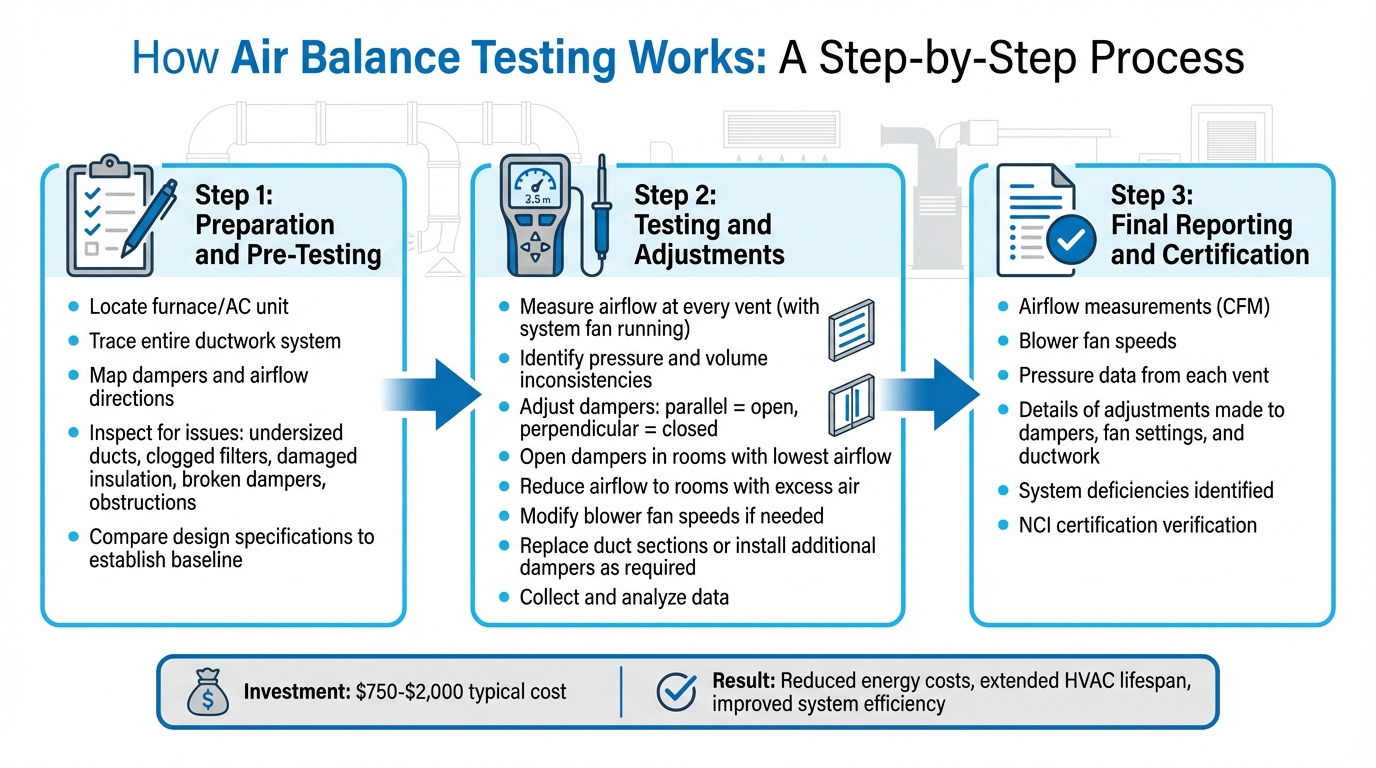
Air Balance Testing Process: 3 Steps to Optimize HVAC Performance
Air balance testing is a step-by-step process designed to ensure HVAC systems operate as efficiently as possible. By breaking it down into distinct phases, technicians can identify and address airflow issues, leading to better system performance.
Preparation and Pre-Testing
The first step involves locating the furnace or air conditioner and tracing the entire ductwork system to map out dampers and airflow directions. During this phase, technicians inspect for potential problems, such as undersized ducts, clogged filters, damaged insulation, broken dampers, or even obstructions like furniture or newly added interior walls. They also compare the system’s design specifications to establish baseline expectations for airflow.
Testing and Adjustments
With the system fan running, technicians measure airflow at every vent to pinpoint pressure and volume inconsistencies. Adjustments are then made using dampers – mechanisms inside the ducts controlled by external handles – and vents, which feature adjustable louvers. Dampers are opened or closed depending on their alignment with the duct: parallel means open, perpendicular means closed.
The process starts with opening dampers in rooms with the lowest airflow. From there, technicians gradually reduce airflow to rooms with excessive air by adjusting vents, redirecting air to areas that need it most. In some cases, more extensive adjustments may be necessary, such as modifying blower fan speeds, replacing duct sections with different sizes, or installing additional dampers. Once all adjustments are complete, the data is collected and analyzed for a detailed report.
Final Reporting and Certification
A professional air balance concludes with a comprehensive diagnostic report that includes airflow measurements (CFM), blower fan speeds, and pressure data from each vent. This report also details the adjustments made to dampers, fan settings, and ductwork, while highlighting any system deficiencies that could impact performance. Organizations like the National Comfort Institute (NCI) offer standardized guidelines and certifications to verify the system meets performance benchmarks. This documentation not only confirms the system’s efficiency but also helps reduce energy costs and prolong the lifespan of the HVAC equipment.
Tools and Techniques for Air Balance Testing
Key Tools for Accurate Measurements
Air balance testing relies on precision instruments to ensure airflow is measured and analyzed correctly. For example, anemometers are used to measure vent air velocity, a key factor in determining air changes per hour (ACH). To measure pressure differentials throughout duct systems, technicians use manometers paired with Pitot tubes, ensuring consistent readings across various conditions.
Other tools like smoke tubes and handheld fog generators help visualize airflow direction and pinpoint stagnant areas. These are particularly useful for verifying that air flows as intended – from cleaner to less-clean areas. For ventilation performance, portable CO2 meters (available for under $300) measure carbon dioxide levels in breathing zones, confirming that the HVAC system is effectively bringing in outdoor air. Ideally, CO2 levels should stay below 800 parts per million (ppm). If readings exceed 110% of the baseline, it could signal a ventilation issue.
For larger, multi-zone systems, more advanced techniques are necessary to achieve accurate results.
Methods for Complex Systems
While basic tools work well for standard setups, complex systems demand specialized methods. One such method is duct traverse testing, which helps account for uneven velocity distribution. For round ducts, technicians typically take 18 readings along three radii spaced 60° apart. Rectangular ducts require more extensive measurements, often between 25 and 49 readings, to ensure accuracy. When measuring airflow through grilles, correction factors are applied – such as 0.88 for square-punched grilles or 0.78 for bar grilles – to account for reduced effective areas.
Another advanced method is tracer gas decay testing, which evaluates how well a ventilation system dilutes airborne contaminants. This technique calculates the "mixing factor" (k), a measure of air mixing efficiency. A perfect mixing factor is 1, while spaces like hospital isolation rooms with high airflow (6+ ACH) typically have a factor of 3. Poorly ventilated areas often range from 8 to 10. As the CDC explains:
"Determining the true value of the mixing factor is difficult and requires special equipment to measure air flows and conduct tracer gas decay testing".
This measurement is essential for calculating how long it takes to remove airborne particles from a space. These advanced techniques build on the foundational tools and methods, ensuring even the most intricate systems achieve proper airflow balance.
Common Challenges and Solutions
Beyond testing, flaws in system design can significantly disrupt airflow balance and overall HVAC performance.
Fixing Design Discrepancies
Even thorough testing can’t compensate for poor design. For example, oversized HVAC units can cause short cycling, while undersized units or improperly sized ducts restrict airflow, leading to inefficiencies and increased wear and tear.
Another common issue is thermostat placement. If a thermostat is installed near heat sources or drafts, it can produce inaccurate readings. Moving it to a more central location ensures better temperature regulation.
Pressure imbalances can also result from having too few or undersized return vents. This problem can be resolved by adding or enlarging return vents. Hiring a professional to balance the air typically costs between $75 and $100 per vent, with total costs ranging from $750 to $2,000 depending on the system.
While design flaws can limit performance, these targeted fixes can help restore proper airflow and improve system efficiency.
Correcting Airflow Distribution Problems
Airflow issues often manifest as uneven temperatures, weak vent output, or pressure imbalances, all of which can reduce HVAC performance by up to 15%.
To address these problems, start by adjusting external dampers. Aligning the damper disk parallel to the duct maximizes airflow, while positioning it perpendicular restricts it. Sealing duct joints and cleaning components like blower blades and evaporator coils can also improve airflow and system efficiency .
For rooms located far from the main unit, duct booster fans can help push air through long duct runs. If certain rooms feel stuffy, check that return vents aren’t blocked by furniture. Adding more return vents may also help the system recondition air more effectively . A general guideline for system airflow is 400 CFM (Cubic Feet per Minute) per ton of AC capacity.
Air Balance Testing in Schools and Healthcare Facilities
Schools and healthcare facilities face distinct challenges when it comes to air quality and ventilation. Air balance testing addresses these issues by ensuring both health and energy efficiency, which are critical in environments that serve vulnerable populations.
Maintaining Healthy Indoor Air Quality
Air balance testing helps manage directional airflow, which is crucial for maintaining cleaner zones and controlling infections. It also establishes pressure differences between spaces, ensuring isolation rooms function effectively. Without proper balancing, stagnant air pockets can form, allowing viral particles and aerosols to linger. Smaller particles, in particular, can remain suspended in the air if ventilation isn’t sufficient to dilute them.
This testing also confirms compliance with outdoor air standards and ensures CO2 sensors operate accurately by avoiding direct airflow interference. Ideally, CO2 levels should stay below 800 parts per million (ppm). When facilities upgrade to advanced filtration systems like MERV 13 or HEPA, air balance testing ensures the HVAC system can handle the increased resistance while maintaining required airflow. These measures not only promote health but also help facilities meet strict regulatory standards.
Meeting Regulatory Requirements
Schools and healthcare facilities must adhere to stringent guidelines to ensure safe air quality. Healthcare facilities, for instance, follow the CDC’s Recommendations for Environmental Infection Control, which include specific ventilation criteria to reduce the spread of infectious diseases. Schools, on the other hand, are required to comply with state and local building codes.
ASHRAE Standard 241, introduced in July 2023, sets minimum requirements for controlling infectious aerosols in both new and existing buildings, as well as major renovations:
"ASHRAE Standard 241… establish[es] minimum requirements aimed at reducing the risk of disease transmission through exposure to infectious aerosols in new buildings, existing buildings, and major renovations." – ASHRAE
The CDC also recommends at least 5 air changes per hour (ACH) of clean air, with hospital isolation rooms often operating at 6 ACH or more to minimize airborne contaminants. ASHRAE Standard 241 further emphasizes delivering "equivalent clean airflow per person" (ECAi) during Infection Risk Management mode (IRMM). Air balance testing verifies these standards using tools like smoke tubes or fog generators.
Managing Energy Use in Large Buildings
Energy efficiency is another key concern, especially in large institutions like schools, where HVAC systems are among the biggest energy consumers. Air balance testing helps prevent over-ventilation, which occurs when too much outdoor air is conditioned, leading to unnecessary heating and cooling costs. It also identifies issues like malfunctioning dampers or incorrect settings that waste energy.
Case studies have shown that air balancing and HVAC commissioning can result in energy savings of up to 29%, with payback periods ranging from 1 to 3 years. Proper balancing also ensures energy-saving systems like Demand Controlled Ventilation (DCV) and Energy Recovery Ventilation (ERV) perform as intended. For example, ERV can reduce the energy required to condition 15 cubic feet per minute (cfm) of outdoor air per person to the equivalent of 5 cfm while still maintaining high air quality. Additionally, a 30% increase in static pressure across a cooling coil – often caused by poor airflow or dirty filters – can add approximately $200 in costs per 10,000 cfm of airflow.
The short answers on air balance testing
Air balance testing plays a key role in ensuring efficient, compliant, and cost-saving HVAC system performance. By making sure every room gets the right amount of conditioned air, this process helps reduce energy use, eases the workload on your system, and extends the lifespan of your equipment. The U.S. Department of Energy highlights its importance, stating, "Commissioning of the HVAC systems often uncovers faulty equipment and mistakes that waste energy and adversely impact indoor air quality and comfort".
The economic benefits of HVAC testing are hard to ignore. For instance, Parkway West High School in Chesterfield, Missouri, saw 27% annual energy savings and a $98,600 cost reduction after retro-commissioning and upgrading HVAC systems. Similarly, the Santee Education Complex in Los Angeles achieved 29% energy savings and avoided $226,000 in costs through comprehensive system balancing. These types of projects generally pay for themselves within 1 to 3 years, making them a smart financial move for facilities of all sizes.
Beyond the monetary advantages, air balance testing is essential for meeting health and safety standards. The CDC stresses the importance of proper ventilation, noting that "Ensuring appropriate outdoor air and ventilation rates is a practical step to ensure good indoor air quality". Testing ensures compliance with standards like ASHRAE Standard 241 for controlling infectious aerosols and keeps CO2 levels below 800 ppm, safeguarding indoor environments in schools, healthcare facilities, and other sensitive spaces.
Another key benefit is the trust and transparency that third-party verification brings. For HVAC professionals, air balance testing confirms that systems operate as designed, providing an objective layer of accountability. This not only builds client confidence but also demonstrates a strong commitment to quality. Even small temperature inconsistencies can point to underlying imbalances that hurt efficiency and comfort. Professional testing catches these issues early, preventing them from turning into expensive repairs.
FAQs
How does air balance testing help improve indoor air quality?
Air balance testing plays a key role in improving indoor air quality by ensuring the HVAC system maintains proper airflow, ventilation, and filtration. It helps pinpoint and fix problems like uneven airflow, insufficient ventilation rates, or malfunctioning filters – issues that can lead to a buildup of contaminants.
By addressing these challenges, air balance testing contributes to a cleaner and healthier indoor environment. It minimizes allergens, pollutants, and other harmful particles in the air. This is particularly crucial in places like schools and healthcare facilities, where maintaining high air quality directly impacts the health and comfort of everyone inside.
What are the financial advantages of air balance testing?
Air balance testing can save you money by boosting the efficiency of your HVAC system. When your system operates more efficiently, it uses less energy, which translates to lower utility bills. Plus, it reduces strain on the equipment, potentially extending its lifespan and cutting down on maintenance costs.
In fact, the savings from energy efficiency and smoother operation often offset the cost of air balance testing within 1 to 3 years. It’s an effective way to keep your system running at its best while trimming unnecessary expenses.
How does air balance testing ensure schools and healthcare facilities meet ventilation and air quality standards?
Air balance testing is essential for making sure HVAC systems in schools and healthcare facilities meet ventilation and indoor air quality standards. This process involves measuring and verifying key factors like airflow rates, outdoor air intake, and correct filter installation to ensure compliance with regulations such as ASHRAE 62.1.
By maintaining proper ventilation and minimizing contaminants, air balance testing helps create safer, healthier spaces. It also ensures systems operate efficiently while meeting regulatory requirements, giving administrators confidence that their facilities adhere to industry standards.


