


If you need the short answer: no single airflow balancing tool does every HVAC job well. I’d use a capture hood for direct register CFM, a probe kit for duct and pressure checks, a multifunction meter for system testing, and a manual TAB kit when simple field checks are enough.
Here’s the article in plain English:
- Dwyer SAH: best when I want fast diffuser readings, with 40 to 2,000 CFM range and app logging.
- TSI EBT731: built for commercial TAB, with backpressure correction for pressure-sensitive systems.
- CPS EasyHood: fits residential and light commercial work, with 35 to 1,200 CFM range and Bluetooth reports.
- Testo Smart Probes VAC Kit: best for duct, pressure, temperature, and humidity checks, not direct grille CFM.
- Testo 440 / 417: the 440 fits system testing; the 417 fits grille and diffuser readings.
- TSI VelociCalc 9565: a handheld meter for velocity, pressure, RH, and duct testing with data logging.
- TSI AirPro AP500: similar handheld setup, but focused on probe changes across different checks.
- Dwyer TABKIT: the manual option for pitot, pressure, and temperature with no wireless logging.
If I had to boil the whole piece down to one point, it’s this: match the tool to the task, not the other way around. For install checks, direct outlet airflow matters most. For commissioning, logging, pressure, and multi-point testing matter more. For closeout paperwork, stored data and calibration records matter just as much as the reading itself.
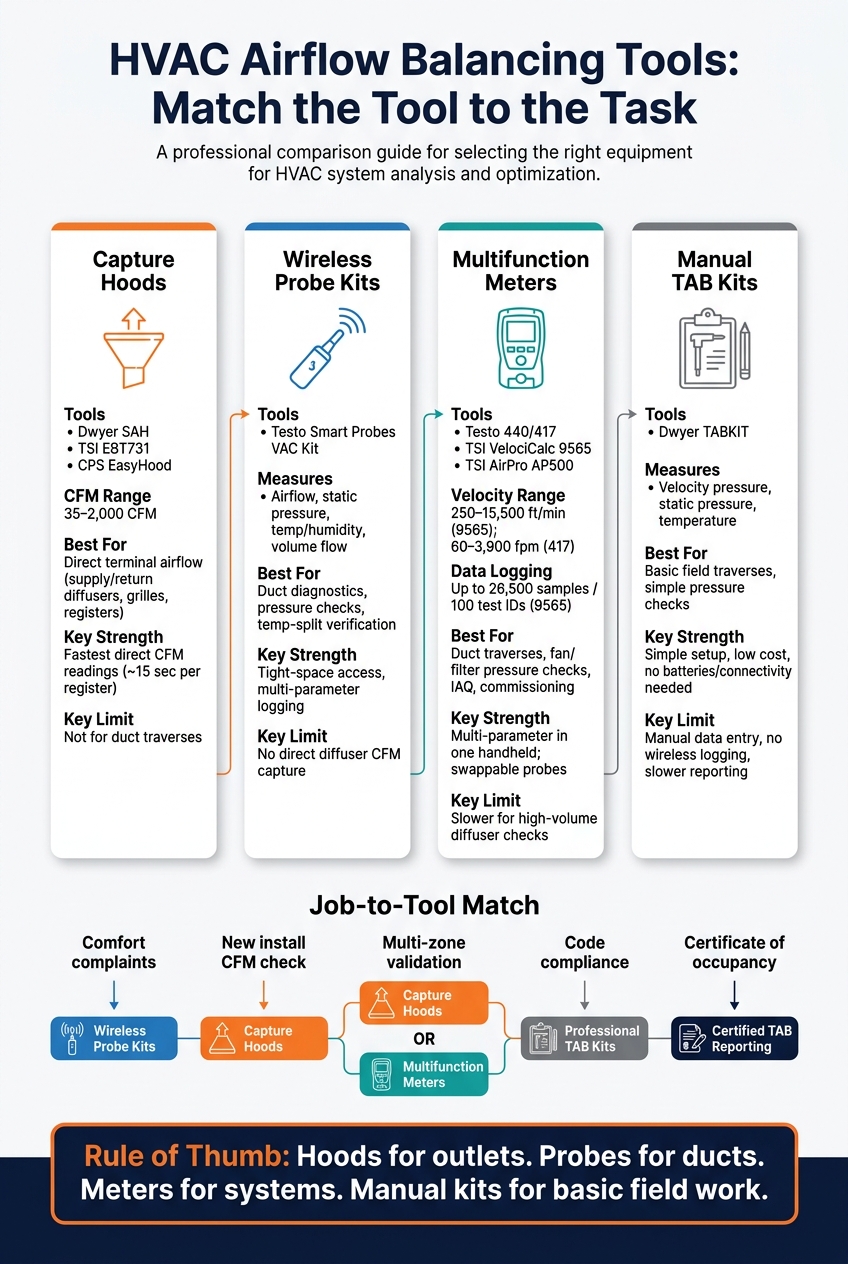
HVAC Airflow Balancing Tools Comparison Guide
How to Use the Dwyer SMART Air Hood® Balancing Instrument
Quick Comparison
| Tool | Best Use | Main Strength | Main Limit |
|---|---|---|---|
| Dwyer SAH | Supply/return diffuser checks | Fast direct CFM readings | Not for duct traverses |
| TSI EBT731 | Commercial register balancing | Backpressure correction | More setup at each outlet |
| CPS EasyHood | Residential/light commercial terminals | Small, light, app reports | Tops out at 1,200 CFM |
| Testo Smart Probes VAC Kit | Duct and equipment checks | Small wireless probes | No direct hood-style grille reading |
| Testo 440 / 417 | System checks or terminal checks | Split between modular meter and vane meter | May need add-ons for some airflow tasks |
| TSI VelociCalc 9565 | Duct, pressure, IAQ-style field checks | Logs up to 26,500 samples | Not the first pick for terminal CFM |
| TSI AirPro AP500 | Handheld multi-check field work | Swappable probes | Less focused on direct grille airflow |
| Dwyer TABKIT | Manual TAB checks | Simple setup | Handwritten notes and slower reporting |
So if you’re choosing between these tools, I’d keep the rule simple: hoods for outlets, probes for ducts, meters for system checks, and manual kits for basic field work. Proper tool selection is a critical part of improving indoor air quality through routine maintenance.
1. Dwyer SMART Air Hood Series SAH
The Dwyer SMART Air Hood Series SAH is a wireless capture hood built for fast CFM checks at supply and return diffusers, grilles, and registers. It works best when you need quick, repeatable readings at terminal devices. It’s not meant for duct traverses or whole-system diagnostics. So if air balancing at the terminal device is the job, this is the fastest pick in that lane.
Measurement Functions
The SAH measures 40 to 2,000 CFM on supply and 80 to 2,000 CFM on exhaust. It has ±3% of reading ±7 CFM accuracy, 1 CFM resolution, and a 1-second response time.
Its patented Quad Flow Design Technology uses four sensors in the polypropylene base to average airflow across the hood face. That helps with accuracy when airflow is uneven or turbulent.
Connectivity and Reporting
The SAH connects by Wi-Fi Direct to a handheld device or mobile app. The SMART Air Hood app for Android and iOS includes:
- high-accuracy mode
- standard mode
- manual mode
- a diffuser library
You can also log readings in the app, which cuts down on manual entry and makes reporting easier for contractors, building owners, and inspection teams.
TAB Workflow Fit
The SAH includes Predictive Balancing / Express Balance mode through PredictAir™ software. This feature estimates the damper adjustments needed to hit target flow, which can reduce ladder climbs at each outlet.
That guided workflow can save time during balancing and make documentation cleaner.
Portability and Jobsite Reach
At about 5.75 lb, the SAH is lighter than many older flow hoods. Its 2 ft × 2 ft opening fits standard ceiling diffusers, and it’s set up for one-person pole operation.
Power options include either a rechargeable 3.6 V Li-ion battery or four AA alkaline batteries. The SAH-22HC model comes with a hard travel case.
The next capture hood handles the same core balancing job, but with a different display and data workflow.
2. TSI EBT731 Balometer Capture Hood
If the SAH leans into speed and a phone-first workflow, the EBT731 is built for tougher commercial TAB jobs. The TSI EBT731 is a capture hood made for commercial TAB work, especially on pressure-sensitive systems and high-volume registers.
Measurement Functions
The big thing here is backpressure compensation. On higher-volume registers, a hood can choke airflow a bit and throw off the reading. So the EBT731 uses a two-step method to correct that result: first with the flaps open, then with them closed.
It measures:
- Volumetric airflow
- Velocity
- Static pressure
- Differential pressure
- Temperature
- Relative humidity
It also works across multiple units, including CFM, m³/h, and l/s.
Connectivity and Reporting
The tool logs readings for TAB reports, including actual vs. design CFM and delivered BTUs.
TAB Workflow Fit
This matters a lot on variable-speed and pressure-sensitive systems. If the hood changes static pressure, the fan may react and shift its output. That can skew the number you’re trying to record.
The usual move is simple: leave the hood in place for 10 to 15 seconds so airflow can settle, then tilt it away from the surface before recording so you can check the seal.
"On variable-speed and pressure-sensitive systems, the fan can adjust output when it senses a static pressure change from the hood."
Portability and Jobsite Reach
You do need a seal at each outlet, which adds a little setup at every register. Even so, it can read a register in about 15 seconds, compared with as much as 30 minutes using a pitot tube and manometer.
Once the work shifts from register-by-register readings to duct or full-system checks, the next category of air balancing tools is probe-based testing.
3. CPS ABM-HOOD / ABM-HOOD-200 EasyHood
This model sits in the middle ground between fast terminal checks and bigger multiuse meters. The CPS EasyHood works well for residential and light commercial TAB jobs, especially when you’re checking smaller terminals or doing quick surveys.
Measurement Functions
CPS lists the EasyHood’s standard airflow range at 35 to 1,200 CFM. That range covers most supply and return grilles in typical homes and in small to mid-size commercial areas. Add the low-flow adapter, and it can read down to about 7 CFM. That’s handy for small diffusers, exhaust grilles, and other low-volume terminals.
The ABM-HOOD-200 also adds environmental readings through the built-in ABM-200 meter. That includes dry bulb and wet bulb temperature, relative humidity with ±4% accuracy from 0% to 85%, dew point, barometric pressure, and air density. The hood uses a vortex straightener and a built-in rubber seal to help improve repeatability. Its 12 in. × 12 in. opening can expand to 24 in. × 24 in. for larger grilles. CPS links its accuracy claims to ANSI/AMCA verification and third-party calibration testing.
Connectivity and Reporting
The EasyHood connects through Bluetooth Smart with a wireless range of up to 100 ft.. Using the free CPS Link app, techs can view live airflow and environmental data, save readings by location or grille ID, and create PDF reports for email delivery right on site. With measureQuick, the ABM-200 can stream Bluetooth data for live comparison against design CFM targets.
TAB Workflow Fit
Setup takes only seconds, which makes the EasyHood a good match for dense grille layouts. When you’re moving room to room, that kind of speed matters. The ABM-200’s environmental readings also help confirm supply air temperature and humidity targets, not just airflow volume.
Its limits are pretty clear. Terminals larger than 24 in. × 24 in., airflow above 1,200 CFM, and special cases like laminar flow diffusers in cleanrooms sit outside its practical range. That makes the EasyHood a small-terminal tool, not an all-purpose hood. For those jobs, a larger capture hood makes more sense.
Portability and Jobsite Reach
With the expansion hood attached, the EasyHood weighs about 4.75 lb and measures 17.75 in. H × 25 in. W × 25 in. D. In plain terms, it’s easier to carry and place than bulkier older balometers. The ABM-200 meter runs on a 3V battery rated for more than 500 hours, so changing batteries in the middle of a job usually isn’t an issue.
The 100 ft. wireless range lets technicians read from the floor, which can cut down on ladder time. In tight spots, like residential attics or packed mechanical rooms, the base hood can be used without the expansion frame to keep things less bulky. Distributor listings put the hood-only ABM-HOOD at about $410 and the ABM-HOOD-200 bundle at about $494.
For duct traverses and broader HVAC testing and diagnostics, probe-based meters are the next step.
4. Testo Smart Probes VAC Kit
After capture hoods, probe kits step in for jobs where a hood just doesn’t make sense. The Testo Smart Probes VAC Kit is built for duct and equipment checks, not direct register airflow capture.
Measurement Functions
It measures airflow, volume flow, static pressure, supply/return temperature split, and humidity. That makes it a good fit for duct and equipment diagnostics. But for direct diffuser CFM, a capture hood is still the better pick.
Connectivity and Reporting
Wireless app logging gives you live readings, data capture, and report generation. That recorded data can support TAB reporting.
TAB Workflow Fit
This kit works best for duct diagnostics, pressure checks, and temperature-split verification in residential and light commercial work. The tradeoff is pretty simple: probe kits give you more flexibility and access, but they don’t provide direct register airflow measurement.
Portability and Jobsite Reach
The small probes and phone-based readings make the kit handy in tight mechanical rooms and at duct points that are awkward to reach.
For broader system measurements and more advanced field diagnostics, the next section covers multifunction meters.
5. Testo 440 Series / testo 417
The Testo 440 Series and testo 417 serve two different kinds of TAB work. The 440 is a modular platform built for system-level checks. The 417 is made for fast readings at terminal devices.
Measurement Functions
The Testo 440 is a modular meter that measures air velocity, airflow (CFM), temperature (°F), relative humidity, CO₂, CO, and differential pressure through interchangeable probes. It can run up to three probes at the same time, including Bluetooth, wired, and Type-K inputs. That lets techs view multiple readings side by side during balancing work.
If you need more pressure-based testing, the 440 dP version adds an integrated differential pressure sensor for Pitot traverses, filter drop tests, and K-factor readings. It also comes with menus for volume flow, K factor, turbulence, and long-term tests.
The testo 417 is a dedicated 100 mm (4 in) vane anemometer built for air velocity, temperature, and airflow readings at grilles and diffusers. Its velocity range runs from 60 to 3,900 fpm. Add the optional round or rectangular hood kits, and it can measure CFM right at registers.
Connectivity and Reporting
The 440 stores up to 7,500 measurement protocols in the meter itself and exports them by USB as CSV files for use in Excel or other reporting tools. It also supports Bluetooth/IRDA printing when you need a hard-copy record on the spot.
The testo 417 connects by Bluetooth to the testo Smart App. That gives you live display, multi-point and timed mean calculations, and simple data export.
TAB Workflow Fit
For day-to-day TAB work, the split is pretty clear:
- Use the 440 as the main logger for duct traverses, fan and filter pressure checks, and IAQ measurements.
- Use the 417 for fast diffuser-by-diffuser checks, especially when hood measurements and repeatable CFM readings matter.
Portability and Jobsite Reach
The 440 offers a wireless range of 20 to 65 ft, which helps cut down on cable clutter in large mechanical rooms and around ceiling diffusers. It weighs about 8.8 oz (250 g) and delivers about 12 hours of battery life, enough for a full day of TAB work.
The 417 is compact, and its hood kits fit into a soft case for easy room-to-room movement. One catch: fixed hood sizes may not work well with oversized or odd-shaped diffusers. In those cases, you may need to enter area data manually or switch to another measurement method.
For broader multi-point TAB work, the next tool adds more logging depth and field flexibility.
6. TSI VelociCalc 9565
The TSI VelociCalc 9565 is a multi-function ventilation meter built for TAB techs who need velocity, pressure, and IAQ readings in one handheld. After diffuser checks, it steps in for branch and system diagnostics without forcing you to switch tools every few minutes. It works best as a partner to a capture hood, not a replacement for one.
Measurement Functions
The 9565 measures air velocity, temperature, relative humidity, differential pressure, and barometric pressure in a single unit. Its velocity range runs from 250 to 15,500 ft/min with a Pitot or airflow probe, with stated accuracy of ±1.5% at 2,000 ft/min. Thermoanemometer probe models extend the range up to 9,999 ft/min. The meter also accepts two K-type thermocouple inputs, and optional gas probes add CO and CO₂ for IAQ checks.
One catch: don’t use Pitot-based velocity readings below 1,000 ft/min. At that point, you’ll want a different method for low-velocity work. The built-in differential pressure sensor covers -15 to +15 in. H₂O, with accuracy of ±1% of reading ±0.005 in. H₂O. That makes it handy for filter drop tests, duct static checks, and checking pressure relationships between spaces.
Connectivity and Reporting
The 9565 logs up to 26,500 samples across 100 test IDs, with logging intervals from 1 second to 1 hour. On Bluetooth-enabled models, logged data can move to a PC through Classic Bluetooth v2.0, while LogDat2 or TrakPro handles download and analysis. The backlit screen can show up to five parameters at once, so a tech can watch velocity, pressure, and humidity on the same screen instead of flipping through menus.
TAB Workflow Fit
In day-to-day TAB work, the 9565 fits well for:
- Duct traverses
- Fan and filter pressure checks
- System verification
For terminal CFM, stick with a hood.
Portability and Jobsite Reach
At 0.8 lb and about 3.8 × 8.3 × 2.1 in., the 9565 is light enough to carry from mechanical rooms to rooftops to occupied spaces without much hassle. It runs on four AA batteries, and there’s an optional AC adapter for shop use. The 9565-A version adds an articulating probe, which helps when diffusers are tucked into tight ceiling spaces. Bluetooth also means techs can leave the laptop behind when they don’t need it on the spot.
For techs who want a similar handheld meter with a different probe setup, the next section covers the TSI AirPro AP500 Series.
7. TSI AirPro AP500 Series
Like the VelociCalc 9565, the AP500 works well for handheld field checks. But where it stands out is probe flexibility.
The TSI AirPro AP500 Series is a modular handheld meter that measures velocity, static and differential pressure, temperature, and RH. It supports interchangeable probe heads, including straight and articulated thermal anemometer probes (VT-S and VT-A models) and thermohygrometer probes. That means the same meter body can move from duct checks to pressure checks to temperature and RH readings without switching platforms.
That setup cuts down on how many tools a tech has to carry. And that’s the AP500’s clearest edge over single-purpose meters: when the job shifts from a duct traverse to a pressure check to a humidity reading, the meter stays the same and only the probe changes.
If a tech needs a broader field kit instead of one modular meter, the next section looks at a bundled TAB setup.
8. Dwyer TABKIT Test, Adjust, and Balance Kit
The Dwyer TABKIT is a manual balance kit built around a pitot tube and manometer for duct traverses, pressure checks, and temperature readings. It’s the manual baseline for sizing up smart, connected balancing tools.
Measurement Functions
It measures airflow velocity pressure, static pressure, and temperature for manual TAB work. With the pitot tube and manometer, techs get a direct, familiar way to verify airflow in the field.
Connectivity and Reporting
The TABKIT has no wireless logging or app-based reporting, so readings need to be written down by hand.
TAB Workflow Fit
Use it when you want a simple, familiar setup for traverses and final checks. It handles the same balancing work as the connected tools covered earlier, but without app integration or automated logging.
Portability and Jobsite Reach
Its compact manual setup works well for field techs who care more about simplicity than automation. That simple design also makes it a useful reference point when comparing the tradeoffs across each tool category.
Pros and Cons by Tool Category
These categories handle different TAB jobs, and none of them does everything well. The tools listed here are the same ones covered earlier, just grouped by how they tend to perform in the field. This summary turns model-by-model differences into a quick, job-based view.
Use the first table to compare strengths and limits.
| Tool Category | Pros | Cons |
|---|---|---|
| Capture Hoods | Best for direct terminal CFM checks | Mostly limited to terminal airflow; can be awkward in tight ceiling spaces; annual calibration adds an extra cost each year |
| Wireless Probe Kits | Best for tight-space diagnostics and logged pressure/temperature checks | Don’t capture volume at diffusers directly; readings depend heavily on probe placement; Bluetooth can cause issues on some job sites |
| Multifunction Meters | Best for duct traverses, static pressure, and IAQ checks | Don’t measure diffuser CFM without extra steps; probe costs can add up; slower than hoods when checking many ceiling diffusers fast |
| Manual TAB Kits | Simple setup; lower cost; familiar for manual traverses and pressure checks | No wireless logging; manual data entry; slower reporting |
Use the matrix below to match each category to the main job types.
| Tool Category | Direct Airflow Capture | Multi-Parameter Diagnostics | Report-Focused TAB Work |
|---|---|---|---|
| Capture Hoods | Primary | Limited | Supporting |
| Wireless Probe Kits | Indirect via traverse | Primary | Supporting |
| Multifunction Meters | Indirect via traverse | Primary | Supporting |
| Manual TAB Kits | Primary | Primary | Primary |
If you need certified reporting, put calibration-backed tools and formal data capture at the top of the list. For smaller jobs, a capture hood + multifunction meter will cover most field work without much fuss. The next section turns these tradeoffs into job-type and budget choices.
Choosing the Right Tool for Your Job Type and Budget
The easiest way to pick the right tool is to start with the measurement you need most often.
Match the tool to the job. Use probes for comfort calls, capture hoods for install checks, and multifunction meters for commissioning. Probes measure temperature and humidity. Anemometers measure air speed. Manometers measure static pressure.
As the job gets more involved, logging and pressure data matter more. If you’re an installer checking new work, a basic capture hood is usually enough. Modern hoods can read in about 15 seconds. If you’re on a commissioning team working with multi-zone or VAV systems, you’ll want multifunction meters with logging.
For certified TAB providers, the standard is higher. Certified TAB work calls for accurate readings and documentation you can stand behind, not just a pricier tool. For projects that need certified air balance testing and reporting in MD, VA, PA, NJ, NY, DE, and DC, Air Balance Masters supports contractors with code-ready documentation and certification.
This quick map shows the best-fit tool category by task.
| HVAC Task | Recommended Tool Category |
|---|---|
| Comfort complaints & troubleshooting | Wireless Probe Kits |
| New installation CFM verification | Capture Hoods |
| Multi-zone performance validation | Capture Hoods or Multifunction Meters |
| Code compliance | Professional TAB Kits |
| Certificate of occupancy | Certified TAB Reporting |
More involved jobs usually call for more spend, though proper HVAC testing offers long-term economic benefits. A basic capture hood handles most installer needs. A full professional TAB kit costs more, and that added cost makes sense when the project calls for tighter measurement, more complex systems, tougher build quality, and stronger reporting needs.
FAQs
Which airflow balancing tool is best for register CFM readings?
It depends on the application.
A flow hood (or balometer) is usually the better pick for commercial diffusers because it gives you direct CFM readings. That means you don’t have to convert air velocity into airflow volume, which saves time and cuts down on mistakes.
For smaller residential floor registers, a vane anemometer can work well as an alternative.
For better accuracy, make sure the instrument is calibrated, and use manufacturer data or correction factors when needed.
When should I use a probe kit instead of a capture hood?
Use a probe kit – such as a hot-wire anemometer or Pitot tube – when performing duct traverses to find total system airflow. By taking multiple velocity readings across the duct cross-section, you get the most accurate measurement of total airflow.
A capture hood is handy because it gives you direct CFM readings at diffusers and grilles. But a probe kit often works better in tight spaces or special jobsite conditions where a hood won’t fit or may not give a solid reading.
Do I need data logging and calibration records for TAB work?
Yes. Data logging and calibration records are a core part of TAB work.
Certified TAB professionals use instruments that are calibrated every year to NIST-traceable standards. The final TAB report should also list each instrument’s serial number and calibration date.
That paperwork matters for a few simple reasons:
- It helps confirm the readings are accurate
- It supports inspections and Certificates of Occupancy
- It documents as-found and as-left conditions for accountability
In plain terms, these records show what was measured, what tools were used, and whether the results can be trusted.


