


Building Management Systems (BMS) control critical systems like HVAC, lighting, and security. However, they are often vulnerable to cyberattacks due to outdated software, default credentials, and weak protocols. This can lead to serious risks like data breaches, operational disruptions, or compromised safety in hospitals and data centers.
To secure HVAC-BMS systems, focus on these core authentication measures:
- Multi-Factor Authentication (MFA): Adds extra layers of security beyond passwords, such as biometrics or physical tokens.
- Role-Based Access Controls (RBAC): Limits access based on job roles, ensuring users only access what they need.
- Zero Trust Framework: Requires continuous identity verification for all access attempts, reducing risks from compromised credentials.
Advanced methods like certificate-based authentication and secure protocols (e.g., TLS 1.3) further protect device communication. Regular audits, penetration testing, and staff training are also critical to maintaining security.
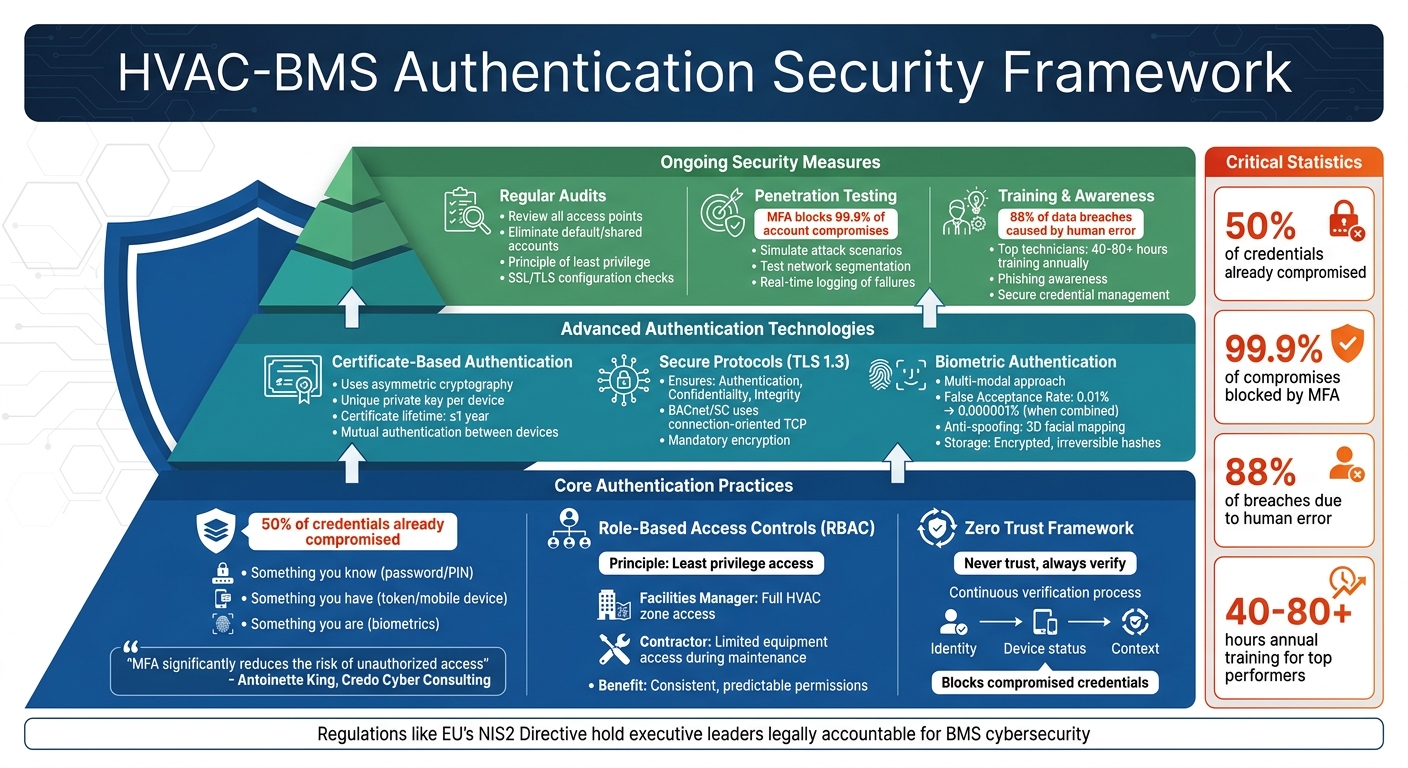
HVAC-BMS Authentication Security Framework: Core Practices and Advanced Methods
Core Authentication Best Practices for HVAC-BMS
Securing HVAC-BMS systems starts with three key authentication practices designed to address common vulnerabilities. These measures work together to prevent unauthorized access to HVAC-BMS systems.
Implement Multi-Factor Authentication (MFA)
Multi-Factor Authentication (MFA) strengthens security by adding multiple layers of verification beyond just passwords. Since attackers may already possess about 50% of the credentials needed to breach a system, relying solely on passwords is risky. MFA combines two or more independent methods of verification, which can include:
- Something you know: A password or PIN.
- Something you have: A physical token or a mobile device.
- Something you are: Biometrics like a fingerprint or facial recognition.
Antoinette King, Founder of Credo Cyber Consulting, emphasizes the importance of MFA:
MFA significantly reduces the risk of unauthorized access and strengthens overall security posture.
Even if a password is compromised, the additional authentication steps act as roadblocks, preventing attackers from gaining control. In the context of HVAC-BMS, this layered approach ensures that critical multi-zone system settings remain protected.
To make MFA effective without disrupting operations, conduct risk assessments to determine the right level of security for each role. Pair MFA with role-based access controls for even tighter restrictions, ensuring only essential personnel can make system changes.
Enforce Role-Based Access Controls (RBAC)
Role-Based Access Controls (RBAC) assign system permissions based on job responsibilities rather than individual users. This scalable framework enforces the principle of least privilege, ensuring users only have access to the tools and data they need. For example, a facilities manager might have full access to HVAC zones and schedules, while a contractor’s access might be limited to specific equipment during a maintenance window.
Acre Security highlights the advantages of role-based access:
When access is tied to roles, not individuals, permissions are consistent and predictable. You avoid over-permissioning, spot gaps faster, and apply the principle of least privilege across the board.
RBAC also simplifies system management. When a role is updated, changes automatically apply across all devices and access points. To maintain accuracy, integrate RBAC with HR systems and conduct regular audits to ensure permissions remain up-to-date.
For even greater security, combine RBAC with a Zero Trust approach.
Adopt a Zero Trust Authentication Framework
Zero Trust builds on the principles of both MFA and RBAC by treating every access attempt as untrustworthy until proven otherwise. Unlike traditional perimeter-based security models that assume internal traffic is safe, Zero Trust requires continuous verification of identity, device status, and context before granting access. This is particularly important for HVAC-BMS systems, which could serve as gateways to broader network vulnerabilities.
Rishit Lakhani, Solutions Engineering Leader at Nile, explains the value of Zero Trust:
By limiting access to essential personnel only, building managers can enhance energy efficiency and the secure operation of automation systems.
Zero Trust ensures that even if credentials are compromised, attackers cannot bypass additional layers of verification. This approach is critical for maintaining the secure operation of HVAC-BMS systems while preventing unauthorized control over building automation.
Advanced Authentication Methods
Securing HVAC-BMS systems has evolved from simply protecting network perimeters to focusing on individual device identities. Advanced methods build upon earlier practices to ensure stronger, device-level communication security.
Use Certificate-Based Authentication
Digital certificates are replacing traditional, less secure passwords in HVAC-BMS systems. These certificates use cryptographic methods to validate device identities. For example, systems like BACnet/SC rely on asymmetric cryptography, where each device is issued a unique private key and operational certificate. This ensures that only authorized devices with valid credentials can access the network.
Jim Butler, CTO at Cimetrics Inc., highlights this shift:
BACnet/SC introduces digital certificates into BACnet communication, enabling a level of control over device identity and network participation that is difficult to achieve with earlier BACnet communication methods.
Certificate-based authentication offers mutual authentication, where both parties verify each other’s identities before establishing a secure, encrypted connection. To minimize risks, IT departments often set certificate lifetimes to one year or less.
To avoid disruptions from expired certificates, automate the processes for issuing and renewing them as part of your HVAC maintenance routine. Each HVAC device should have its own unique credentials rather than sharing one across the network. If a device is compromised, reissuing the issuer certificate can create a new trust boundary since online revocation checks are rare in BMS environments.
The next step is ensuring secure transmission of authentication traffic.
Enable Secure Protocols for Authentication Traffic
TLS 1.3 (Transport Layer Security) is the gold standard for encrypting authentication data during transmission. It ensures authentication (verifying identities), confidentiality (protecting data from unauthorized access), and integrity (detecting tampering).
BACnet/SC adopts TLS 1.3 to secure communication, aligning with IT security practices. Unlike older protocols, BACnet/SC uses connection-oriented TCP with mandatory encryption, simplifying integration with IT firewall policies and removing the need for complex port forwarding.
Its hub-and-node design also reduces firewall configuration challenges by allowing devices to initiate outbound connections to a central hub. Contemporary Controls explains:
BACnet/SC used connection-oriented TCP instead of UDP and TLS 1.3 for security with encrypted communications. Each device must be authorized to be on the network and assigned a certificate and key.
Where possible, transition from BACnet/IP to BACnet/SC for built-in encryption. For temporary access, issue certificates with shorter expiration times. If BACnet/IP must be used over the internet, employ VPNs to encrypt traffic and restrict access to authorized endpoints.
Integrate Biometric Authentication Options
Biometric authentication introduces a physical layer of security for environments requiring higher protection. Technologies like fingerprint scanning and facial recognition provide an additional safeguard. For even stronger security, systems can combine multiple biometric methods – such as facial recognition, iris scanning, and fingerprints – to address weaknesses in any single approach.
Using multiple biometric modalities significantly reduces false acceptance rates (FAR). For instance, combining two systems with an FAR of 0.01% could theoretically lower the combined FAR to 0.000001%.
Integration typically occurs at the score level, where match scores from different sensors are merged. This method is popular because it works well with commercial, off-the-shelf components and is easier to implement than more complex feature-level fusion. To ensure fairness, normalize all scores to a range of 0 to 1 so no single modality dominates the decision-making process.
For real-time access, initial feature extraction should happen at the sensor level to minimize delays. Anti-spoofing measures, such as 3D facial mapping or monitoring physiological responses, can help distinguish between live individuals and fake artifacts. To protect privacy, store biometric data as encrypted, irreversible hashes rather than raw images, reducing risks in case of a data breach.
Monitoring and Maintenance
Strong authentication is just the first step in securing HVAC-BMS integrations. To ensure lasting protection, continuous monitoring and testing are essential. Authentication systems, in particular, need regular scrutiny as they age and become vulnerable to unpatched issues. Without this oversight, these systems can become entry points for lateral network attacks.
Nautilus OT highlights a critical challenge in this area:
Without defined governance, BMS cybersecurity controls are rarely tested, logged or reviewed at the same frequency as other operational systems.
A stark example of this came in October 2021, when CISA issued a warning about a vulnerability in a widely used building automation system. Exploiting this flaw could give attackers administrator credentials. In sensitive environments like healthcare, compromised HVAC-BMS systems could lead to devastating consequences, such as the loss of vaccines or stem cells, or even patient deaths due to air-filtration malfunctions.
To address these risks, regular audits and penetration testing are crucial. They not only help detect vulnerabilities before attackers exploit them but also ensure compliance with emerging regulations like the EU’s NIS2 Directive. This directive holds executive leaders legally accountable for the cybersecurity of systems impacting health and safety.
Conduct Regular Authentication Audits
Authentication audits are a systematic way to review who has access to HVAC-BMS systems and how they are accessing them. Start by mapping all access points – VPNs, remote desktops, and cloud dashboards – to uncover any unauthorized entry points.
Credential hygiene is a key focus. Default and shared accounts should be eliminated immediately. As Caroline Jacobsson, Circular Business Director at Swegon, advises:
Each user should be assigned a unique and personal user account… This reduces not only the risk of a password falling into the wrong hands, but also makes it possible… to trace which individuals have made changes and when.
Passive monitoring tools can help establish a baseline of connected systems, IP addresses, and protocols without disrupting operations. Access privileges should follow the principle of least privilege, ensuring no one has more access than necessary. Additionally, devices should be configured to use SSL/TLS for web communications and require HTTPS connections.
Anomaly detection tools tailored to OT-specific protocols can catch misuse patterns early. To bridge gaps between IT and facilities teams, hold regular meetings to discuss vulnerabilities and align on security strategies.
Perform Penetration Testing
While audits track ongoing access, penetration tests simulate attacks to gauge system resilience. These tests can uncover vulnerabilities in internet-facing BMS systems, including risks like remote manipulation of temperature settings, alarm disabling, or unauthorized access to doors.
Penetration testing also evaluates defenses against automated attacks. For instance, multi-factor authentication can block 99.9% of account compromises. Tests can identify vulnerabilities to tactics like brute-force attacks, credential stuffing, and password spraying. They can also detect time-based attacks, where server response times reveal whether usernames or passwords are valid. To counter this, systems should use generic error messages like "Invalid user ID or password" regardless of the actual issue.
Network segmentation is another critical defense, as Alessio Rosas, Head of OT and Cyber Threat Intelligence at Sicuranext, explains:
By isolating the BMS, you minimize the number of entry points an attacker can exploit. A compromise in the IT network won’t necessarily disrupt critical building functions like HVAC, lighting, or security.
Penetration tests also validate whether a compromised BMS could be used to access other critical systems, like financial databases. To enhance detection, enable real-time logging of authentication failures and deploy anomaly detection tools to spot attack patterns quickly.
Training and Awareness
Even the best authentication technology can fail if users don’t know how to use it correctly. With human error responsible for 88% of all data breaches, educating employees becomes a critical layer of defense. Training bridges the gap between technical safeguards and human behavior, transforming potential weaknesses into proactive defenses. When HVAC-BMS technicians and facility managers learn to spot phishing attempts, create strong passwords, and follow access protocols, they become an integral part of the security framework.
Educate Teams on Authentication Best Practices
Training should begin with the basics of secure credential management. For instance, replace factory-default credentials with unique, memorable passphrases. A good example? A phrase like “securepassphraseexample” is easier to remember than a complex string like “bn^T65#_” but is still much harder for attackers to crack.
Caroline Jacobsson, Circular Business Director at Swegon, highlights a key principle:
A user is not granted higher privileges than necessary in order to carry out their work.
This underscores the importance of applying the least privilege principle. Employees must understand that shared accounts undermine accountability. For example, if multiple people log in as "admin", it becomes impossible to trace who made a risky change or when it occurred.
Training should also focus on phishing and social engineering awareness. Functional Devices, Inc. notes:
Human error, such as clicking on phishing links or using weak passwords, often leads to security breaches.
Employees need to recognize red flags like suspicious emails requesting credentials, unusual login prompts, or other tactics designed to steal authentication details. Alessio Rosas, Head of OT and Cyber Threat Intelligence, emphasizes:
Training employees on cybersecurity best practices is essential.
Beyond passwords, secure remote access is another priority. Teach teams to identify phishing attempts and ensure remote access always uses encrypted channels like HTTPS and VPNs. Training should also explain lateral movement – how attackers can use a compromised BMS to infiltrate financial systems or other sensitive networks. When technicians grasp these broader risks, they’re more likely to consistently follow secure authentication practices.
Measuring the success of training programs requires tracking specific metrics. Certification compliance is a strong indicator of effectiveness. For example, top-performing technicians complete 40 to 80+ hours of training annually, while less-engaged staff often fall below 20 hours. Assigning unique personal accounts to every user also helps administrators monitor compliance. Audit logs can confirm whether staff are following secure protocols, such as connecting via HTTPS, adhering to access restrictions, and updating passwords on first login.
This ongoing education complements technical measures, aligning team behavior with robust authentication standards. Regular training, combined with monitoring and audits, is essential to maintaining HVAC-BMS security.
Lock down HVAC and BMS access
Protecting HVAC-BMS systems is essential for safeguarding building infrastructure. A layered security approach – combining multi-factor authentication (MFA), role-based access control (RBAC), and Zero Trust principles – can significantly reduce the risk of breaches. This strategy ensures attackers cannot exploit HVAC systems to gain access to sensitive corporate networks.
While strong authentication measures are a critical starting point, they must be bolstered by continuous monitoring and regular security audits to address evolving threats. Since human error is often a weak link, organizations should also prioritize comprehensive user training. Additional steps, like adopting network segmentation and transitioning to encrypted protocols, are vital for strengthening defenses.
The importance of resilience in BMS cybersecurity cannot be overstated. As Jeroen van Es, Chief Commercial Officer at Nautilus OT, explains:
BMS cybersecurity is about resilience. Smart buildings are operational assets, and protecting them demands the same structured approach applied to industrial control systems.
The global vulnerability of BMS systems highlights the urgency of these measures. Furthermore, regulations, such as the EU’s NIS2 Directive, now hold executive leaders accountable for implementing proper cybersecurity protocols.
To achieve a secure HVAC-BMS environment, organizations should adopt a holistic approach. Key steps include conducting passive scans to inventory devices, fostering collaboration between IT and facilities teams, and maintaining consistent patch management. By combining robust authentication with ongoing monitoring and user education, businesses can establish a resilient security framework that protects both their digital and physical assets.
FAQs
How do I roll out MFA in a BMS without disrupting operations?
To introduce Multi-Factor Authentication (MFA) into a Building Management System (BMS) without causing disruptions, here’s how you can proceed:
- Evaluate your existing setup: Start by reviewing your current infrastructure to pinpoint MFA solutions that align with your system’s capabilities.
- Implement in phases: Roll out MFA gradually, beginning with non-critical systems. This approach minimizes risk and allows for smoother adjustments.
- Ensure compatibility: Test the MFA solution with your BMS hardware and software to prevent integration issues.
- Educate your team: Offer clear training and communication to help staff understand the new process and their role in maintaining security.
- Monitor and refine: After implementation, closely track performance and address any challenges that arise to ensure the system runs smoothly.
By taking these steps, you can strengthen security without interrupting daily operations.
What roles should we define first for RBAC in an HVAC-BMS?
Defining roles based on responsibilities is a smart way to maintain both security and efficiency in system management. For instance, you can create specific roles like operators, technicians, and administrators, each tailored to their unique duties and access needs. This ensures that users only have access to the information and tools necessary for their tasks.
Additionally, it’s important to include roles for temporary or emergency access. These can be activated when special circumstances arise, ensuring critical tasks can be handled without compromising cybersecurity standards. By structuring roles this way, you not only improve access control but also enhance the system’s auditability, making it easier to track and manage user activities.
How do we manage device certificates at scale and avoid expirations?
To handle device certificates efficiently and avoid expiration issues, leverage automated certificate management solutions along with proactive renewal strategies. Automation reduces mistakes and ensures certificates are updated on time, which is particularly critical for protocols like OPC-UA or BACnet/SC that depend on expiring certificates. By implementing Certificate Lifecycle Management (CLM), you can simplify the process of issuing, renewing, and replacing certificates across extensive device networks. This approach helps maintain seamless communication and minimizes the risk of operational interruptions.


