


Certified TAB (Testing, Adjusting, and Balancing) services ensure HVAC systems operate as designed, meeting efficiency, safety, and compliance standards. Skipping certified testing can lead to costly project delays, failed inspections, and higher energy bills. Here’s what you need to know:
- Basics of TAB Services: Measures airflow, pressure, and temperature; adjusts system components; and balances airflow to meet design requirements.
- Problems Without Certification: Uncertified testing often results in inaccurate reports, energy waste (up to 40%), and compliance failures.
- Benefits of Certification: Certified professionals follow strict standards, use calibrated tools, and deliver reliable reports essential for inspections and occupancy certificates.
- Common Challenges: Field changes, such as duct rerouting or equipment substitutions, often lead to performance gaps that only certified TAB professionals can address.
- Preventing Issues: Proper testing avoids comfort complaints, warranty calls, and energy waste (up to 30%), while ensuring systems meet design specifications.
Certified TAB services save time, reduce costs, and ensure HVAC systems perform efficiently. For projects in MD, VA, PA, NJ, NY, DE, and DC, firms like Air Balance Masters provide reliable, fast, and compliant testing with reports delivered in 48 hours.
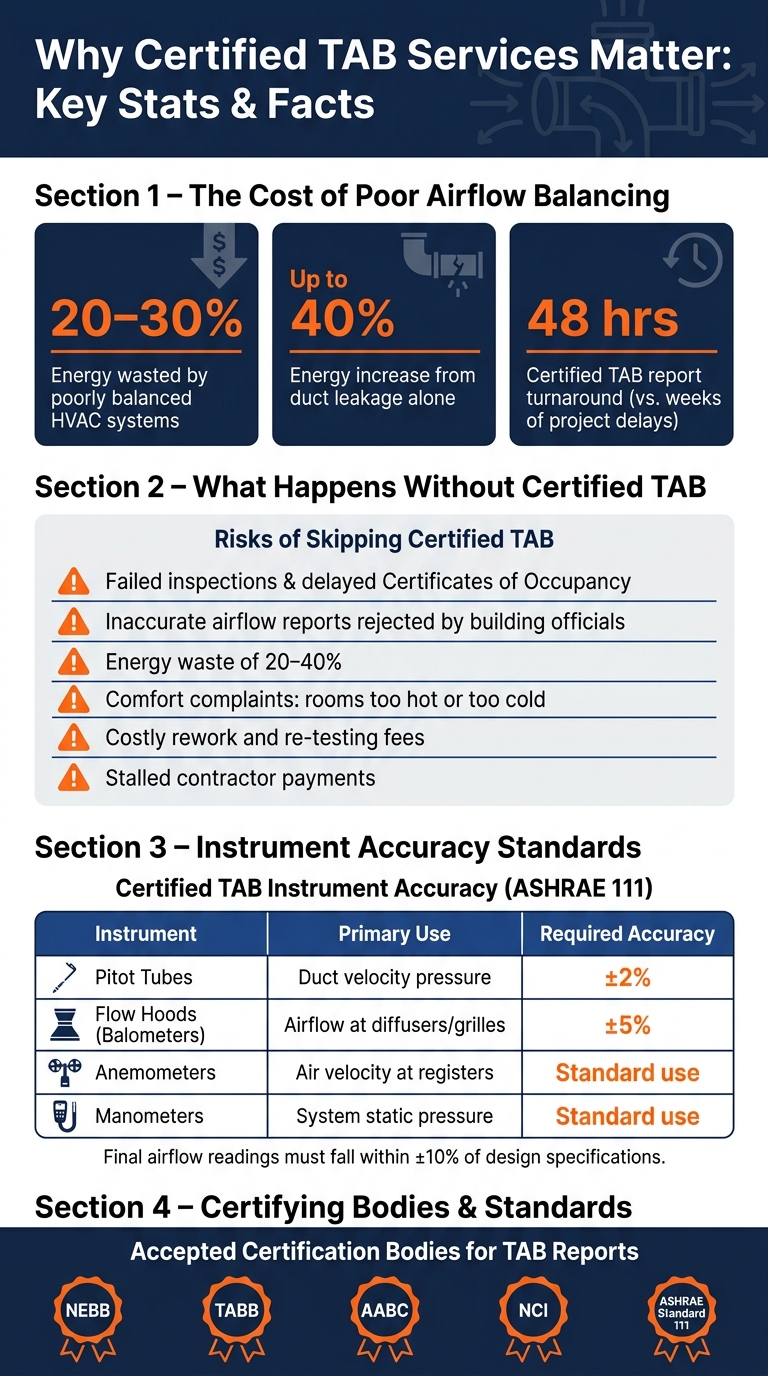
Cost of Skipping Certified TAB Services: Key Stats & Facts
Common Airflow Testing Challenges in New Construction
Design Intent vs. Field Conditions
No construction project ever sticks perfectly to its design. HVAC systems are initially designed based on controlled assumptions, but real-world conditions rarely align with these ideal scenarios. As Delo HVAC puts it:
"Every HVAC system, upon installation, operates outside the manufacturer’s ideal parameters, which are designed under controlled lab conditions."
The main issue? Field changes. Flexible ducts often get rerouted to work around structural obstacles. Equipment substitutions happen mid-project. Even room purposes can shift – what was supposed to be a standard office might suddenly become a high-heat print room, introducing entirely new airflow requirements. These changes often bypass the engineer of record, leaving a gap between the original design and how the system actually performs. Certified TAB (Testing, Adjusting, and Balancing) professionals are essential to bridging this gap. They assess these deviations and ensure the system operates as intended, despite the unexpected changes.
What Inaccurate Airflow Testing Causes
When airflow testing isn’t precise, the consequences show up fast. Temperature inconsistencies and pressurization failures are some of the most obvious signs. Some rooms might feel like a sauna while others are freezing. Pressure imbalances can create even bigger problems – doors might slam shut unexpectedly or refuse to close properly. In critical environments like hospitals, these failures can disrupt the pressure gradients necessary for safety. In restaurants, poorly balanced exhaust and makeup air systems can lead to smoke backflow, unpleasant grease odors, and even sewage smells from disrupted drain traps.
Inaccurate testing also impacts indoor air quality. If the ratio of outdoor air to return air is off, occupants are left in poorly ventilated spaces that fail to meet standards. Another overlooked issue? Loaded filter pressure tests. Without accurate data, building managers can’t plan timely filter replacements, leading to clogged filters and reduced airflow. Certified testing eliminates these problems, ensuring systems meet compliance standards while maintaining comfort and air quality.
How Failed Tests Lead to Delays and Added Costs
When airflow tests fail, the ripple effects can be costly. A failed test doesn’t just mean a do-over – it often halts the entire project. In most U.S. jurisdictions, building officials only accept air balance reports from firms certified by organizations like NEBB, TABB, AABC, or NCI. Submitting an uncertified report – or one that exposes overlooked deficiencies – can stall inspections and lead to hefty re-testing fees.
These delays can snowball. Inspections get pushed back, certificates of occupancy are delayed, and tenant move-ins or final loan draws are postponed. On top of the financial strain, these delays can sour contractor-client relationships. As Jonathan Lloyd, a NEBB Certified Professional, points out, many issues uncovered during testing "are just swept under a very lumpy rug" when decisions driven by cost and speed take precedence. Unfortunately, these shortcuts often lead to even more expensive fixes down the line.
What Certified TAB Services Provide
Standardized Testing and Clear Documentation
Certified TAB (Testing, Adjusting, and Balancing) firms adhere to systematic procedures based on nationally recognized standards, ensuring uniformity and reliability. Organizations like NEBB, AABC, and TABB establish these procedural guidelines, detailing how data is collected, instruments are used, and final reports are structured. Additionally, ASHRAE Standard 111 (ANSI/ASHRAE 111) provides the technical framework for measurement and balancing practices across the industry.
The outcome? A TAB report that’s far more than a basic summary. These reports include detailed information on every fan, terminal unit, and outlet tested. They also document instrument serial numbers, calibration dates, and both the as-found and as-left conditions. This level of detail ensures compliance with AHJ (Authority Having Jurisdiction) requirements for Certificates of Occupancy.
Calibrated Tools and Accurate Measurements
Accuracy and consistency are the foundation of certified TAB services, ensuring systems perform as intended and pass inspections. Properly calibrated instruments are key to achieving reliable airflow measurements. Certified TAB professionals are required to calibrate their tools annually, following standards traceable to the National Institute of Standards and Technology (NIST). This is a mandatory step to maintain certification.
| Instrument | Primary Use | Required Accuracy (ASHRAE 111) |
|---|---|---|
| Pitot Tubes | Measuring velocity pressure in ducts | ±2% |
| Flow Hoods (Balometers) | Measuring airflow at diffusers/grilles | ±5% |
| Anemometers | Measuring air velocity at registers | Standard use |
| Manometers | Measuring system static pressure | Standard use |
The industry standard demands that final airflow readings fall within ±10% of design specifications for supply, exhaust, and return terminals. Without calibrated tools, maintaining this level of precision is impossible. Submitting results outside this range can lead to failed inspections. Accurate measurements not only ensure compliance but also help uncover and address hidden system issues right away.
Identifying and Fixing System Deficiencies
Certified TAB professionals excel at spotting hidden system deficiencies that might otherwise go unnoticed. For instance, they can identify system effects – issues caused by ductwork layouts, such as sharp turns near fan outlets, which can reduce system performance. These are details that non-certified testers often overlook.
Once deficiencies are identified, certified technicians have the expertise to address them immediately. They can adjust fan speeds using variable frequency drives (VFDs), fine-tune pulley settings, and regulate volume control dampers to bring airflow back within design tolerances. Additionally, they use calibrated handheld instruments to verify the accuracy of a building’s permanent Direct Digital Control (DDC) sensors, catching any discrepancies before they lead to long-term issues.
"The information contained within the TAB report and building control system will almost always provide the information needed to resolve the problem." – Peter Diperna, Mechanical Technical Specialist, Fitzmeyer & Tocci Associates Inc.
Delays and failures certified TAB helps you avoid
Avoiding Failed Inspections and Rework
Certified TAB (Testing, Adjusting, and Balancing) reports are a must-have for obtaining a Certificate of Occupancy. Inspectors don’t typically recheck airflow themselves; instead, they rely on certified reports to ensure code compliance. If the documentation is incomplete, inaccurate, or comes from an uncertified firm, the entire project can face delays.
In many areas, TAB reports must come from independent firms with no ties to the contractor who installed the system. A report from the same company that handled the installation often won’t pass in these jurisdictions. Beyond just meeting regulations, certified TAB services are key to ensuring systems operate efficiently and provide a comfortable environment for occupants.
Reducing Comfort Complaints and Warranty Calls
A well-balanced system ensures that each zone receives the correct amount of airflow (CFM). Without proper balancing, some rooms might get too hot while others stay too cold, leading to frequent occupant complaints and costly warranty calls. Certified TAB professionals can also identify mechanical issues like undersized ductwork or underperforming fans that might otherwise go unnoticed. Fixing these problems during the TAB process is significantly cheaper than addressing them after tenants are already using the space. As Air Balance Masters explains:
"Proper air balancing isn’t just about passing inspection – it’s about reducing energy waste, extending equipment life, and eliminating comfort complaints."
Cutting Energy Waste and Improving System Performance
Certified TAB services don’t just prevent warranty issues – they also enhance energy efficiency. Poorly balanced systems can waste 20–30% of energy output, and duct leakage alone can increase energy consumption by up to 40%.
Certified technicians tackle energy waste by fine-tuning motor performance with variable frequency drives (VFDs) and adjusting dampers to keep static pressure at optimal levels. They also ensure outside air intake is calibrated correctly, as too much outside air can lead to higher cooling costs in summer or frozen coils in winter. These adjustments result in a system that operates efficiently from the start, with a documented baseline for building management systems to monitor future issues, such as clogged filters. This proactive approach helps keep projects on schedule while minimizing long-term operational costs.
Certified TAB Services From Air Balance Masters
Local Knowledge Across MD, VA, PA, NJ, NY, DE, and DC
Covering MD, VA, PA, NJ, NY, DE, and DC means navigating a wide range of local codes, climates, and inspection requirements. For instance, projects in New York City, suburban Maryland, and northern Virginia each come with their own unique code challenges. With its headquarters in Elkridge, MD, Air Balance Masters is strategically positioned in the Mid-Atlantic, ensuring prompt and effective service across its entire coverage area.
This deep understanding of regional codes is essential, as it directly impacts whether a TAB (Testing, Adjusting, and Balancing) report will pass final inspections. Air Balance Masters customizes its documentation to align with the specific requirements of each jurisdiction, reducing the risk of delays during project close-outs. Combined with their efficient testing process, this expertise ensures that every project complies with local inspection standards.
Testing, Reporting, and Certification in One Process
Air Balance Masters simplifies the entire TAB process by combining testing, issue identification, and reporting into a single, cohesive workflow. On-site, their technicians measure airflow, fine-tune VFD (Variable Frequency Drive) settings, and balance terminal devices to meet industry standards.
When problems like undersized ductwork, malfunctioning dampers, or underperforming fans arise, the team not only documents these deficiencies but also provides clear, actionable solutions. Certifications from respected organizations like NCI, NEBB, BPI, and AEE reinforce the trustworthiness of their reports, which are widely accepted by building officials across the region.
Final TAB reports are delivered within 48 hours, helping projects stay on track and ensuring payments aren’t delayed. This quick turnaround eliminates bottlenecks and keeps the approval process moving smoothly.
Supporting Final Inspections and Certificates of Occupancy
Air Balance Masters was established to address the common delays caused by late TAB reports, which can stall projects and hold up payments. The TAB report acts as the key compliance document for building inspectors, who rely on certified reports rather than re-checking airflow measurements themselves.
AABC TAB Talk: Fundamentals of Test, Adjust, & Balance for Engineers, Cx & Energy Providers
Why certified TAB is worth hiring
Investing in certified TAB services might seem like an upfront expense, but the alternative – risks of failed inspections and project delays – can cost much more in the long run. Certified TAB services help avoid setbacks like rework, inspection failures, and delayed occupancy approvals, which can push a project back by weeks. And those delays? They directly impact when contractors receive their payment.
In most areas, only firms certified by NEBB, TABB, AABC, or NCI can issue air balance reports that meet city inspection requirements. This thorough process not only satisfies inspection criteria but also ensures the building systems operate at their best.
Skipping proper air balancing isn’t just a minor oversight – it’s costly. Poor balancing can waste 20%–30% of a building’s energy output, leading to higher utility bills month after month. Fixing this inefficiency is crucial for reducing long-term operational costs.
"Proper air balancing isn’t just about passing inspection – it’s about reducing energy waste, extending equipment life, and eliminating comfort complaints." – Air Balance Masters
For projects in MD, VA, PA, NJ, NY, DE, and DC, Air Balance Masters provides certified TAB services designed to meet tight timelines. With reports delivered within 48 hours, same-day quotes, and a deep understanding of regional codes, they help contractors avoid surprises and complete projects smoothly. Their track record? A stellar 5.0/5 rating from 33 Google reviews. That’s performance you can trust.
FAQs
When should TAB be performed on a new construction project?
TAB, or Testing, Adjusting, and Balancing, should take place once all mechanical systems are completely installed but before the building is occupied. Conducting TAB at this stage ensures that HVAC systems are functioning as intended, which can help prevent delays in obtaining final inspections and occupancy approvals.
What makes a TAB report “certified” and inspection-ready?
A TAB report is considered "certified" and ready for inspection when it is prepared by a qualified, independent TAB professional recognized by an approved certification organization. The report must provide detailed airflow measurements, document system conditions, and outline any adjustments made. Additionally, it must be signed and sealed by a certified engineer or technician. This process ensures the report meets industry standards such as ASHRAE 170, as well as local codes.
How do I know if my jurisdiction requires an independent certified TAB firm?
Many areas require an independent, certified TAB (Testing, Adjusting, and Balancing) firm to inspect commercial buildings before granting a Certificate of Occupancy. To avoid delays and ensure everything meets regulations, make sure this requirement is clearly stated in your project documentation right from the beginning.


