


Balancing HVAC systems ensures even airflow and consistent temperatures, improving comfort, efficiency, and system longevity. While the goal is the same, commercial and residential air balance testing differ significantly in methods, equipment, and requirements:
- Commercial Testing: Governed by strict standards (e.g., NEBB, AABC), it involves detailed measurements, certified reports, and mandatory compliance for occupancy permits. HVAC air balancing tools like micromanometers and thermal cameras are used for large-scale systems.
- Residential Testing: Focuses on practical fixes for comfort and energy savings. Voluntary and less regulated, it uses tools like balancing hoods and infrared thermometers for smaller systems.
Both approaches address airflow issues but cater to different scales and needs.
Quick Comparison:
| Feature | Commercial Testing | Residential Testing |
|---|---|---|
| Purpose | Regulatory compliance and efficiency | Comfort and energy savings |
| Standards | NEBB, AABC, TABB | Voluntary (e.g., DOE programs) |
| Tools | Advanced (e.g., flow hoods, cameras) | Basic (e.g., balancing hoods, meters) |
| Scale | Large multi-zone systems | Small single-zone systems |
| Challenges | Complex layouts, regulatory needs | Budget limits, lack of design data |
Balancing your system – whether in a home or commercial building – helps reduce energy costs, ensures comfort, and prevents wear on HVAC components.
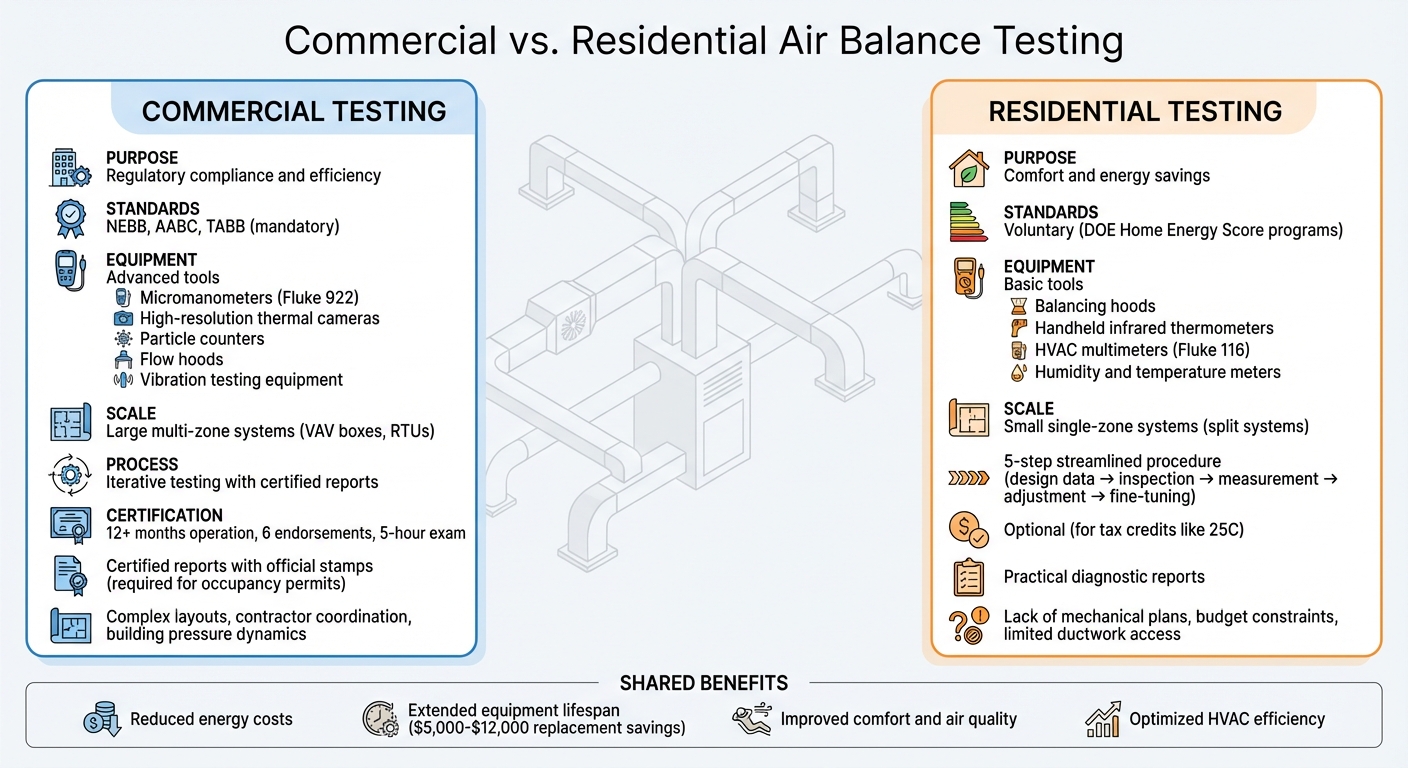
Commercial vs Residential Air Balance Testing: Key Differences
LIVE Test and Balance from a Field Pro
This video demonstrates why air balancing is essential for contractors to ensure system performance and client satisfaction.
Regulatory Requirements and Standards
Commercial air balance testing is tightly regulated, while residential testing remains optional, focusing on improving comfort and energy efficiency.
Commercial Testing Requirements
Commercial air balance testing, formally called Testing, Adjusting, and Balancing (TAB), is governed by standards set by NEBB, AABC, and TABB. These guidelines are critical for securing occupancy permits and passing final building inspections.
"TAB helps in maintaining regulatory compliance and achieving sustainability goals by ensuring the HVAC system operates at peak efficiency." – NEBB
Achieving TAB certification is no small feat. Companies must operate for at least 12 consecutive months with a dedicated mechanical or TAB team and provide six endorsements from industry professionals to qualify for NEBB certification. For individual technicians, the process involves an intensive study period covering six core areas, followed by a challenging 5-hour closed-book exam.
Once the testing is complete, certified professionals must review and officially stamp the TAB report, which is essential for regulatory approval and occupancy. TAB firms also face strict requirements for maintaining calibrated instruments, such as flow hoods, manometers, and tachometers, to ensure accuracy.
In contrast, residential testing operates with a more flexible approach, focusing on practical improvements for homeowners.
Residential Testing Requirements
Residential air balance testing is typically part of a Professional Home Energy Assessment, a program supported by the U.S. Department of Energy through initiatives like the Home Energy Score. Unlike commercial testing, residential assessments are voluntary and aim to address everyday concerns like uneven temperatures, high energy bills, and indoor air quality rather than meeting regulatory mandates.
Homeowners often opt for testing to qualify for incentives like the 25C federal tax credit. This credit requires assessments to be conducted by certified home energy auditors participating in a Qualified Certification Program. Unlike the formal, certified TAB reports required for commercial projects, residential testing focuses on diagnosing and solving issues that directly impact comfort and energy savings.
Equipment and Methods
The tools and techniques used for air balance testing vary significantly between commercial and residential settings, largely because of the differences in system scale. Commercial systems are designed to handle large volumes of air across multiple zones, while residential systems focus on maintaining comfort in individual rooms. These distinctions in equipment highlight the broader differences in testing methodologies, which are explored later.
Commercial Testing Equipment
Commercial air balance testing requires specialized tools tailored to the demands of large-scale HVAC systems. For example, technicians use micromanometers, such as the Fluke 922, to measure duct pressures in complex setups like variable air volume (VAV) systems and rooftop units (RTUs). High-resolution thermal cameras are employed to detect heat loss and overheating components in large buildings, while particle counters monitor air quality in sensitive environments like hospitals and laboratories.
In safety-critical applications, tools like carbon monoxide detectors are essential for monitoring CO levels in spaces such as restaurants and retail stores. Additionally, vibration testing equipment is used to assess the performance of large mechanical fans and motors. Given the high voltages and pressurized refrigerants found in commercial systems, these instruments must comply with strict safety standards, including CAT ratings and NFPA 70E guidelines. When balancing hoods are too small for larger commercial grilles, technicians conduct airflow traverses of ducts following ASHRAE Standard 111.
Residential Testing Equipment
For residential systems, technicians rely on adapted tools designed for smaller-scale setups, such as split systems with an outdoor condenser and indoor air handler. Key instruments include commercial-grade balancing hoods to measure airflow at supply registers, manometers for checking duct static pressure, and HVAC multimeters like the Fluke 116 for testing components such as thermostats, control boards, and flame sensors. Handheld infrared thermometers are used to pinpoint hot and cold spots, while humidity and temperature meters help verify comfort levels throughout the home.
Rob "Doc" Falke, President of the National Comfort Institute, underscores the importance of a comprehensive approach to testing:
"Measurement with an air-balancing hood alone is insufficient to balance a system. Additional testing is essential required on each air balance job".
Certified instruments are crucial for obtaining accurate data. Beyond basic measurements, technicians evaluate static pressure, fan speed, temperature differences, and electrical signals to ensure the system operates as a cohesive unit.
Testing Procedures and Common Challenges
Commercial Testing Procedures
Testing multi-zone systems in commercial buildings is a meticulous process. Technicians begin by reviewing mechanical plans and inspecting key components like VAV boxes, RTUs, and economizers. Once the groundwork is laid, they take initial measurements, make adjustments, and repeat the process until the system meets the design specifications. While effective, this iterative approach can be both time-intensive and expensive.
In modern facilities, advanced methods like model-based analysis and supervised machine learning are often used to streamline the process. These techniques help determine system parameters and optimize damper positions more efficiently. Impressively, they’ve achieved airflow targets with a maximum absolute percentage error of just 4.6% and reduced fan power consumption by as much as 14.3%. After completing the adjustments, technicians produce certified reports that include schematics and documentation of any deviations. These reports are often mandated by local authorities, such as city or health departments.
However, commercial testing comes with its own set of challenges. Coordinating among multiple contractors is a common obstacle, especially when dealing with the intricate pressure dynamics of large buildings. High-traffic areas, where doors are frequently opened, can disrupt building pressure, while specialized spaces like commercial kitchens require precise balancing between exhaust hoods and Make-Up Air (MAU) units. Additionally, factors like aging systems and changes in room usage often necessitate periodic readjustments to maintain proper indoor air quality.
Residential Testing Procedures
Testing residential HVAC systems is a more streamlined process, typically involving five steps. Technicians start by gathering design data using Manual J calculations or equipment details. Next, they inspect for defects, measure airflow at registers using a balancing hood, adjust fan speeds to meet total airflow targets, and fine-tune dampers until airflow at each register falls within 10% of the design specifications. This straightforward approach ensures systems operate efficiently while maintaining comfort.
Despite its simplicity, residential testing has its own challenges. A common issue is the lack of mechanical plans, which forces technicians to reverse-engineer design details from equipment nameplates. Physical problems, such as poorly suspended ducts or open dampers, must also be fixed before balancing can begin. Budget constraints and homeowner expectations for quick results can add further pressure, particularly when significant ductwork modifications are needed. HVAC designer Jason Rende highlights a key limitation in homes where spaces like studs and joists are used as return air paths without dampers: "not much can be done to balance the return side without significant modifications".
Both commercial and residential testing aim to achieve better energy efficiency and indoor comfort, though the methods and challenges vary significantly between the two.
Performance Results and Selecting the Right Service
Performance Comparison
Keeping HVAC systems balanced does more than just improve efficiency – it helps reduce energy bills, prevents equipment overuse, and avoids sudden spikes in demand, especially in commercial settings. For homeowners, a well-balanced system means lower monthly utility costs and better SEER2 performance ratings.
Comfort is another major factor. In commercial spaces like conference rooms or gymnasiums, balanced air circulation ensures occupants don’t feel stifled. Residential systems benefit by eliminating temperature differences between floors or rooms. For more specialized environments, such as medical labs or surgical suites, precise pressurization is critical, while homes rely on proper filtration to reduce allergens and dust.
Balancing also extends the life of HVAC equipment. By easing the strain on fans, motors, and compressors, it reduces wear and tear. For homeowners, this means delaying costly replacements, which can range from $5,000 to $12,000. These practical benefits make air balancing a valuable tool for both contractors and homeowners when deciding on the best testing and maintenance strategies.
Guidance for Contractors and Homeowners
The advantages of proper air balancing highlight the importance of customized testing solutions. In commercial buildings, air balance testing is particularly important after major layout changes, tenant moves, or equipment upgrades. For example, when open areas are converted into offices or walls are removed, airflow adjustments are essential. Spaces like server rooms and surgical suites demand precise airflow control to maintain functionality.
For residential systems, testing is often necessary when homeowners notice uneven temperatures, strange fan noises, or inconsistent airflow from vents. If the system is aging, the "$5,000 Rule" can help guide decisions: multiply the unit’s age by the repair cost – if the total exceeds $5,000, replacing the system may be more economical.
Air Balance Masters provides certified testing services and detailed reports on system deficiencies for both residential and commercial projects. Operating across MD, VA, PA, NJ, NY, DE, and DC, they ensure HVAC systems meet design requirements while helping contractors secure final inspections without unnecessary delays.
Commercial and residential balancing compared
While the methods for air balance testing differ between commercial and residential projects, they share a common goal: ensuring HVAC systems provide the comfort and efficiency they promise. Commercial testing often follows precise mechanical plans and aligns with ASHRAE Standard 111, whereas residential testing leans on "reverse engineering" techniques, such as Manual J calculations or manufacturer guidelines, to determine design parameters. This balance between adhering to strict standards and achieving practical performance is essential for success in both settings, influencing energy efficiency, system lifespan, and occupant comfort.
"Balancing is the single-most important step that can be taken to assure your systems produce comfort and operate efficiently."
- Rob ‘Doc’ Falke, President, National Comfort Institute
Effective air balancing does more than just fine-tune HVAC systems – it reduces energy waste, extends equipment life, and ensures steady comfort for occupants. Whether it involves navigating tight crawl spaces in a home or managing complex multi-zone systems in a commercial building, the process demands skilled professionals who can spot issues like disconnected ducts or open dampers before they compromise performance.
FAQs
What’s the difference between commercial and residential air balance testing?
The key distinction between commercial and residential air balance testing lies in the scale, complexity, and objectives of each process.
Commercial air balance testing is designed for large, multi-zone HVAC systems commonly found in office buildings, retail spaces, and industrial facilities. These systems must meet stringent industry standards, often requiring detailed engineering plans and adhering to precise tolerances – typically within ±10% of the design flow. Advanced tools and techniques are used to optimize airflow, energy efficiency, and indoor air quality, ensuring the system performs effectively under varying occupancy demands. Detailed reports are usually prepared for building owners or engineers to document compliance and performance.
In contrast, residential air balance testing caters to smaller spaces like single-family homes or small multifamily units. The primary goal here is comfort and efficiency, ensuring each room maintains consistent temperature and humidity levels. This process is less complex, with tolerances ranging between ±10–15%, and involves minimal documentation, often just a straightforward report for the homeowner. Technicians rely on basic tools like handheld flow hoods to make quick adjustments, aligning airflow with calculations such as Manual J load requirements to create a comfortable living environment.
While both types of testing aim to optimize HVAC performance, the methods and tools differ significantly based on the size and purpose of the system.
Why are there stricter regulations for commercial air balance testing compared to residential testing?
Commercial air balance testing is subject to stricter regulations because large-scale HVAC systems in commercial buildings must align with detailed federal and industry standards. These include specifications like UFGS 23 05 93, which governs testing, adjusting, and balancing (TAB) procedures, and ventilation standards such as ASHRAE 62.1. These rules are designed to ensure that systems perform efficiently, maintain energy standards, and prioritize occupant safety in more complex environments.
On the other hand, residential air balance testing operates under less rigorous guidelines, such as ASHRAE 62.2, which are tailored to the simpler HVAC systems found in homes. This difference in regulation highlights the varying levels of complexity, scale, and impact between commercial and residential HVAC systems.
What are the key tools needed for residential air balance testing?
Residential air balance testing depends on a handful of key tools to ensure HVAC systems run smoothly and deliver consistent comfort throughout the home. A calibrated manometer is used to measure static pressure in both supply and return ducts, verifying that the system aligns with its intended design. To check airflow at individual registers, technicians rely on a flow hood or a handheld anemometer, which helps fine-tune the system to meet the specific heating or cooling needs of each room.
For detecting duct leakage, a blower door fan pressurizes the house to assess its airtightness, ensuring it meets industry guidelines. A smoke pencil or incense stick is also handy for visualizing airflow, making it easier to pinpoint small leaks or misaligned vents that might otherwise be missed. Together, these tools provide a detailed picture of how well the system performs in terms of energy use, airflow, and overall comfort.


