


Did you know HVAC systems consume 40% of building energy and contribute the same percentage to global CO2 emissions? With cooling demands set to triple by 2050, improving HVAC efficiency isn’t just smart – it’s necessary. Predictive HVAC analytics is changing the game by using AI, machine learning, and IoT to predict conditions like weather and occupancy, allowing systems to adjust before issues arise. This shift saves energy, cuts costs, and boosts reliability.
Key takeaways:
- Energy savings: Predictive systems reduce HVAC energy use by 20–40% and utility bills by up to 40%.
- Cost efficiency: Average savings of $30,000+ annually for office buildings, with ROI in 8–14 months.
- System reliability: Predictive maintenance detects failures 30–90 days early, reducing unplanned outages by nearly 50%.
- Maintenance improvements: Condition-based maintenance eliminates unnecessary repairs, cutting downtime by 41%.
Examples include Google’s 40% cooling energy reduction using AI and Microsoft’s 15–25% savings at its Redmond campus. Predictive analytics, paired with HVAC testing and balancing (TAB) services, ensures HVAC systems perform efficiently and meet design specs over time.
Bottom line: Predictive HVAC analytics is a smart investment, delivering energy savings, fewer outages, and lower costs while addressing climate concerns.
What Is AI-Driven Predictive Maintenance? HVAC, Refrigeration & MEP Explained
1. Predictive HVAC Analytics
Predictive HVAC analytics leverages AI and machine learning to forecast future conditions, allowing systems to adjust proactively rather than reacting to temperature changes or equipment failures. By analyzing historical data, weather forecasts, and occupancy trends, these systems fine-tune operations ahead of time, improving building performance, energy use, cost savings, reliability, and maintenance efficiency.
Energy Savings
Predictive analytics can slash HVAC energy use by 20–40%. How? By aligning system output with actual demand, it avoids the inefficiencies of over-cooling or over-heating. These systems also excel at load shifting – pre-cooling buildings during off-peak hours when electricity rates are lower – resulting in utility bill savings of 30–40%.
Take Google and Microsoft as examples: both have successfully used AI-powered load shifting and optimization strategies, achieving results that surpass traditional methods. These energy savings translate directly into financial benefits, as outlined below.
Cost Efficiency
Predictive analytics doesn’t just save energy – it redefines the economics of HVAC operations. On average, commercial real estate portfolios using these systems report energy savings of 23%, often recouping their investment within two years. For a single office building, this could mean annual savings of at least $30,156.40. Most facilities see a full return on investment within 8 to 14 months.
Maintenance costs also drop significantly. By reducing unplanned outages and minimizing downtime, predictive systems lower overall operating expenses, creating a noticeable impact on the bottom line.
System Reliability
Reliability is another standout benefit. Predictive systems detect potential equipment issues well in advance by analyzing patterns like changes in vibration, declining compressor efficiency, or heat exchanger fouling – problems that traditional alarms often miss. These systems can identify failures 30 to 90 days before they occur, giving teams ample time to schedule repairs during routine maintenance windows rather than dealing with emergency breakdowns.
Here’s a real-world example: in February 2026, a Chicago office tower implemented AI-driven predictive maintenance and saw unplanned failures drop by 91% while cutting maintenance costs by 38% within 18 months. The system flagged bearing degradation in an air handler 47 days before a scheduled inspection, avoiding a $67,000 compressor replacement. In similar cases, machine learning models have achieved up to 94% accuracy in predicting critical failures.
Maintenance Requirements
Instead of relying on calendar-based schedules, predictive analytics focuses on condition-based maintenance. This approach eliminates unnecessary tasks and directs resources to where they’re actually needed. AI systems generate prioritized work orders with clear diagnoses and timelines, reducing troubleshooting time and preventing costly emergency repairs.
2. Conventional HVAC Methods
Conventional HVAC systems operate reactively, addressing issues only after they arise. Compared to systems that use predictive analytics, these traditional methods fall short in improving energy use and maintenance efficiency. Reactive maintenance often leads to repairs either too early – wasting resources – or too late, after significant damage has occurred [16, 18].
Energy Savings
Traditional HVAC systems rely on fixed setpoints and simple on/off controls. Many maintain a constant Discharge Air Temperature (DAT) throughout the day, regardless of changes in occupancy, weather, or how the building is being used. This lack of flexibility often results in inefficient energy use, with spaces being over-cooled or over-heated. Studies indicate that switching from fixed DAT control to optimized control can reduce cooling energy consumption by about 3.2% on a typical day.
Cost Efficiency
Operating costs for conventional HVAC systems tend to be higher. Sudden equipment failures often require emergency repairs, which can involve after-hours service calls and expedited shipping for replacement parts [14, 16]. Scheduled maintenance at fixed intervals can also inflate costs, as it may involve replacing components that could still function effectively for some time. Without real-time diagnostics, troubleshooting becomes a guessing game, sometimes requiring multiple visits to resolve a single issue. These inefficiencies not only raise costs but also place additional strain on system components, accelerating wear and tear.
System Reliability
Traditional systems have difficulty identifying hidden issues, such as refrigerant undercharge, dirty heat exchangers, sensor inaccuracies, or bearing wear. These problems often go unnoticed during routine inspections, leading to reduced efficiency and system outages, particularly during periods of high demand. As noted by Smart Cities:
"The traditional method to sustain ventilation systems often lacks proactive action due to the absence of real-time data. This can lead to the delayed identification of system failures and reduced performance."
These undetected problems complicate maintenance and highlight the need for more adaptive solutions.
Maintenance Requirements
The maintenance practices associated with conventional systems are often inefficient, further diminishing energy performance. Typically, these systems are set up during installation and rarely adjusted to account for changing conditions. As buildings and their usage evolve, traditional HVAC systems continue to operate based on their original settings. This static approach means they rarely perform at peak efficiency beyond the first few months after installation [3, 5].
Pros and Cons
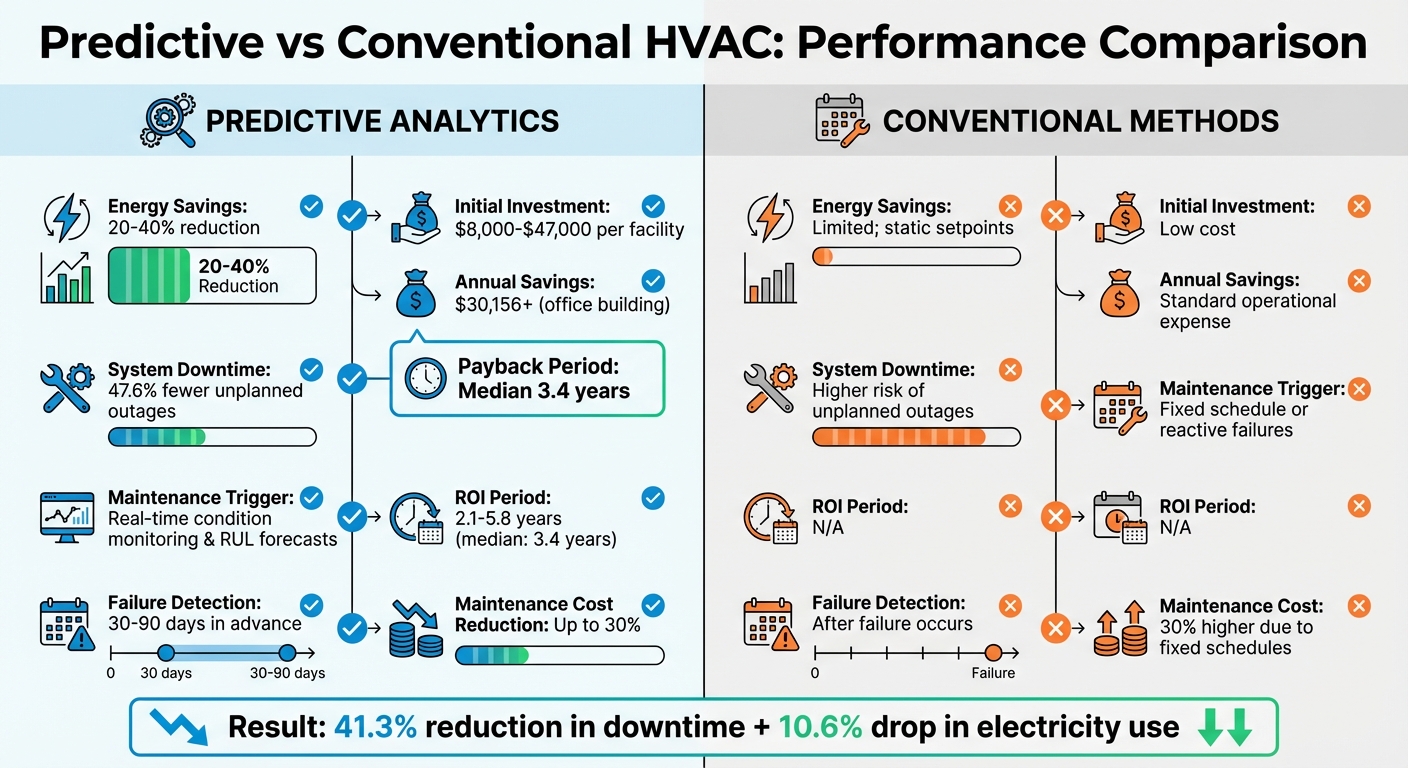
Predictive vs Conventional HVAC Systems: Energy Savings and ROI Comparison
Predictive HVAC analytics come with an upfront cost ranging from $8,000 to $47,000 per facility, but they can deliver 20%–40% energy savings and typically pay for themselves within a median of 3.4 years. In contrast, conventional systems rely on static schedules and basic thermostats, which are cheaper initially but lack the ability to optimize operations for long-term efficiency.
Take predictive maintenance as an example. A Riyadh Class A office tower implemented this approach between 2023 and 2025, achieving a 47.6% reduction in unplanned outages and cutting downtime by 41.3%. Conventional preventative maintenance methods, on the other hand, often miss slow-developing issues, leading to sudden system failures during peak demand.
Predictive maintenance also trims costs by intervening only when necessary. In contrast, fixed schedules used in conventional systems can increase expenses by up to 30%. As highlighted in Energy Reports:
"Predictive maintenance… can diminish the cost of maintenance by reducing the frequency of maintenance as much as possible to avoid unplanned reactive maintenance, without incurring the costs associated with too frequent preventive maintenance."
While conventional systems stick to fixed schedules or react to failures, predictive systems rely on real-time condition monitoring. This approach not only extends the life of components but also avoids premature replacements. Here’s a side-by-side comparison of the two methods:
| Feature | Conventional Methods | Predictive Analytics |
|---|---|---|
| Energy Savings | Limited; static setpoints | 20%–40% reduction with real-time optimization |
| Initial Investment | Low cost | $8,000–$47,000 per facility |
| Annual Savings | Standard operational expense | $30,156+ annually (office building example) |
| System Downtime | Higher risk of unplanned outages | 47.6% fewer unplanned outages |
| Maintenance Trigger | Fixed schedule or reactive failures | Real-time condition monitoring and RUL forecasts |
| ROI Period | N/A | 2.1–5.8 years (median: 3.4 years) |
The choice is clear: while predictive analytics require an upfront investment and a well-developed data infrastructure, they offer significant improvements in energy efficiency, system reliability, and overall cost savings. When paired with professional testing, adjusting, and balancing (TAB) services, these systems can unlock even greater performance benefits, aligning HVAC operations with real-time needs for optimal efficiency.
Combining Predictive Analytics with TAB Services for Better Performance
Predictive analytics and TAB services work hand in hand to address HVAC performance gaps. While TAB ensures the system is physically balanced and meets design specs during commissioning, predictive analytics offers ongoing monitoring to prevent the typical performance decline that happens after setup. Together, they help maintain system optimization over time.
This integration builds on the proactive nature of predictive analytics, enhancing the precision provided by TAB services. It leverages BMS telemetry – data from Building Management Systems (BMS) – to feed predictive models that identify issues beyond TAB’s initial scope. Take, for instance, a Riyadh office building in November 2025 that used LSTM networks to analyze two years of equipment data. The system flagged problems like refrigerant undercharge and fouled heat exchangers, resulting in a 10.6% drop in HVAC electricity use and a 41.3% cut in total downtime. These are the types of inefficiencies that often creep in between TAB certifications.
Air Balance Masters applies this approach across states like MD, VA, PA, NJ, NY, DE, and DC by incorporating predictive data into the TAB process. Their technicians utilize real-time condition monitoring to detect when systems deviate from their certified state. Instead of conducting full system audits, they perform targeted micro-rebalancing, which speeds up compliance with energy codes and design standards. This localized strategy ensures systems consistently meet performance goals, delivering energy savings similar to the example above.
By adhering to rigorous standards like ASHRAE 180 and ASHRAE Guideline 22, this combined methodology ensures systems maintain their specifications over time. Predictive Remaining Useful Life (RUL) forecasts give technicians clear maintenance targets, reducing downtime and maintaining efficiency. This approach minimizes the disruptions caused by forced outages and emergency repairs, especially during peak demand periods.
The result? HVAC systems that adjust dynamically to environmental changes and occupancy levels, moving away from rigid, fixed schedules. Yury Dvorkin, Associate Professor at Johns Hopkins University, highlights the value of this approach:
"What makes DFL [Decision-Focused Learning] unique is that it directly connects predictions to outcomes. It doesn’t just model temperatures – it helps users decide how to run HVAC systems to meet their goals".
For contractors and building owners in the Mid-Atlantic and Northeast regions, this means lower energy bills, improved grid reliability, and HVAC systems that consistently meet design specs without constant manual input. This dynamic adaptation combines the strengths of predictive analytics and TAB services to deliver reliable, efficient performance.
Where predictive analytics fits in HVAC energy use
Predictive HVAC analytics is transforming how HVAC systems are managed, shifting from reactive, schedule-based maintenance to proactive, data-driven strategies. These analytics have proven their value by delivering measurable benefits like energy savings, fewer outages, and longer equipment lifespans. Considering that HVAC systems account for 40% of energy consumption, these advancements not only cut utility costs but also help reduce carbon emissions.
From a financial perspective, the case for predictive analytics is strong. With a payback period of less than two years, the investment quickly justifies itself. In contrast, traditional approaches – where systems are often left unchecked after commissioning – can lead to performance decline and operational costs that are as much as 30% higher. By continuously monitoring equipment health, predictive tools catch potential failures early, avoiding expensive repairs and downtime.
Integrating predictive analytics with Testing, Adjusting, and Balancing (TAB) services takes these benefits even further. This combination ensures systems operate within their design parameters while meeting energy codes and adapting dynamically to changing conditions. Unlike fixed maintenance schedules, this approach provides a level of precision and responsiveness that maximizes both efficiency and reliability.
Air Balance Masters applies this advanced methodology throughout MD, VA, PA, NJ, NY, DE, and DC. By incorporating real-time monitoring into the TAB process, their technicians pinpoint and address deviations from certified system states. This enables precise micro-rebalancing, ensuring systems maintain TAB certification compliance and design specifications. For contractors and building owners in these areas, this means dependable performance, reduced energy costs, and HVAC systems that meet inspection standards without constant manual oversight.
FAQs
What data do I need to start predictive HVAC analytics?
To get started with predictive HVAC analytics, you’ll need both historical data and real-time inputs from sensors. These sensors monitor critical factors such as temperature, humidity, pressure, vibration, and overall equipment performance. Combining these data points allows for precise predictions and helps optimize system efficiency.
Will predictive analytics work with my existing BMS and HVAC equipment?
Yes, predictive analytics can work alongside your current BMS and HVAC systems, particularly if they support IoT and cloud-based APIs. This means AI-driven tools can improve system performance without the need for expensive hardware upgrades.
How do predictive analytics and TAB services work together long-term?
Predictive analytics and Testing, Adjusting, and Balancing (TAB) services complement each other to improve HVAC system performance and energy efficiency. Predictive analytics helps anticipate system behavior, identify possible problems early, and suggest preventative maintenance. Meanwhile, TAB ensures systems are properly balanced, delivering the right airflow and temperature while adhering to design requirements. Together, they boost accuracy, minimize downtime, and contribute to long-term energy savings and reliable equipment operation.


