


In healthcare facilities, HVAC systems are critical for patient safety and infection control. They regulate ventilation, air quality, and pressure in areas like operating rooms and nurseries. Power outages disrupt these systems, risking lives and clinical operations. Hospitals rely on emergency power systems, including generators and transfer switches, to ensure HVAC systems function without interruption.
Key points:
- HVAC systems prevent airborne pathogens and maintain sterile environments.
- Emergency power must restore HVAC operations within 10 seconds to meet strict codes like NFPA 99 and NFPA 110.
- Generators require regular testing and fuel reserves for up to 96 hours.
- Proper design and placement of emergency power systems reduce risks like generator exhaust contamination.
Maintaining reliable HVAC operation during outages is non-negotiable for patient care and regulatory compliance.
Emergency Power Generators for Healthcare Facilities
How Power Outages Affect Healthcare HVAC Systems
When a healthcare facility experiences a power outage, the consequences go far beyond a temporary loss of lighting. HVAC systems shut down, disrupting essential air quality controls and pressure regulation. This breakdown jeopardizes patient safety and interrupts clinical operations. It highlights the importance of dependable emergency power systems to keep healthcare HVAC systems running.
Why HVAC Is Critical for Patient Safety and Infection Control
HVAC systems play a key role in infection control by managing air quality and pressure levels.
"The equipment branch essentially serves the mechanical loads required for the support of clinical activities… Equipment typically connected include HVAC (ventilation, exhaust/smoke control, and stair-pressurization systems)."
– Vahik Davoudi, PE, LEED AP, Arup
Proper ventilation helps stop airborne pathogens from spreading and ensures sterile conditions in critical areas. Maintaining correct air pressure differentials prevents contaminated air from entering sterile environments. Additionally, temperature control isn’t just about comfort – it’s vital for avoiding harmful clinical outcomes.
What Happens When HVAC Fails During Power Outages
The effects of HVAC failure during a power outage can be immediate and severe. Take, for example, the incident at Queen Alexandra Hospital in Portsmouth in August 2024. A power loss at 7:00 AM forced the Emergency Department to close its doors to new patients and led to the cancellation of multiple procedures. Full restoration of power and IT systems didn’t occur until 4:00 PM.
Similar challenges arose at East Surrey Hospital in March 2024, where a prolonged power outage forced ambulances to divert to other facilities while the hospital remained closed to new arrivals. In another instance, Swindon Hospital faced significant disruptions in its Accident & Emergency department and urgent treatment center due to a power failure in July 2024.
These disruptions don’t stop at HVAC failures. Generators placed near air intakes can pull exhaust fumes indoors, further endangering patients. On top of that, failures in communication systems – such as phone lines, switchboards, and staff paging – make it harder to coordinate during a crisis.
Jason Koffler, CEO of Critical Power Supplies, emphasizes the importance of quick action:
"Even if it’s just for a few minutes, those minutes can keep people safe, prevent weeks of work, and keep financial losses to an absolute minimum."
Without a reliable HVAC system, hospitals lose a critical layer of protection for patient care. This underscores the urgent need for emergency power solutions that ensure HVAC systems stay operational, safeguarding both patient safety and hospital functionality.
Emergency Power Requirements for Healthcare HVAC Systems
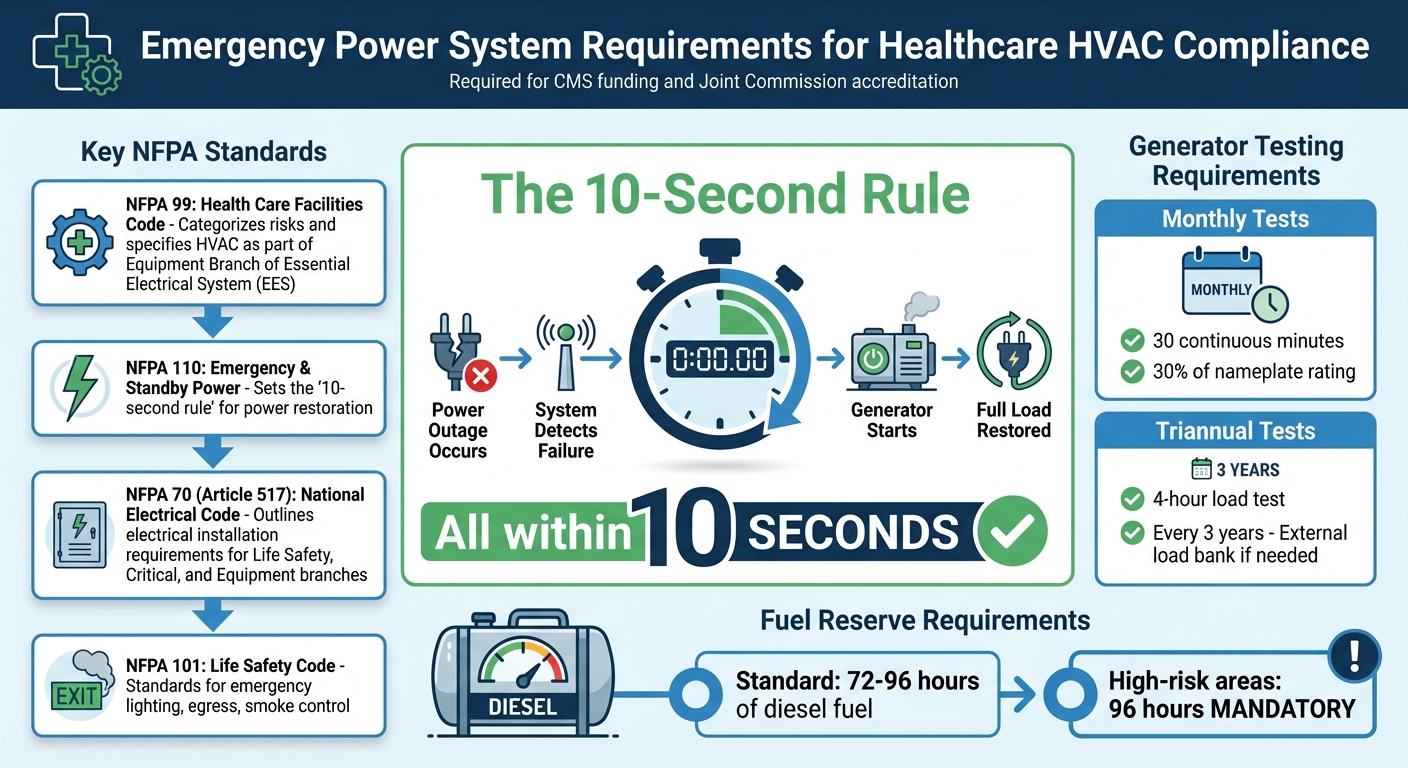
Emergency Power System Requirements for Healthcare HVAC Compliance
Given the risks previously discussed, strict emergency power regulations are in place to ensure that HVAC systems in healthcare facilities operate without interruption. In the United States, these facilities must comply with rigorous standards to maintain eligibility for CMS funding and accreditation from The Joint Commission.
NFPA and Other Required Standards
Several key codes – NFPA 99, NFPA 110, NFPA 70 (Article 517), and NFPA 101 – govern emergency power and electrical systems in healthcare settings. Here’s a closer look at how they apply:
- NFPA 99 (Health Care Facilities Code): This code categorizes risks and specifies that HVAC systems essential to patient care are part of the Equipment Branch of the Essential Electrical System (EES).
- NFPA 110 (Standard for Emergency and Standby Power Systems): It sets performance and maintenance standards for generator systems, including the "10-second rule", which requires emergency power systems to detect power failure and assume full load within 10 seconds [7,8].
- NFPA 70 (National Electrical Code, Article 517): This section outlines the electrical installation requirements for healthcare facilities, detailing the configuration of the Life Safety, Critical, and Equipment branches of the EES.
- NFPA 101 (Life Safety Code): It sets standards for emergency lighting and egress illumination, often tied to HVAC functions like smoke control and stair pressurization.
Accreditation organizations, including The Joint Commission, enforce these codes through detailed inspections. Additionally, facilities in high-risk areas are required to maintain fuel reserves for at least 96 hours [7,9].
"In a healthcare facility, the electrical grid is more than a utility, it’s a lifeline. When an outage occurs, the seamless transition to backup power is not a matter of convenience; it can be the difference between life and death."
– Generator Source
These codes establish the foundation for how emergency power systems must be designed and operated.
Specific Emergency Power System Requirements
Healthcare facilities face stringent requirements to ensure their emergency power systems function reliably. The Emergency Power Supply System (EPSS) must detect power loss, start the generator, and restore power to all EES branches – including critical HVAC components like ventilation, exhaust, and pressure control – within 10 seconds [7,8].
Generators must undergo regular testing to ensure reliability. This includes:
- Monthly Tests: Generators must run under load for 30 continuous minutes at 30% of their nameplate rating.
- Triannual Tests: A 4-hour load test must be conducted every three years. If the facility’s natural load is insufficient, an external load bank is required to meet the necessary load and prevent wet stacking in diesel engines [7,8].
Most hospitals store enough diesel fuel to operate for 72–96 hours, and planning for 96 hours of sustained operations is typically mandated by local authorities and Joint Commission Emergency Management Standards. Diesel generators provide a reliable power source during outages.
Danny Chisholm, a Technical Committee Member for NFPA 99, 110, and 111, highlights the critical role of expertise in managing these systems:
"The operation of the emergency power supply system (EPSS) depends on individuals well versed in maintenance, testing, and compliance."
Proper documentation is essential. Weekly inspections, monthly load tests, and repairs must all be recorded meticulously. These records are among the first items reviewed during Joint Commission surveys, and missing documentation can lead to compliance issues, even if the systems themselves are functioning correctly.
How to Ensure Reliable Emergency Power for Healthcare HVAC
Main Components of Emergency Power Systems
In healthcare settings, a dependable emergency power system revolves around the Essential Electrical System (EES). This system is divided into three branches:
- Life Safety branch: Powers egress lighting and alarms.
- Critical branch: Supports patient care areas.
- Equipment branch: Handles HVAC loads like ventilation, exhaust fans, compressors, and pumps, which activate through delayed transfer.
The Life Safety and Critical branches are designed to restore power within 10 seconds, ensuring minimal disruption to essential operations. Meanwhile, the Equipment branch uses a delayed automatic or manual transfer to prevent generator overload during startup.
Automatic Transfer Switches (ATS) are crucial for shifting from utility power to emergency power. There are two types:
- Open-transition switches: Cause a brief power interruption.
- Closed-transition switches (make-before-break): Prevent power loss during transitions.
For maintenance, bypass or isolation switches allow technicians to service the ATS without interrupting power to critical HVAC loads. Larger facilities often use paralleling switchgear to synchronize multiple generators. This setup enhances reliability by offering redundancy and better load management.
Modern emergency power systems also feature SCADA (Supervisory Control and Data Acquisition) and PLC (Programmable Logic Controllers). These technologies enable real-time monitoring and automated testing, helping identify potential issues before they cause disruptions. Experts stress that EES designs must operate flawlessly, regardless of the circumstances.
Together, these components ensure the seamless operation of HVAC systems during emergencies, aligning with strict design and operational standards.
Design Guidelines for Emergency Power Systems
Beyond the components, thoughtful design is essential for boosting system reliability and meeting compliance standards. Proper sizing and configuration are critical to prevent overload, particularly when accounting for the high inrush currents of HVAC motors, compressors, and fans. Sequential starting, achieved through delayed transfer, ensures a smooth restoration process after the 10-second power recovery window.
Generator placement is another key consideration. To avoid contaminating HVAC airflow, generators should be positioned away from air intakes and conditioning units. In colder regions, battery and block heaters should be installed to ensure generators start reliably in low temperatures. If remote radiators are used for cooling, their associated components – like cooling tower fans and water pumps – should connect to the non-delayed equipment branch and be excluded from load-shedding protocols.
Redundancy is vital for eliminating single points of failure. As George Baker, a retired senior system engineer at Wellspan, explains:
"A single generator represents a single point of failure."
Using multiple generators controlled by paralleling switchgear increases reliability and flexibility. Rod Allen, System Director of Plant Operations at Lee Memorial Health System, emphasizes the importance of tailoring systems to local conditions:
"The codes are minimums. Depending on where you’re at, you have to look at the environment around you."
For facilities in areas prone to hurricanes or with unreliable utility services, planning for extended outages is crucial. While a 24-hour fuel supply is the baseline, 96 hours is becoming the standard in high-risk locations.
Finally, derangement panels should be installed in areas staffed 24/7 to monitor potential issues like high engine temperature or low fuel levels. Overcurrent protective devices must also be selectively coordinated for faults lasting longer than 0.1 seconds, as required by NFPA 99. Additionally, compliance with NEC Article 700 may demand full coordination for these devices.
How Air Balance Masters Supports Emergency Power Compliance
Certified TAB Services for Healthcare HVAC Systems
Air Balance Masters ensures that HVAC systems in healthcare facilities perform reliably during emergency power transitions. Their testing verifies that critical components – like ventilation, exhaust, smoke control, and stair-pressurization systems – are properly connected to the Equipment Branch of the Essential Electrical System during power outages.
Certified technicians conduct sequential load tests to confirm that high-inrush devices transfer power according to prescribed time-lags. This step is crucial to prevent generator overload and avoid tripping overcurrent protective devices during these critical moments. As Vahik Davoudi, PE, LEED AP at Arup, notes:
"Equipment-branch loads shall be installed and connected to the alternate source of power at appropriate time-lag intervals after power interruption via delayed automatic or manual connection as prescribed by code."
This highlights the importance of precise TAB (Testing, Adjusting, and Balancing) verification to ensure compliance and functionality.
Air Balance Masters also supports blackout testing, a process that confirms all equipment operates correctly under emergency power. During these tests, TAB professionals measure the time it takes for systems to reach steady-state operation, ensuring compliance with NFPA 110 standards. Additionally, load-shedding tests are conducted to verify that safe airflow levels are maintained even under reduced power conditions.
These detailed services ensure HVAC systems not only align with design specifications but also perform reliably during emergency scenarios. By bridging the gap between design expectations and real-world performance, Air Balance Masters helps facilities achieve smoother regulatory approvals.
Help with Regulatory Compliance and Inspections
In addition to technical testing, Air Balance Masters simplifies the regulatory compliance process. Their detailed TAB reports compile performance data and test logs that inspectors rely on to verify adherence to NFPA 99 and NFPA 110 standards. These reports also meet the documentation requirements set by the Facility Guidelines Institute (FGI) for new construction and major renovations.
For HVAC and general contractors working in MD, VA, PA, NJ, NY, DE, and DC, Air Balance Masters plays a key role in securing final inspection approvals and certificates of occupancy. Their testing ensures that HVAC systems meet performance standards under both normal and emergency power conditions, helping to avoid delays caused by last-minute performance issues identified during inspections.
Keep healthcare HVAC running through an outage
Emergency power for healthcare HVAC systems isn’t just a technical requirement – it’s a lifeline for patient safety. When the power grid goes down, systems like ventilation, exhaust, smoke control, and stair-pressurization must stay operational to protect everyone in the facility. Experts stress that the reliable performance of the Essential Electrical System (EES) is crucial because patient lives are directly at stake.
It’s not just about installing a generator. HVAC loads need to seamlessly transfer to emergency power without overloading the system. At the same time, critical pressure relationships must be maintained to support infection control and meet NFPA standards. Achieving compliance demands thorough testing and documentation to confirm that these systems perform as expected under real-world conditions.
This is where Air Balance Masters steps in. Their certified Testing, Adjusting, and Balancing (TAB) services ensure that HVAC systems function properly during emergency power transitions. They verify performance under full load conditions, helping contractors across MD, VA, PA, NJ, NY, DE, and DC meet regulatory standards. Their detailed reports not only streamline inspections but also make it easier to secure final approvals, ensuring healthcare facilities can keep running without interruption when it matters most.
FAQs
Why is emergency power essential for healthcare HVAC systems?
Emergency power is essential for healthcare HVAC systems because it keeps them running smoothly during power outages caused by events like natural disasters, utility disruptions, or other emergencies. These systems are key to ensuring patient safety, comfort, and infection control by managing temperature, air quality, and ventilation in critical areas such as operating rooms and intensive care units.
A loss of power can jeopardize vital care services and create unsafe conditions for both patients and staff. Reliable backup power ensures HVAC systems can maintain life-saving operations, avoid equipment failures, and uphold strict healthcare regulations.
What happens if a hospital’s HVAC system fails during a power outage?
When a hospital’s HVAC system goes down during a power outage, the impact can be severe. Without reliable heating, cooling, and ventilation, indoor temperatures can quickly reach dangerous levels, putting patients – especially those in critical care or receiving temperature-sensitive treatments – at significant risk. On top of that, poor air circulation can lead to an increased presence of airborne contaminants, undermining infection control protocols.
The situation can also affect essential medical equipment that depends on stable environmental conditions to function properly. Meanwhile, staff may struggle to handle emergencies in an environment that’s no longer safe or efficient. This is why dependable emergency power systems are absolutely crucial – they keep HVAC systems running and ensure a stable, secure environment for both patients and healthcare workers.
Why is emergency power essential for HVAC systems in healthcare facilities?
Emergency power plays a crucial role in keeping HVAC systems in healthcare facilities running smoothly during power outages. These systems are essential for maintaining safe air quality, consistent temperature, and proper ventilation – key factors in protecting patient health and preventing the spread of infections.
To comply with regulations, healthcare facilities adhere to standards such as NFPA 110 and NFPA 70, which require dependable emergency and standby power systems. Ensuring these systems function seamlessly during emergencies depends on thoughtful design, routine maintenance, and regular testing. Certified experts, like the team at Air Balance Masters, can help ensure HVAC systems operate effectively while meeting all necessary regulatory standards.


