


HVAC project delays often stem from system deficiencies found during inspections. TAB (Testing, Adjusting, and Balancing) services help contractors avoid these setbacks by ensuring HVAC systems meet design and regulatory standards early in the process.
Here’s what you need to know:
- What TAB Services Do: Measure, adjust, and verify airflow, hydronic flow, and system performance.
- Why They Matter: TAB reports are required for compliance under codes like IMC and ASHRAE 90.1, ensuring faster approvals for Certificates of Occupancy.
- Common Issues Solved by TAB: Airflow imbalances, duct leakage, life safety system failures, and missing documentation that can delay inspections.
- When to Involve TAB Agencies: Early involvement, like pre-construction balanceability reviews, catches problems before installation begins, saving time and money.
- Independent Verification: 83% of projects now require third-party TAB agencies to ensure accurate, unbiased reports.
AABC TAB Talk: Fundamentals of Test, Adjust, & Balance for Engineers, Cx & Energy Providers
Common HVAC Deficiencies That Delay Projects
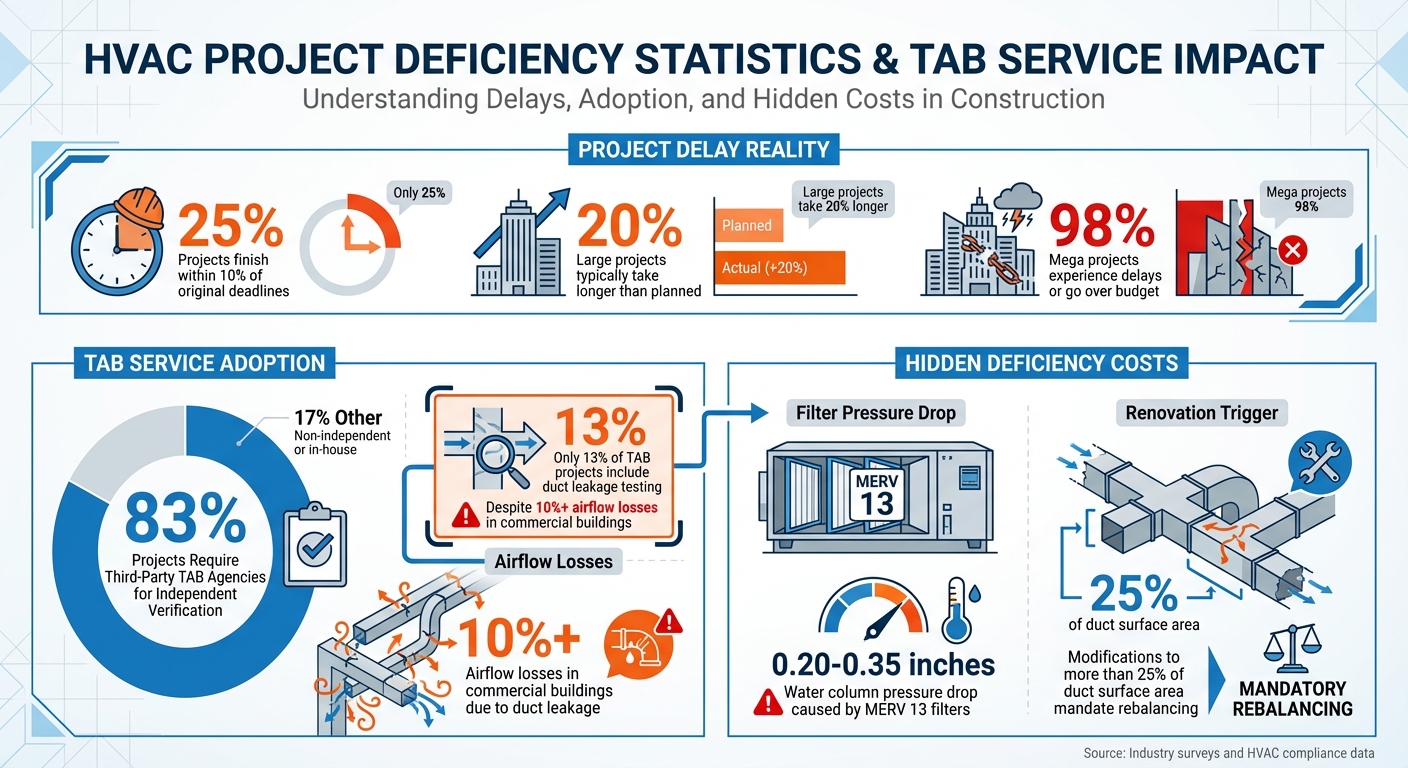
Common HVAC Deficiencies and TAB Service Impact Statistics
Certain HVAC issues are notorious for causing inspection failures and dragging out project timelines. For instance, airflow and hydronic imbalances are a frequent culprit. These occur when actual system performance doesn’t align with the design specifications. If air volumes fall short of requirements or water-based heating and cooling systems fail to deliver the expected capacity to terminal units, inspections often end in rejection. In healthcare settings, the stakes are even higher. Not meeting the directional pressure relationships or minimum air change rates required under ASHRAE 170 can immediately halt a project’s progress.
Life safety system failures are another major roadblock. Smoke control systems and fire/smoke dampers must meet strict standards for pressure differentials and airflow paths. Without proper Testing, Adjusting, and Balancing (TAB) verification, authorities won’t grant approval. Renovations that modify more than 25% of a system’s duct surface area also mandate rebalancing. This requirement often catches teams off guard, leading to inspection failures and delays.
Surprisingly, the most common delay isn’t even technical – it’s missing documentation. Jurisdictions that follow the International Mechanical Code require a certified TAB report to issue a Certificate of Occupancy or close out permits. Without this report, inspectors can’t confirm compliance, effectively halting the project.
Duct leakage is another hidden challenge. Since it’s not visible to the naked eye, detecting it requires specialized tools. In commercial buildings, duct leakage can lead to airflow losses of 10% or more. Despite this, only about 13% of TAB projects include duct leakage testing. When leakage goes unnoticed, contractors may attempt to compensate by increasing fan speeds. However, this approach is counterproductive, as it increases leakage in proportion to the square of the velocity, offering little to no improvement at the diffusers. What seems like a minor oversight can snowball into significant delays.
These deficiencies can quickly derail timelines. Only 25% of construction projects finish within 10% of their original deadlines, and large projects typically take 20% longer than planned. Mega projects fare even worse, with 98% experiencing delays or going over budget. When HVAC issues are discovered late, teams often have to reopen ceilings and walls to make corrections. What might have been a simple fix earlier in the process can turn into weeks or even months of delays. Recognizing these common pitfalls highlights the importance of TAB services in identifying and resolving problems efficiently.
How TAB Services Find and Document Deficiencies
System Performance Measurements
TAB professionals rely on specialized tools to measure critical system parameters – such as airflow, water flow, temperature, and pressure – at every distribution point to confirm that actual performance aligns with design specifications. For instance, pitot tube manometers are used to determine total and static pressure in ductwork, which helps calculate air velocity (FPM). Capture hoods, on the other hand, measure terminal airflow directly in cubic feet per minute (CFM). When evaluating fan performance, technicians compare static pressure differences and fan RPM against manufacturer specifications. Additionally, they perform duct traversals using a pitot tube grid and statistical methods to verify airflow in trunk ducts. This thorough process helps identify problems early. For example, a dirty MERV 13 filter can cause a pressure drop of 0.20–0.35 inches of water column, significantly reducing airflow. These detailed measurements are essential for creating accurate TAB reports.
Detailed TAB Reports
The information gathered during testing is meticulously compiled into comprehensive TAB reports. These reports document key performance metrics such as terminal airflow (CFM), air velocity (FPM), the percentage of design performance achieved at each terminal, total external static pressure (TESP), and motor amperage. These reports serve as a clear guide for troubleshooting. As highlighted by Consulting-Specifying Engineer:
The final TAB report is a complete record of the HVAC system performance, including conditions of operation, items outstanding, and any deviations found during the TAB process.
When performance standards fall short, TAB firms provide detailed test results that demand immediate attention. Consulting-Specifying Engineer further notes:
If acceptable performance cannot be achieved because of system or construction deficiencies, the test data will be documented in writing to the appropriate responsible parties in order for the design engineer to take corrective action.
This precise documentation identifies underperforming terminals and provides actionable data. By quantifying system performance and highlighting deviations, TAB processes enable focused corrections, helping to minimize project delays.
How TAB Services Help Fix Deficiencies Faster
Ranking Deficiencies by Urgency
TAB professionals prioritize deficiencies based on safety, compliance, and schedule impact, with life safety systems always at the top of the list. Systems like smoke control and fire/smoke damper configurations are addressed first because their results are critical for Authority Having Jurisdiction (AHJ) inspections and cannot be delayed.
Following these, systems where airflow is crucial – such as medical and kitchen exhaust systems – are tackled. For example, in medical settings, maintaining proper room pressurization is vital. Positive pressure rooms help keep harmful airborne toxins out. Similarly, kitchen hood exhaust systems need immediate attention to prevent smoke buildup. Systems failing to meet ASHRAE 170 standards for healthcare air change rates or ASHRAE 90.1 standards for energy efficiency can delay a Certificate of Occupancy. Larger systems, such as those with over 5 tons of cooling capacity or 10,000 CFM of supply airflow, require third-party TAB verification. Any deficiencies in these systems become high-priority issues for project close-out.
By ranking issues and streamlining communication, TAB services help teams act quickly to resolve problems.
Improving Communication Between Project Teams
TAB services do more than just identify and rank deficiencies – they also improve communication among project teams. Certified TAB companies, like Air Balance Masters, provide unbiased, third-party verification, which gives their reports credibility with all stakeholders. These reports become a key communication tool, offering engineers the data they need to assess system performance and providing contractors with actionable recommendations for fixes.
Getting TAB professionals involved early can prevent costly installation errors and disputes. As Ray Bert, Deputy Executive Director of the Associated Air Balance Council, explains:
TAB agencies and project engineers should be allies in achieving optimum system performance.
This collaborative process, supported by detailed documentation that serves as the primary compliance record for building inspectors, ensures smoother permit approvals and faster resolution of deficiencies.
How TAB Services Reduce Delays and Costs
Getting Inspections Approved Faster
TAB reports are essential for meeting compliance standards outlined in IMC and ASHRAE 90.1. These reports simplify the permit close-out process by removing the need for independent measurements. Without TAB, design issues like missing dampers, improperly sized VAV boxes, or piping problems often go unnoticed, leading to failed inspections and expensive delays. Pre-construction balanceability reviews help identify these problems early, allowing for corrections before installation starts.
Using third-party verification eliminates conflicts of interest, making it easier for engineers to approve system performance. According to industry surveys, 83% of projects require independent balancing to ensure impartiality. This approach not only speeds up approvals but also lays the groundwork for better system performance and reduced energy costs.
Lower Energy Costs Through System Optimization
Quick approvals and early problem detection have a direct impact on energy savings by ensuring systems run efficiently. For instance, Duct Air Leakage Testing (DALT) identifies leaks in casings and ductwork, helping to minimize energy loss.
When air and water systems operate at their best, inefficiencies that force equipment to work harder are corrected. Spotting these issues early avoids costly retrofits, such as tearing out finished ceilings or walls to access HVAC components. As Ray Bert, Deputy Executive Director of the Associated Air Balance Council, explains:
Balanceability reviews frequently catch a variety of small problems before they become bigger, time-consuming, and expensive to correct.
Use TAB to shorten deficiency fix time
TAB services play a crucial role in keeping HVAC projects on track and within budget. By addressing potential issues early – whether through pre-construction balanceability reviews or systematic testing during installation – contractors can sidestep the expensive delays that often arise during final inspections. As Nicholas Muscolino from Aero Performance Group aptly puts it:
A qualified balancing contractor can make or break a project. Their ability to identify, communicate and resolve issues separate the good balancers from the great ones.
The numbers back this up: around 83% of projects require balancing to be performed by an independent TAB agency to avoid conflicts of interest. Agencies like Air Balance Masters provide crucial documentation that simplifies inspections across states like MD, VA, PA, NJ, NY, DE, and DC.
Beyond preventing delays, proper TAB services enhance energy performance from the start, sparing contractors from costly retrofits that could involve tearing into completed walls or ceilings. Bringing TAB contractors into the process early ensures that system design and HVAC performance, installation requirements, and schedules align seamlessly for a smoother project completion.
For contractors aiming to deliver top-notch results and secure repeat business, professional TAB services offer clear advantages. As Muscolino emphasizes:
The TAB contract is the smallest contract on the project, with the largest impact on the end product and customer experience.
Choosing certified TAB services safeguards project timelines, manages costs effectively, and ensures HVAC systems meet both design specifications and regulatory requirements. In essence, certified TAB services are the cornerstone of maintaining efficiency and project integrity.
FAQs
When should I schedule TAB to avoid last-minute HVAC inspection failures?
Plan to conduct Testing, Adjusting, and Balancing (TAB) during the final stages of your project. This should happen after the HVAC system is fully installed and operational, but before the final inspection. For the process to go smoothly, make sure the following steps are completed beforehand:
- Seal the building envelope to avoid airflow inconsistencies.
- Start up all HVAC equipment to ensure it’s functioning properly.
- Review all necessary documentation to confirm everything is in order.
Taking these steps ahead of time ensures the TAB process aligns with regulatory standards and helps you avoid delays or inspection failures at the last minute.
What should be included in a TAB report for permit close-out and a Certificate of Occupancy?
A TAB report should provide a clear executive summary that outlines the overall conditions of the project. It should also include a detailed list of unresolved deficiencies or issues that need attention. To strengthen the report, attach supporting documentation – such as photographs of deficiencies, when applicable. This comprehensive approach ensures all required information is on hand for permit close-out and obtaining the Certificate of Occupancy.
Do I need third-party TAB for my project, and what triggers that requirement?
You might require third-party TAB (Test, Adjust, and Balance) services depending on regulatory requirements, the scope of your project, or the complexity of your HVAC system. TAB plays a key role in meeting building codes, optimizing energy use, and ensuring proper indoor air quality. Common reasons for needing TAB services include local code compliance, the need for certified documentation during inspections, or the challenges posed by intricate HVAC setups. Certified TAB providers can help you avoid project delays by confirming that systems align with design specifications and pass inspections without issues.


