


HVAC deficiency reporting ensures systems meet design and safety standards. It involves inspecting, documenting, and addressing issues that affect performance, compliance, or safety. Here’s a quick breakdown:
- Why It Matters: Reporting helps avoid delays, ensures regulatory compliance (e.g., ASHRAE 90.1, NFPA 90A), and prevents costly repairs.
- Common Issues: Airflow imbalances, mechanical failures, dirty filters, installation errors, and missing documentation.
- 5 Key Steps:
- Inspect: Visually and operationally check the system using maintenance logs and tools.
- Document: Record precise data (e.g., airflow, pressures) and compare it to design specs.
- Categorize: Sort issues by severity – safety-critical, performance-degrading, or comfort-impacting.
- Report: Create detailed reports with measurements, photos, and corrective actions.
- Communicate: Share findings with stakeholders and ensure corrections are properly tracked.
Accurate reporting is essential for passing inspections, maintaining performance, and ensuring safety. Following these steps helps identify problems early and resolve them efficiently.
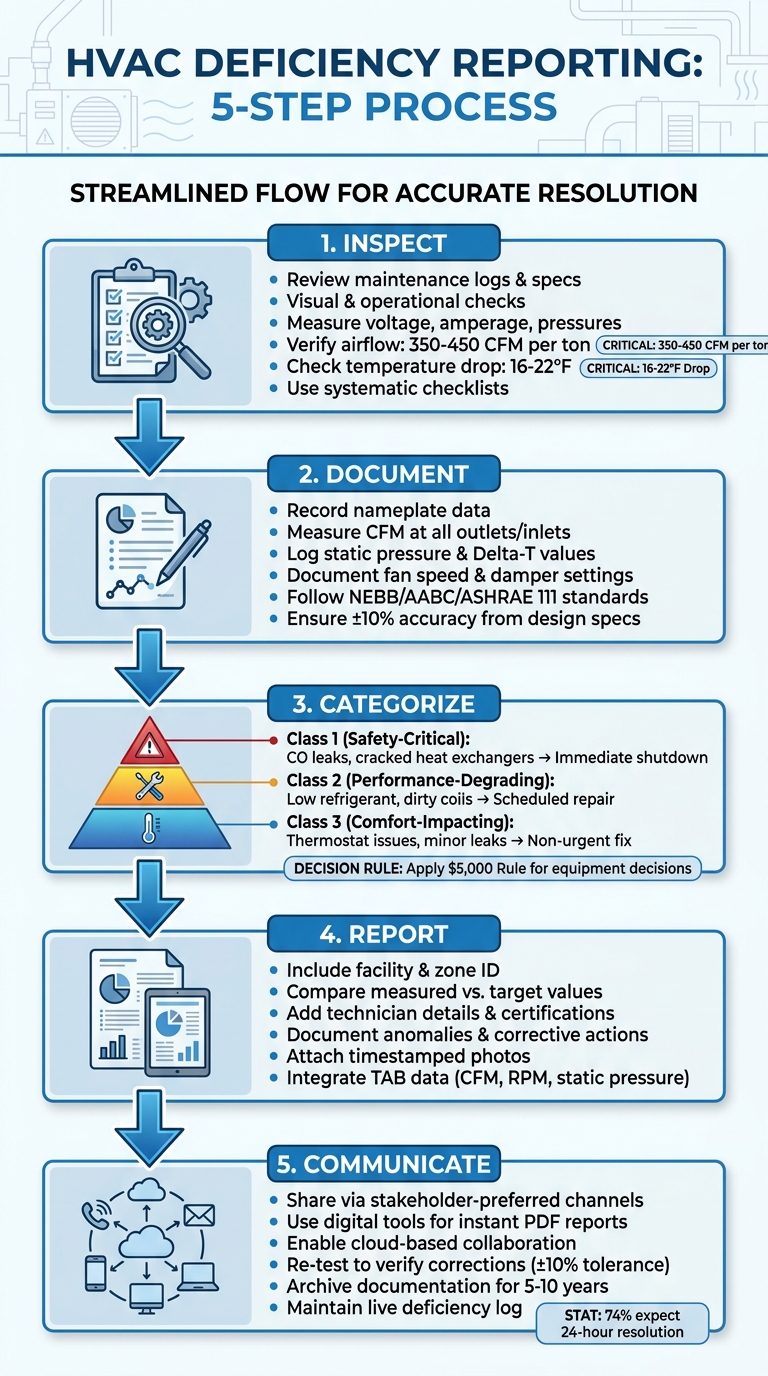
5 Key Steps for HVAC Deficiency Reporting Process
How to perform an HVAC Inspection
Step 1: Inspect the HVAC System
The first step in reporting HVAC deficiencies is a detailed inspection. Start by reviewing maintenance logs, past reports, and manufacturer specifications to establish a baseline for evaluation.
Perform Visual and Operational Checks
Begin with a visual assessment of the system. Look for signs of corrosion, damage, or loose fasteners on unit cabinets, mounting hardware, and structural supports. For rooftop units, ensure roof penetrations are properly sealed to prevent leaks. Next, check the electrical system by measuring voltage, amperage, and capacitor ratings, comparing them to the nameplate specifications. Confirm that disconnect switches are functioning and that grounding continuity is intact.
Evaluate operating pressures, superheat, and subcooling to verify the refrigerant charge, keeping in mind that even a 10% deviation can reduce efficiency by up to 20%. Inspect blower motor amperage, belt tension, filter condition, and coil cleanliness. Ensure cooling airflow management is within the range of 350–450 CFM per ton and that the temperature drop is between 16–22°F.
"Operational response does not confirm correct refrigerant charge, airflow volumes, or controls sequencing. A system can cool the space while running at 85% of design airflow and 15% overcharge."
– HVAC Installation Authority
After completing the physical inspection, use a checklist to systematically confirm all measurements and conditions.
Use Checklists for System Verification
Checklists are essential for ensuring nothing is overlooked. Utilize phased checklists that cover pre-installation readiness, equipment inspection, and performance testing. These checklists should align with enforceable standards like the International Mechanical Code (IMC), ASHRAE 90.1, and ASHRAE 62.1.
Digital tools can simplify this process by enabling real-time logging, photo documentation, and automatic generation of QA reports. Your checklist should include critical field measurements such as airflow at terminals, static pressure readings, thermostat setpoint ranges, condensate drainage slopes (minimum 1/4-inch per foot), and combustion air openings. For new residential construction under the 2021 IECC, ensure total duct leakage does not exceed 4 CFM25 per 100 square feet of conditioned floor area.
Step 2: Document Deficiencies Accurately
Once the inspection is complete, the next step is to document all deficiencies with precision. This isn’t just about jotting down notes – it involves capturing detailed measurements and data that align with design specifications. Such thorough documentation is key to assessing system performance and planning effective repairs.
Record Key Measurements and Data
Start by recording all equipment nameplate data. Collect static pressure readings, duct traverse measurements, and Delta‑T values to confirm whether the system is operating within acceptable ranges. Then, measure the actual CFM (cubic feet per minute) at each supply outlet and return inlet. Use the right tools for this: a vane anemometer for smaller registers and a flow hood for larger diffusers. To ensure accuracy, include manufacturer-specific AK factors for each register in your calculations.
"Make a chart to track the airflows of each inlet and outlet, noting design airflows and leaving room to record actual airflows for comparison."
– Jason Rende, HVAC Designer and Air Balancing Specialist
Additionally, document the current fan speed and the settings of all volume and splitter dampers. Before finalizing any readings, confirm that all dampers are fully open, filters are clean, and the fan speed is correctly adjusted. Systems are generally considered balanced when the measured airflow at all outlets is within 10% of the specified design values. Once adjustments are complete, record the final CFM to create an accurate "as-left" report.
Follow Industry Standards for Documentation
Accurate measurements are only part of the process – consistent documentation is equally important. Use established frameworks like NEBB, AABC, or ASHRAE Standard 111 to ensure you take measurements systematically at every distribution point. Compare these measurements (e.g., CFM, feet per minute, and static pressure) to the original design documents and equipment schedules. Select the appropriate tools for the job: Pitot tubes for duct traverses, thermal anemometers for low-velocity VAV systems, and flow hoods when working with non-uniform diffusers. For rectangular ducts, apply the log-linear method with at least 16 traverse points, and for circular ducts, use the log-Tchebycheff method. Always account for manufacturer-published K-factors when using flow hoods to maintain accuracy.
Be sure to also record all "as-found" conditions, including fan RPM, total external static pressure (TESP), and motor amperage, before making any mechanical changes. Adding timestamps and environmental data – such as static pressure at fan inlets and outlets – creates a verified snapshot of system performance. This level of detail ensures that your documentation meets compliance requirements and can stand up to scrutiny during inspections.
Step 3: Categorize and Prioritize Deficiencies
Using the detailed data gathered earlier, the next step is to sort deficiencies based on their severity and urgency. Not all issues are created equal – some might pose immediate safety threats, while others could simply affect comfort or efficiency. A well-organized classification system ensures resources are used wisely, addressing the most critical problems first.
Classify Deficiencies by Severity Level
Start by assigning each deficiency to one of three severity categories:
- Class 1 (Safety-Critical): These are the most urgent issues, such as carbon monoxide leaks, cracked heat exchangers, refrigerant exposure, or electrical shock risks. According to NFPA 54, these deficiencies demand an immediate system shutdown to prevent harm.
"A cracked heat exchanger – a Class 1 safety hazard per NFPA 54 – allows combustion gases to enter the air stream."
– HVAC Service Authority - Class 2 (Performance-Degrading): Problems like low refrigerant levels, dirty coils, or failing capacitors fall into this category. These issues don’t stop the system from functioning but significantly reduce its efficiency. For example, a capacitor is considered failing if it tests below 10% of its rated microfarad (µF) value.
- Class 3 (Comfort-Impacting): These are less urgent issues, such as thermostat miscalibration or minor duct leaks, which primarily affect occupant comfort without compromising the system’s overall functionality.
In addition to severity, track the inspection status of each issue:
- Hold Point (HP): These issues, like refrigerant pressure test failures or fire/smoke penetrations, require work to pause until a third-party or Authority Having Jurisdiction (AHJ) inspector verifies the correction.
- Verify and Document (VD): These require contractors to document specific measurements, such as airflow or static pressure, to confirm compliance with design standards.
- Contractor Self-Inspection (CSI): Items like filter installation or thermostat programming can be addressed without external oversight.
This classification system lays the groundwork for prioritizing actions based on urgency.
Create a Prioritization Framework
Once categorized, deficiencies should be further organized within a prioritization framework that matches their severity and urgency with the necessary corrective actions. A simple table can help visualize which problems need immediate attention and which can wait.
For equipment-specific issues, the $5,000 Rule offers a practical guideline. Multiply the unit’s age by the repair cost. If the result exceeds $5,000, replacement becomes the more cost-effective choice. For example, a 12-year-old unit needing a $500 repair yields $6,000, suggesting replacement is the smarter move.
| Severity Class | Description | Examples | Action Required |
|---|---|---|---|
| Class 1 | Safety-Critical | CO leaks, electrical shock hazards, cracked heat exchangers | Immediate shutdown per NFPA 54 |
| Class 2 | Performance-Degrading | Low refrigerant, dirty coils, failing capacitors | Scheduled repair to restore efficiency |
| Class 3 | Comfort-Impacting | Thermostat miscalibration, minor duct leakage | Non-urgent adjustment for occupant comfort |
This structured approach ensures that safety concerns are tackled first, critical repairs are scheduled promptly, and minor fixes are addressed without delay. By categorizing and prioritizing systematically, you create a clear action plan that protects occupants, maintains compliance, and keeps systems running smoothly.
Step 4: Generate a Detailed Deficiency Report
Once you’ve prioritized findings, the next step is to compile a detailed report that outlines the issues and guides corrective actions. This report isn’t just a formality – it serves as both a compliance record and a practical roadmap for resolving deficiencies. Consider this: in 2026, NewYork-Presbyterian faced $4 million in penalties, while Cedars-Sinai incurred $3.1 million in losses, not due to equipment malfunctions, but because of documentation gaps and missing evidence of utility system management related to hospital-acquired conditions. This highlights the importance of thorough and accurate reporting.
Structure the Deficiency Report
A properly structured deficiency report needs to meet specific codes, project specifications, and accrediting standards. Here’s how to organize it effectively:
- Facility and Zone Identification: Clearly specify the building name, floor, room number, and functional classification (e.g., ASHRAE 170 guidelines for healthcare settings).
- Measured vs. Target Values: Provide a side-by-side comparison of key parameters like pressure differentials, air changes per hour (ACH), temperature, humidity, and airflow (CFM), noting any deviations from required standards.
- Technician Details: Include the technician’s name, certifications, and HVAC system calibration records to ensure data integrity.
- Anomaly Log: Document all out-of-range findings, who was notified, the safety assessments performed, and the time taken to resolve each issue.
- Corrective Actions: Link each deficiency to a specific corrective action plan, complete with work order references and post-repair verification readings.
- Visual Evidence: Add timestamped photos or videos to document the issues.
- Final Sign-Off: Conclude with a supervisor’s signature, the date of the next scheduled inspection, and any recommended follow-up actions.
By incorporating these elements, the report becomes a clear and actionable tool for stakeholders, ensuring timely and effective resolution of deficiencies.
Integrate with Test, Adjust, and Balance Services
For HVAC systems, integrating Test, Adjust, and Balance (TAB) data with deficiency reporting is essential to confirm that systems meet design flow rates, energy efficiency goals, and proper control sequences before final handover. This integration creates a single, reliable source of truth for the engineer of record by combining deficiency documentation with TAB data, such as:
- Fan performance metrics (static pressure, RPM, motor amperage)
- Duct traversal results
- Terminal CFM readings
This comprehensive approach is vital for securing final inspection approvals and certificates of occupancy.
Standardized frameworks from organizations like the Associated Air Balance Council (AABC) or the National Environmental Balancing Bureau (NEBB) ensure that reports meet compliance requirements. Companies like Air Balance Masters specialize in merging TAB services with deficiency reporting, helping contractors in states like MD, VA, PA, NJ, NY, DE, and DC achieve approvals efficiently while adhering to NCI standards. This streamlined process not only simplifies the path to system acceptance but also ensures all compliance needs are met.
Step 5: Communicate and Track Resolutions
Resolving HVAC deficiencies effectively hinges on two key actions: clear communication and thorough tracking of corrective measures. After creating a detailed deficiency report, the next step is ensuring it reaches the right people. Poor communication is a major source of customer dissatisfaction.
Share Reports with Stakeholders
The way you share reports should align with the preferences of your stakeholders. For instance, about 50% of stakeholders favor detailed discussions over the phone, while 24% and 12% prefer updates via text messages and online platforms, respectively. When it comes to formal deficiency reports, email is the go-to option (8.2% preference), as it provides a documented record.
Digital commissioning tools make this process simpler by automatically generating detailed PDF reports that include photos, measurements, field notes, and timestamps. These reports can be instantly shared with clients, engineers, and building managers. Cloud-based platforms also allow real-time collaboration, enabling field teams, engineers, and quality assurance reviewers to comment, flag issues, and resolve problems quickly.
"Scheduling problems usually stem from breakdowns between systems, not the scheduling tool itself. Communication gaps, limited system access, phone bottlenecks, and lack of visibility across platforms all surface in the same place: the dispatch board."
- Lliam Holmes, CEO, MIS Solutions
Centralized access to information is critical. By storing all test logs, deficiency reports, and approvals on a secure platform, stakeholders can easily retrieve information during handovers, inspections, or future maintenance – without digging through email chains or file cabinets. Including the full service history and job notes when sharing reports with field technicians also speeds up follow-up work.
Homeowners set high expectations for HVAC issue resolution: 74% expect urgent problems to be addressed within 24 hours, and nearly 30% expect same-day service. While these numbers reflect residential needs, they highlight the importance of fast communication and clear timelines in commercial projects as well.
Once reports are distributed effectively, the focus shifts to verifying corrections and maintaining proper documentation.
Verify Corrections and Archive Documentation
After corrective actions are completed, re-testing is non-negotiable to confirm the system meets design specifications. Formal Testing and Balancing (TAB) services ensure that adjustments bring the system within acceptable tolerances – typically ±10% of the design CFM. Inspectors rely on certified TAB reports as the main compliance documents instead of conducting their own airflow measurements.
Verification goes beyond airflow checks. Adjusting one damper can affect upstream static pressure and other terminals, meaning every adjustment requires re-measuring related branches to ensure the entire system remains stable.
HVAC commissioning and deficiency reports should be retained for 5–10 years to meet audit requirements and serve as compliance documentation for Certificate of Occupancy inspections. This long-term record-keeping safeguards contractors and building owners during future inspections, warranty claims, or potential liability issues. Air Balance Masters, for example, provides documentation services that meet these standards in states like MD, VA, PA, NJ, NY, DE, and DC, helping contractors maintain defensible records throughout their projects.
For projects requiring seasonal verification – such as testing cooling capacity in summer for a building completed in winter – maintain a "live" deficiency log. This log tracks issues from discovery through re-testing and final approval. This approach ensures that no detail is overlooked, even during longer commissioning timelines.
Report HVAC deficiencies so they get fixed
Getting HVAC deficiency reporting right is critical for keeping projects on track, securing occupancy approvals, and maintaining system performance over time. Inaccurate or incomplete reporting can lead to project delays and even non-compliance with energy standards like ASHRAE 90.1.
A structured reporting process helps avoid these pitfalls. By following a clear five-step method, teams can systematically identify and address every issue. This approach reduces errors, confirms equipment meets the permitted scope, and ensures it operates within ±10% of the designed performance values.
"The information contained within the TAB report and building control system will almost always provide the information needed to resolve the problem."
- Peter Diperna, Mechanical Technical Specialist, Fitzmeyer & Tocci Associates Inc.
Detailed documentation plays a key role in maintaining consistent building performance. Regular TAB audits, conducted every five years as suggested by ASHRAE Standard 62.1, help prevent performance declines and keep systems running efficiently. For contractors working in areas like MD, VA, PA, NJ, NY, DE, and DC, using certified services from Air Balance Masters simplifies this process and supports successful project inspections.
It’s also important to remember that HVAC systems are interconnected. Adjusting one damper can shift upstream pressure and airflow, impacting the entire network. Comprehensive deficiency reporting takes these system-wide interactions into account, ensuring that corrections align the entire system with compliance standards while delivering the safety, comfort, and energy efficiency building owners expect.
FAQs
What should I measure to prove an HVAC issue is a real deficiency?
To determine if an HVAC issue is genuinely a problem, you need to measure airflow, temperature, and pressure at critical points in the system. Here’s what to focus on:
- Airflow: Measure it in cubic feet per minute (CFM) at both supply and return vents.
- Static Pressure and Fan Performance: Check the duct system’s static pressure and evaluate how well the fan is performing.
These measurements are essential for comparing the system’s actual performance against its design specifications, making it easier to pinpoint and address any issues.
When does an HVAC deficiency require an immediate shutdown?
If an HVAC system poses a clear threat to health, safety, or property, it should be turned off right away. This includes issues like refrigerant leaks, potential fire hazards, or mechanical problems that could endanger safety. Acting quickly helps avoid further risks and ensures everything stays in line with safety standards.
How long should HVAC deficiency reports and TAB records be kept?
HVAC deficiency reports and TAB records need to be kept for a minimum of three years. However, in certain situations, regulations might mandate retaining them for as long as seven years. Always check the specific retention requirements for your area or project to stay compliant.


