


When HVAC systems undergo Testing, Adjusting, and Balancing (TAB), issues often surface that prevent the system from meeting design specifications. TAB deficiency reports are critical for identifying these problems, providing a clear list of discrepancies, and ensuring they are resolved. These reports are essential for:
- Verifying HVAC performance against design standards.
- Meeting building codes and industry standards to secure occupancy permits.
- Simplifying final inspections by addressing issues early.
Key components of a TAB deficiency report include an executive summary, a detailed list of issues, and supporting visuals like photos and diagrams. Industry standards, such as those from NEBB and AABC, ensure consistency and accuracy in reporting. Properly addressing deficiencies ensures HVAC systems perform as intended, avoiding costly delays and ensuring compliance.
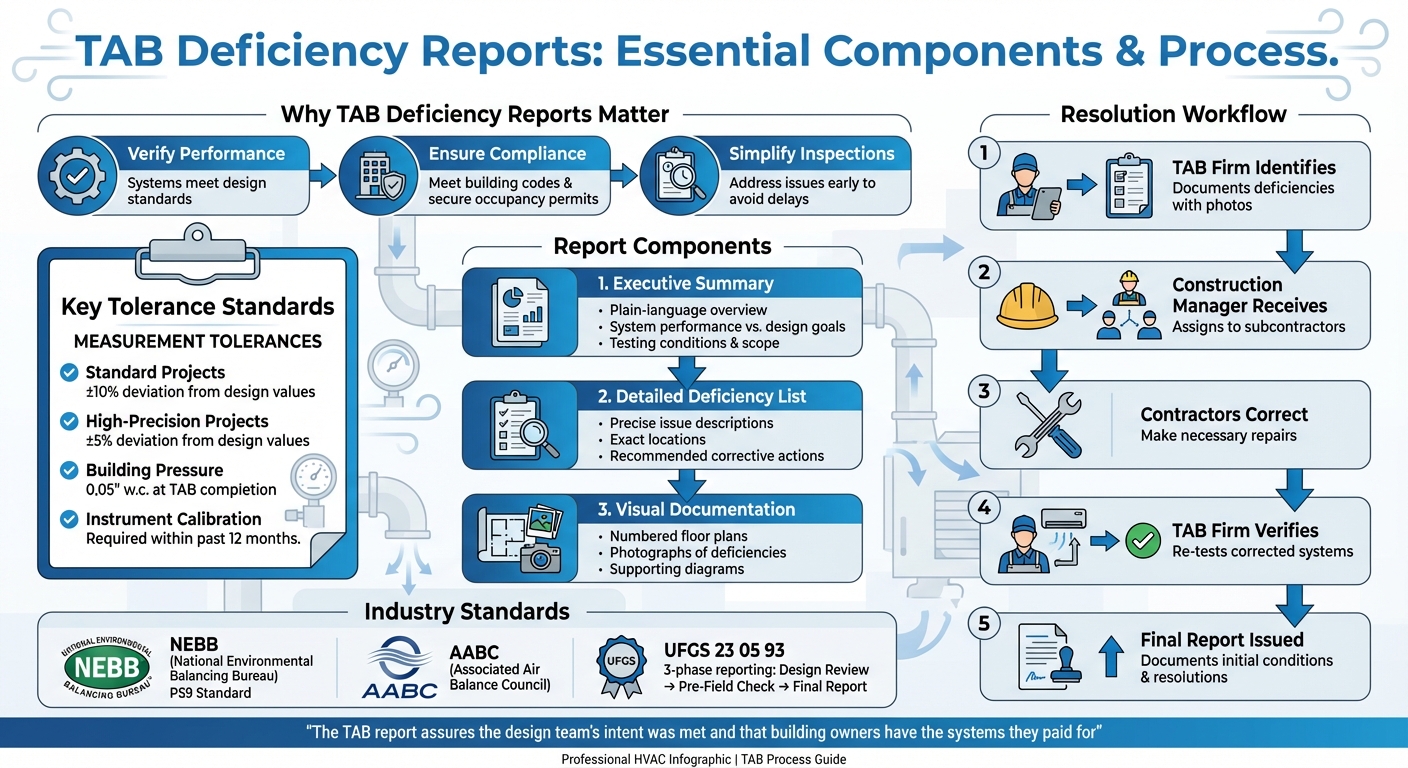
TAB Deficiency Report Components and Resolution Workflow
AABC TAB Talk: TAB Best Practices from the ACG Building Systems Commissioning Guideline

Why TAB Deficiency Reports Matter
TAB deficiency reports act as the essential bridge between a system’s design intent and how it actually performs. They highlight necessary corrections to secure approvals and occupancy, ensuring HVAC systems operate as intended. Without these reports, systems risk running inefficiently, which can lead to higher costs and performance issues.
Finding and Fixing System Problems
Deficiency reports identify mechanical and electrical problems – like equipment malfunctions or installation errors – that prevent systems from functioning properly. Industry standards require flagging any measurements that deviate by more than +/- 10% (or 5% for high-precision projects) from design values, prompting corrective action.
These reports often include photos and diagrams, making it easier for subcontractors to locate and resolve issues quickly. For instance, building pressures are typically set to 0.05" w.c. at the end of the TAB process. However, even something as simple as a 10 mph wind can disrupt this balance, emphasizing the need for accurate and precise measurements. Beyond identifying problems, these reports ensure systems meet both design and regulatory standards.
Meeting Design Standards and Requirements
TAB deficiency reports verify that installed systems align with the original design specifications and comply with regulatory codes. They compare actual measurements – such as airflow, water flow, and temperature – against design parameters, ensuring building owners receive what they paid for.
"The TAB report is a critical element of the construction process that assures the design team’s intent was met. It also assures the building owner that they have the systems they paid for".
These reports also confirm that ventilation rates adhere to ANSI/ASHRAE standards 62.1 and 62.2, which are essential for maintaining indoor air quality and occupant health. Additionally, all instruments used in testing must be calibrated within the past 12 months to guarantee accurate data for system evaluations and municipal inspections.
Getting Final Inspections and Approvals
By identifying issues early, TAB deficiency reports simplify both repairs and final inspections. Addressing problems ahead of time prevents schedule delays and ensures construction managers can resolve them before final inspections. Regularly sharing these reports throughout a project keeps subcontractors on track and minimizes disruptions.
"An excessively long list of deficiencies is usually a symptom of poor quality control or a compressed construction schedule".
Skipping or rushing the TAB process to meet inspection deadlines or occupancy goals is not an option. Municipal inspectors rely on these reports to verify that HVAC systems meet health and safety standards before granting certificates of occupancy. Accurate and timely reporting is critical for keeping projects on schedule. Working with experienced professionals, like Air Balance Masters, ensures thorough and reliable TAB deficiency reports, paving the way for smooth final inspections and occupancy. Up next, we’ll explore the core elements of these reports and the standards that guide effective documentation.
What Goes Into a TAB Deficiency Report
A well-organized TAB deficiency report turns raw testing data into actionable insights.
"The report should be able to tell the overall story in a way that virtually ANYONE can understand, regardless of background." – Melink Corp
These reports typically include three main components: an executive summary, a detailed deficiency list, and supporting visuals. The executive summary provides a clear overview, the deficiency list outlines specific problems, and visuals help illustrate exactly where and how issues impact the system. Let’s break these elements down further.
Executive Summary and General Observations
The executive summary is the starting point of the report and provides a concise, plain-language narrative of the project. This section reflects TAB’s collaborative role with HVAC contractors by summarizing how the system performs compared to its design goals, noting any unusual conditions observed during testing, and documenting critical setpoints necessary for maintaining performance.
This summary is particularly helpful for facility managers, offering clarity on system quirks and unique operational needs. It also records the exact conditions during testing and outlines the scope of work performed. This context ensures that even months or years later, the report remains a reliable resource. Following this overview, the report dives into the specifics with a detailed list of deficiencies.
Detailed List of Deficiencies
The deficiency list is the technical core of the report, highlighting every issue that prevents the system from meeting design standards. Each entry should include:
- A precise description of the issue
- Its exact location
- Recommended corrective actions
Industry standards typically flag measurements outside design tolerances – ±10% for general applications or ±5% for high-precision systems. For instance, if a supply diffuser is delivering 450 CFM when it should be providing 500 CFM, the report would note this 10% shortfall and recommend checking for duct restrictions or damper misalignments.
"TAB firms should promptly communicate all issues they encounter with as much detail as possible so that the responsible parties can set about resolving identified issues." – APPA
This level of detail helps construction teams act quickly to resolve problems. The report must also confirm that all instruments were calibrated within the past 12 months and, in modern buildings, verify that every point in the Building Management System is operational, properly calibrated, and accurately labeled. While TAB professionals identify and document these issues, it’s up to the construction manager and subcontractors to address them.
Photos, Diagrams, and Supporting Documents
Visual aids tie the report together, connecting technical findings to real-world conditions. Numbered floor plans are a must, linking measurements to specific locations within the building.
"These numbered plans and/or drawings are the glue that bind the TAB report together, and MUST be included." – Melink Corp
Photographs of deficiencies are now a standard feature, allowing project teams to quickly locate and understand issues without wading through lengthy descriptions. Additionally, administrative documents like a table of contents and certification details ensure the report remains a comprehensive and practical reference throughout the building’s lifespan.
Industry Standards for Deficiency Reporting
Adhering to established industry standards ensures that Testing, Adjusting, and Balancing (TAB) deficiency reports are consistent, accurate, and reliable. These reports play a critical role in verifying design compliance and maintaining system performance. The National Environmental Balancing Bureau (NEBB) and the Associated Air Balance Council (AABC) set the guidelines that govern professional TAB work. Following these standards ensures building owners and contractors receive dependable data.
"It is the responsibility of the NEBB Certified Firm and NEBB Certified Professional to establish and maintain procedures and practices that will assure a consistent pattern of high-quality work on all projects." – NEBB
When project-specific tolerances are stricter than standard limits (e.g., ±5% instead of ±10%), this must be clearly documented. Such precision is essential for facilities requiring higher levels of accuracy.
NEBB and AABC Standards for TAB Reports
The NEBB Procedural Standard for Testing, Adjusting and Balancing of Environmental Systems 2019 – 9th Edition (PS9) is the definitive guide for NEBB-certified firms. Projects contracted after July 15, 2019, must comply with this standard to carry the official NEBB TAB Stamp. One key requirement is outlined in Section 5.2.4, which mandates a "Report Summary / Remarks" section that lists all deficiencies along with their corresponding page references.
A NEBB Certified Professional (CP) oversees the entire TAB process, identifying significant deficiencies and certifying the final report. This certification confirms that all measurements and observations meet NEBB’s standards. Additionally, the final report must include specific language noting any variances that exceed NEBB tolerances.
Similarly, the Associated Air Balance Council (AABC) provides detailed standards for verifying and optimizing HVAC performance. Both NEBB and AABC require that the NEBB TAB Stamp appear exclusively on the Final TAB Report, not on preliminary documents like Pre-Read Reports or System Readiness Reports.
The next step involves understanding the UFGS 23 05 93 Guidelines, which outline a phased approach to TAB reporting, ensuring discrepancies are addressed throughout the project lifecycle.
UFGS 23 05 93 Guidelines
The Unified Facilities Guide Specifications (UFGS) 23 05 93 emphasizes a phased reporting process, requiring three distinct reports: a TAB Design Review Report, a TAB Pre-Field Check Report, and a Final TAB Report. This systematic approach allows teams to identify and address deficiencies during the design, installation, and operational stages, rather than waiting until the end of construction.
UFGS 23 05 93 also requires a standardized data format that compares actual measurements with design specifications. This consistent format is particularly beneficial for federal and government projects, as it streamlines the identification of discrepancies and simplifies tracking their resolution.
For expert support in ensuring your HVAC project meets these rigorous standards, consider consulting with Air Balance Masters, a certified air balance company dedicated to ensuring systems align with design specifications and regulatory requirements.
How to Address and Resolve Deficiencies
When a TAB (Testing, Adjusting, and Balancing) firm uncovers deficiencies during testing, they document these findings in detailed reports. These reports often include photographs to provide clear evidence of the issues. The reports are then shared with the construction manager and relevant subcontractors, ensuring a transparent chain of accountability.
While TAB firms are skilled at identifying problems and may even suggest potential solutions, they are not responsible for making the actual repairs. Instead, it falls to the construction manager to assign the tasks to the appropriate subcontractors – whether it’s a mechanical contractor, controls technician, or another specialist. Once the necessary corrections are completed, the responsible parties report back to the TAB firm for verification.
"The TAB firm is responsible for testing all the systems covered by the design documents. When deficiencies are found, the TAB firm is not responsible to correct the deficiencies but will often be able to make suggestions about possible remedies."
– APPA
In some cases, deficiencies can be resolved on the spot during testing, provided contractors are available to assist. This kind of real-time collaboration can lead to a final report with no unresolved issues. However, even in these cases, the final report should include remarks that outline the initial conditions and the corrective actions taken. This ensures clarity and accountability throughout the process.
Tracking Deficiency Resolution
An organized tracking system is crucial for managing corrections effectively. Deficiencies are typically compiled into an ongoing, itemized list that is shared with the mechanical contractor or construction manager. This list serves as a live accountability tool. Regular meetings between the TAB firm and the construction team further help to address issues promptly and avoid project delays in new construction.
Before corrections can be verified, mechanical contractors need to ensure that all air systems are running without alarms, dampers are open, filters are correctly installed, and the Building Management System (BMS) is functioning properly. Conducting a pre-TAB walkthrough and using visual documentation can help identify and address potential issues early, reducing friction between trades. This systematic approach streamlines the process and sets the stage for a thorough and well-organized final report.
Adding Resolved Issues to the Final TAB Report
The final TAB report must clearly document both the deficiencies identified and how they were resolved. The executive summary should include remarks that describe the initial conditions and the steps taken to meet the desired performance standards.
"Often such deficiencies are corrected during the course of the test and balance work and by the time the final TAB report is issued, there are no remaining issues. If that is the case, there should still be general remarks explaining the scope of work and conditions at times of testing."
– Melink Corp
Typically, the process begins with an initial report from the TAB contractor, highlighting issues that need to be addressed before the project can be completed. After the necessary corrections are made, the contractor verifies the work and issues a final report. This two-step process ensures that no detail is overlooked, providing building owners with a complete record of the system’s performance – from initial testing to final certification.
For projects in Maryland, Virginia, Pennsylvania, New Jersey, New York, Delaware, or the District of Columbia, Air Balance Masters offers comprehensive reporting and verification services. Their expertise simplifies the resolution process, ensuring that HVAC systems meet design specifications and facilitating smooth final inspections and certificate of occupancy approvals.
What a good TAB deficiency report contains
A thorough TAB deficiency report does more than just identify and fix problems – it also confirms that your HVAC system performs as designed. It ensures compliance with the original design intent and validates system functionality.
"The TAB report is a critical element of the construction process that assures the design team’s intent was met. It also assures the building owner that they have the systems they paid for".
These reports also play a key role in reducing energy costs by ensuring that measurements stay within specified tolerance limits. By documenting that airflow and water flow align with design specifications, contractors showcase their dedication to quality and long-term system performance.
Clear and detailed reporting can simplify final approvals. When deficiencies are supported by visual evidence, detailed floor plans, and precise remarks explaining corrective actions, construction managers can address issues swiftly, avoiding delays. Rebecca T. Ellis, P.E., President of Questions & Solutions Engineering, Inc., emphasizes the importance of balance in her statement:
"No amount of commissioning can make an unbalanced system work".
This level of documentation not only aids in project oversight but also ensures adherence to local regulations. For contractors in the Mid-Atlantic region, investing in comprehensive deficiency documentation minimizes callbacks, guarantees alignment with design standards, and smooths the transition to commissioning teams. Air Balance Masters offers certified TAB services across Maryland, Virginia, Pennsylvania, New Jersey, New York, Delaware, and the District of Columbia, helping contractors meet performance standards and secure final inspection approvals with confidence.
FAQs
What are the key elements included in an HVAC TAB deficiency report?
An HVAC TAB (Testing, Adjusting, and Balancing) deficiency report serves as a detailed breakdown of how a system is performing compared to its original design. It typically includes design specifications, measured performance data, and adjustments made to improve system efficiency. This report pinpoints where the system falls short, offering contractors a clear view of any issues.
Additionally, these reports provide recommendations to fix identified deficiencies, ensuring the HVAC system aligns with required standards. By addressing these gaps, contractors can ensure the system functions as intended, meets compliance standards, and simplifies the process for final inspections and approvals.
How do TAB deficiency reports support the occupancy permit process?
TAB (Testing, Adjusting, and Balancing) deficiency reports are essential when it comes to securing occupancy permits. They verify that HVAC systems are correctly balanced and align with the original design specifications. These reports are critical for ensuring the system operates efficiently, adheres to building codes, and meets the performance standards required during final inspections.
Contractors can use these reports to identify and resolve any system issues, showcasing compliance and helping to speed up the approval process for occupancy permits. This proactive approach minimizes delays and keeps projects on track toward smooth completion.
Why should HVAC TAB reports follow NEBB and AABC standards?
Adhering to NEBB (National Environmental Balancing Bureau) and AABC (Associated Air Balance Council) standards in TAB (Testing, Adjusting, and Balancing) reports ensures accuracy and dependability in results. These standards establish a uniform framework to confirm that HVAC systems align with design requirements and comply with local regulations.
By sticking to these protocols, contractors can effectively identify and address system issues, enhance energy efficiency, and optimize overall building performance. On top of that, meeting these standards simplifies final inspections and approvals, making the certification process much more straightforward.


