


If you want the short answer: the commissioning agent checks TAB, but does not perform TAB.
I’d explain it this way: the TAB contractor measures and adjusts air and water flow, while the independent commissioning agent (CxA) reviews readiness, checks sample readings, reviews the report, and tracks issues through closeout. On many projects, the CxA may spot-check only 10% to 20% of readings, and if results fall outside project limits – often near ±10% of design cfm – more testing may be required.
Before you read the full piece, here’s the core idea:
- TAB and commissioning are different jobs
- The CxA works for the owner, not the installing contractor
- The CxA checks if startup, controls, and site conditions are ready before TAB starts
- The CxA reviews TAB reports for missing data, bad totals, pressure issues, and calibration dates
- Accepted TAB results usually need to be in place before HVAC functional testing begins
- Open TAB issues can delay turnover, occupancy, and final sign-off
A simple way to look at it:
| Role | Main job |
|---|---|
| TAB contractor | Measure, adjust, and record airflow and water flow |
| Independent CxA | Review, witness, verify, and document |
Bottom line: I see the CxA as the owner’s checker. They do not rebalance the system. They make sure the TAB work was done at the right time, under the right conditions, with numbers that match the project requirements.
That’s the line the article draws, and it stays consistent from startup through closeout.
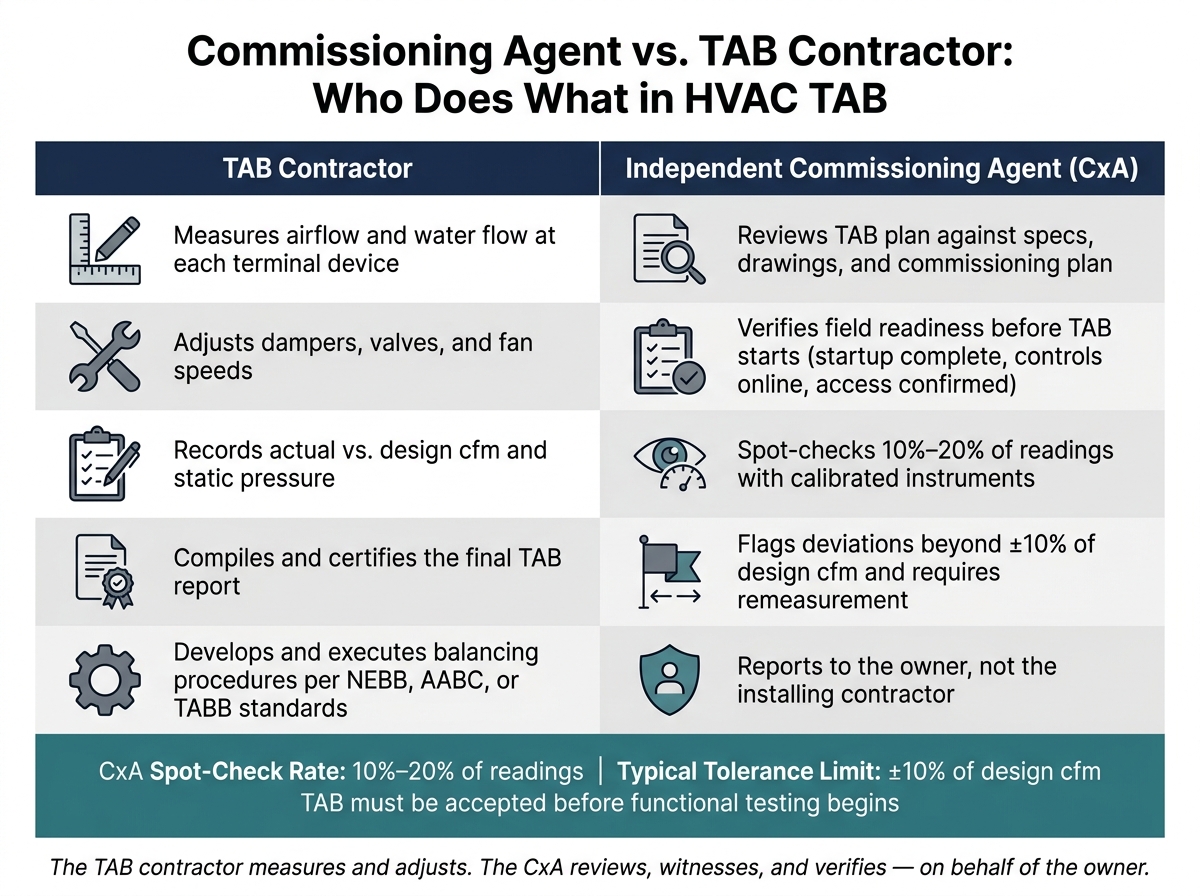
Commissioning Agent vs. TAB Contractor: Roles & Responsibilities in HVAC TAB
AABC TAB Talk: TAB Best Practices from the ACG Building Systems Commissioning Guideline
The Independent Commissioning Agent’s Role in the Building Commissioning Process
That owner-side reporting line gives the CxA some breathing room. Because the agent reports to the owner, not the teams doing the work, they can flag problems without getting squeezed by the people under review.
On the owner’s behalf, the CxA manages the commissioning process from a high level. That usually means reviewing design documents, checking that equipment startup was done properly, coordinating functional testing, and confirming that building systems work the way they’re supposed to before turnover. That separation is a big deal because commissioning and TAB are not the same job.
How Commissioning Differs from TAB
TAB is a narrow, field-driven process. A certified TAB contractor measures airflow and water flow, adjusts dampers and valves, and records the results against design values within the tolerances listed in the project documents. This work usually happens late in construction, after equipment has been installed and started up.
Commissioning begins much earlier – sometimes during schematic design – and can continue through the first year of occupancy. It covers design reviews, submittal reviews, startup verification, functional testing under actual operating conditions, and operator training. TAB results support commissioning tests, but they don’t replace them. The commissioning report treats TAB as one check among several.
Here’s how that split usually works:
| Task | Commissioning Agent (CxA) | TAB Contractor |
|---|---|---|
| Procedure Review | Reviews TAB plans and test forms against project specifications | Develops and executes balancing procedures per NEBB, AABC, or TABB standards |
| Measurement Verification | Witnesses selected readings and spot-checks results with calibrated instruments | Performs primary measurements, makes adjustments, and demonstrates readings to the CxA |
| Report Preparation | Reviews the TAB report for completeness and incorporates findings into the commissioning report | Compiles field data, adjustments, and final readings into a certified TAB report |
Why Third-Party Independence Matters on Construction Projects
When TAB results don’t match the design, the CxA looks at the issue and decides what kind of problem it is: installation-related, design-related, or still within the contract requirements. The agent can do that without bias because they don’t have money tied to the outcome.
That distance from the work also creates a clear paper trail. The CxA’s issue log and commissioning report show what was found, who owned the issue, and how it got fixed. That record can cut down on closeout disputes and gives the owner solid documentation before final inspection and building turnover. It also supports acceptance, turnover, and final approvals.
The Commissioning Agent’s Scope of Work in HVAC TAB
The CxA reviews TAB readiness, procedures, and results before balancing starts. Before TAB begins, the CxA checks the TAB plan against the project specifications, the commissioning plan, and the applicable TAB standard. That early review helps catch problems like missing zones, incomplete reporting templates, or procedures that don’t match how the systems are supposed to run in occupied, unoccupied, or economizer modes. It sets the baseline for what the team will verify in the field.
What the Agent Reviews Before TAB Starts
The document review goes beyond the TAB plan. The CxA cross-checks drawings, schedules, and approved submittals to make sure TAB lines up with the installed system, including any approved substitutions or changes. The CxA also reviews control sequences, because TAB data only means something when the system is operating in a stable mode.
Field readiness matters just as much as the paperwork. The agent verifies that equipment startup is complete and documented, that controls are installed and communicating, and that there is access to diffusers, VAV boxes, shafts, and other terminals. Permanent ductwork and piping should be installed, temporary conditions should be removed, and the building envelope should be substantially closed so pressure readings aren’t thrown off. If those conditions aren’t in place, the CxA does not approve TAB to start.
Once readiness is confirmed, the CxA can help the team schedule TAB without setting up avoidable rework.
How the Agent Supports TAB Scheduling and Sequencing
TAB needs to happen at the right point in the project timeline, not just whenever the TAB firm has an opening. Start too early, and technicians may balance systems under unstable conditions. That usually leads to rework. Wait too long – until after functional testing starts – and the test results may not hold up, because airflow rates still haven’t been verified.
The CxA uses coordination meetings and schedule reviews to keep TAB in the right slot: after startup and controls checkout, but before functional testing.
With the schedule in place, the CxA can shift from readiness checks to verifying the TAB results.
How the Commissioning Agent Reviews and Verifies TAB Results
Once TAB starts, the CxA moves from pre-checks into result verification. At this stage, the agent reviews submittals, checks the data against the design, and confirms key items in the field. That review starts during TAB, not after it, so mistakes can be fixed early instead of showing up later during functional testing.
The agent also compares the TAB report with the commissioning plan and equipment submittals. The goal is simple: make sure every system and operating mode that needs balancing has actually been covered before functional testing begins.
What the Agent Looks for in a TAB Report
The first review is a basic completeness check. The agent confirms that every terminal device shown on the drawings has a recorded airflow reading. The report should also show fan speed, actual vs. design cfm, static pressure, and the required control setpoints. System totals for supply, return, exhaust, and outside air should match the contract requirements, ventilation standards, and basis of design.
Pressure relationships get extra attention, especially in spaces where they matter most, like restrooms, isolation rooms, laboratories, and data rooms. A negative-pressure isolation room, for example, usually needs more exhaust than supply. The agent checks that the TAB report shows both the cfm difference and the measured room pressure in inches of water column. If a room that should be negative tests as neutral or positive, that gets flagged for correction.
The agent also checks current calibration records and stable test conditions. A nice-looking reading isn’t enough if the instruments weren’t currently calibrated. In the field, the agent usually spot-checks a sample instead of remeasuring the whole job. Standards often call for checking a small portion of the data, usually 10% to 20%. That sample usually centers on high-priority items like life safety systems, code-required pressurization, outside air intakes, key VAV boxes, and critical exhaust systems. The agent may witness selected readings such as AHU total flows, static pressure control values, outlet flows, and building or space pressures.
If those spot checks show deviations beyond project limits – often around ±10% of design cfm – the agent can require the TAB firm to remeasure larger parts of the system and turn in updated documentation.
| Verification Element | What the Agent Checks |
|---|---|
| Terminal device readings | Airflow at each outlet, inlet, and terminal unit vs. design cfm |
| System totals | Supply, return, exhaust, and outside air totals vs. design values |
| Fan data | Speed, static pressure, actual vs. design cfm |
| Pressure relationships | Room differentials in inches of water column for critical spaces |
| Calibration records | Instrument serial numbers and current calibration dates |
| Deficiencies section | Open issues, corrective actions, and unresolved notes |
When differences go past project tolerances, the agent logs the location, design value, reported value, verified value, and variance. Then the issue gets assigned to the right contractor and stays open until the fix is done and verified. Those open items then move into contractor coordination and retesting.
How TAB Results Affect Functional Testing and Project Closeout
Verified TAB results also affect when functional testing can start. Accepted TAB results often need to come first. Commissioning plans usually call for a substantially complete TAB report before major functional tests begin. That makes sense. If airflow is off, a controls sequence can look broken when the real problem is the balance.
Accepted TAB reports also support closeout, code documentation, and occupancy approval. If deficiencies are still open, acceptance or occupancy can be delayed until the corrections are retested and documented.
Coordination Between the Commissioning Agent, Contractors, Engineers, and TAB Firms
Once the TAB findings are in, the CxA turns those results into action across the project team.
The commissioning agent keeps TAB coordination on track among the contractor team, engineer, and TAB firm, while looking out for the owner’s interests and building performance. The mechanical contractor makes sure systems are ready for TAB and fixes issues found by the TAB firm or CxA. The controls contractor helps maintain stable test conditions in the BAS and updates sequences when TAB or commissioning shows something is off. The engineer of record checks TAB findings against the basis of design and issues clarifications if the installed system can’t reasonably hit the original targets. The TAB firm takes measurements, records the results, and delivers the final TAB report for commissioning review.
The CxA brings these groups together without doing their work for them or having a financial interest in the outcome. That role matters most when the TAB firm begins field work.
How the Commissioning Agent Works with the TAB Contractor
The CxA coordinates site access, controls settings, and report review with the TAB firm. The agent also works with the controls contractor to confirm stable BAS settings, including operating mode, static pressure reset, and minimum airflow. If TAB readings are taken under temporary overrides, the numbers won’t show how the system is meant to run.
Before field work starts, balancing tolerances should be set, with tighter limits for critical spaces. Once testing begins, the CxA asks for a draft TAB report before the final version goes out. That early review helps catch missing devices, inconsistent units, or open deficiencies before they linger. After that, the CxA checks that corrections were made and closes the issue log when the work is done.
Where Air Balance Masters Fits In
In day-to-day project work, certified TAB reporting gives the CxA the paperwork needed to track corrections and support closeout.
For projects in MD, VA, PA, NJ, NY, DE, and DC, Air Balance Masters provides certified TAB testing, reporting, and certification that support commissioning and closeout.
Key Takeaways on the Independent Commissioning Agent’s Role in TAB
The main point is straightforward: the CxA turns TAB data into verified commissioning evidence. Because the CxA works independently, their review of airflow, pressure, and report data gives owners unbiased proof that the system is doing what it should.
TAB confirms measured airflow and water flow. Commissioning checks system performance as a whole. Once that line is clear, the CxA’s role is to verify the data, not redo the balancing work.
In practice, the CxA checks system readiness, spot-checks key readings using specialized air balancing tools, and flags unresolved variances before closeout. That matters because draft-stage issues are usually much easier to fix than defects found at the end of the job.
Those verified results then become part of the project record and help support closeout. Verified TAB results support commissioning sign-off and closeout, providing documented evidence that HVAC systems meet ventilation and performance requirements under codes like ASHRAE 62.1 and 90.1 – and become part of the building record for future maintenance, warranty claims, and energy audits.
FAQs
When should TAB start on a project?
TAB should be part of the project from day one, before design work even gets rolling. When TAB teams review plans and duct drawings early, they can spot problems while they’re still easy to fix – things like equipment that won’t be reachable later or layouts that can’t be tested in the field. That kind of early input can cut down on costly construction mistakes.
That said, the actual testing, adjusting, and balancing work belongs much later in the process. It should happen only after all mechanical systems are fully installed, up and running, and operating under design conditions. In practice, that means TAB takes place before final inspections and before a Certificate of Occupancy is issued.
What happens if the CxA finds TAB errors?
If a Commissioning Agent or TAB technician spots a problem, they document the gap by comparing field measurements with the original design specs. They also add narrative notes that explain what went wrong and what corrective action was taken.
If an imbalance still isn’t fixed, those notes give the Engineer of Record a clear starting point for working out the next step. Air Balance Masters supports that work with detailed deficiency reports and root cause analysis, helping teams fix issues without wasting time.
Can functional testing begin before TAB is accepted?
No. Functional performance testing is not complete without TAB, because TAB is a required part of commissioning.
Pre-functional checklists can show that equipment is running and ready for testing. But that alone doesn’t close the loop. You still need a completed, accepted TAB report to verify system flows and confirm that performance matches the design.


