


If smart HVAC parts can’t share data the same way, your BAS, analytics, and TAB work all get harder. In most U.S. buildings, the fix comes from using a simple standards stack: BACnet for device communication, Haystack/Brick/223P for data meaning, OpenADR/CTA-2045 for grid response, and 62443 plus BACnet conformance testing for security and device behavior.
Here’s the short version in plain English:
- BACnet is still the main open protocol for commercial HVAC in the U.S.
- Modbus is common for meters, VFDs, and older gear, but it often needs extra mapping.
- KNX is often used for room control and lighting, then linked back to BACnet.
- Semantic models like Project Haystack, Brick, and ASHRAE 223P help software read point data correctly.
- OpenADR and CTA-2045 let HVAC and related equipment react to utility demand-response signals.
- ISA/IEC 62443, ASHRAE 135.1, and Guideline 13 help with network security, segmentation, testing, and access control.
- For field work, these standards help connect BAS trends, commissioning checks, and TAB readings with less manual cleanup.
A few numbers stand out:
- AHRI 1380 uses about 70% of rated load as a general curtailment target for demand response.
- One Southern California Edison VRF project reported about 15% to 25% average demand reduction during 1- to 2-hour events at around 95°F.
What this means for you is simple: device communication alone is not enough. You need both devices that can exchange messages and data that means the same thing across systems. That’s what makes mixed-brand HVAC setups easier to test, trend, verify, and maintain over time.
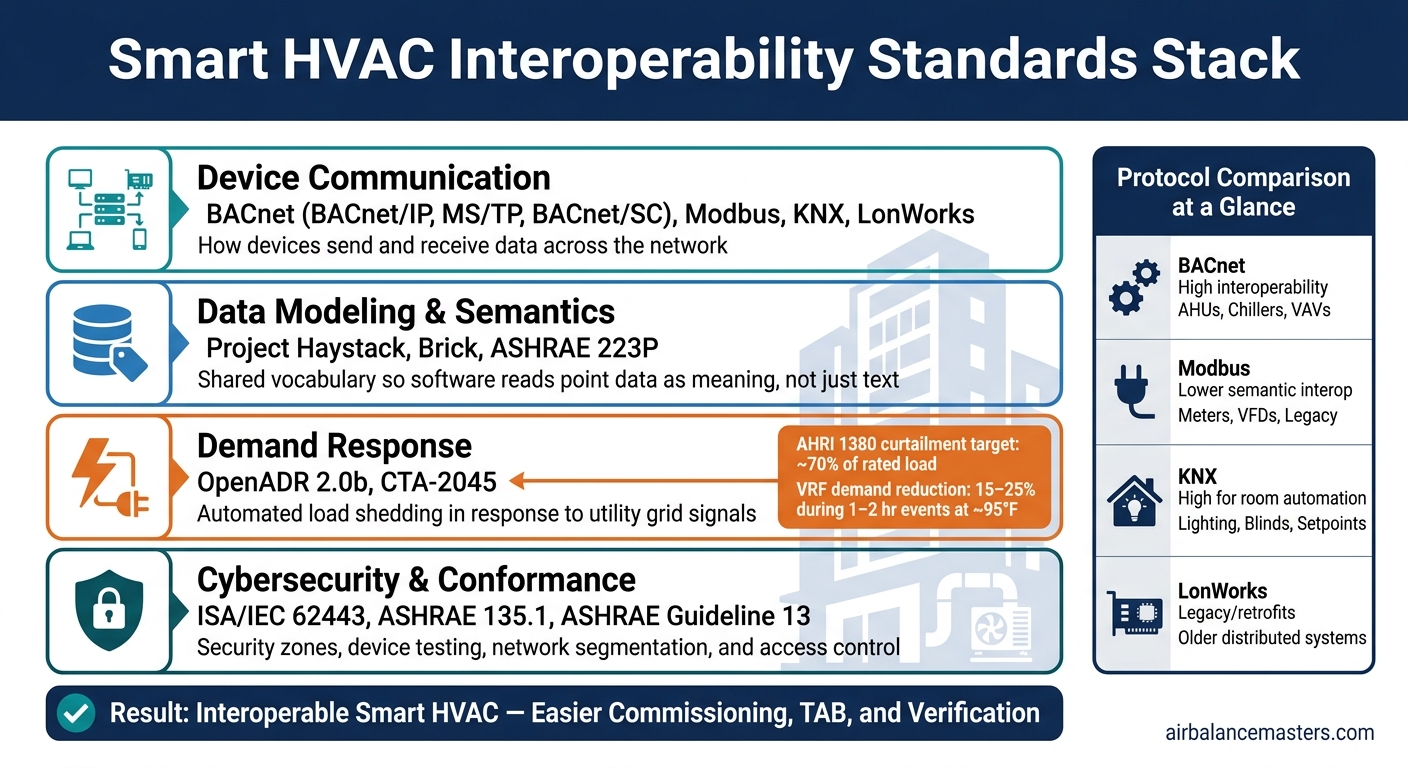
Smart HVAC Interoperability Standards Stack: Protocols, Data Models & Security
Quick comparison
| Standard/group | Main job | Where it fits |
|---|---|---|
| BACnet | Device communication for BAS | AHUs, chillers, VAVs, controllers, front end |
| Modbus | Simple device data exchange | Meters, VFDs, older plant equipment |
| KNX | Room-level control communication | Lighting, blinds, room setpoints |
| Haystack / Brick / 223P | Data naming and meaning | Analytics, dashboards, commissioning tools |
| OpenADR / CTA-2045 | Demand-response communication | Utility events, load shed, connected equipment |
| ISA/IEC 62443 / 135.1 / Guideline 13 | Security and conformance | Network design, device testing, remote access |
If I had to boil the article down to one point, it’s this: smart HVAC works best when communication, data structure, demand response, and security are planned together from design through closeout and ongoing maintenance.
Core Communication Standards Used in Smart HVAC
Smart HVAC systems only work well together when they speak the same language. That language comes from communication protocols.
Protocols set the rules for how devices package data, send it, and read it on the other end. So when teams pick a protocol, they’re not just choosing a wiring or network method. They’re setting the base for every other standard that comes after it.
BACnet: The Primary Open HVAC Standard
BACnet, defined by ANSI/ASHRAE Standard 135 and ISO 16484-5, is the main open protocol for commercial building automation in the U.S. Its object-based data model turns HVAC functions into standardized objects with defined properties. In plain English, that makes points more self-describing and cuts down on guesswork during integration, helping ensure HVAC design intent is realized.
Different BACnet versions serve different parts of a system. BACnet/IP is common on building backbone networks. BACnet MS/TP is common for field controllers on serial trunks. BACnet Secure Connect (BACnet/SC) is used when IT teams or owner cybersecurity rules call for secure, authenticated communications. BACnet/SC adds certificate management and calls for network infrastructure that supports it. On most jobs, BACnet/IP handles the backbone and BACnet MS/TP handles the field trunks.
That said, BACnet interoperability doesn’t come from the word "BACnet" by itself. It depends on device profiles and BIBBs. Profiles in Annex L, such as B-BC, B-AAC, B-ASC, B-SS, and B-SA, give specifiers a way to ask for a defined set of device functions from vendors. A device’s PICS spells out what that device supports, which helps during commissioning when teams need to check a device before tying it into the system.
BACnet still has limits. It handles transport and object structure, but naming, shared models, and secure data exchange need other standards layered on top.
How Modbus, LonWorks, and KNX Compare
No single protocol fits every device in a building. That’s why many projects use more than one.
Modbus is still common for meters, VFDs, and older plant equipment. But there’s a catch: register meanings come from vendor-specific maps. So teams usually need register mapping, point list documentation, and gateway setup in the commissioning scope. Base Modbus also has no built-in security, which is why it usually stays on isolated network segments.
LonWorks shows up mostly in older BAS installations and retrofit work. In new commercial construction, it’s much less common today. KNX, on the other hand, is strongest in room automation and often connects back to BACnet when a site needs central control.
A common U.S. building setup looks like this:
- BACnet as the backbone
- Modbus for meters and older equipment
- KNX where room automation or lighting integration matters most
Those pieces are usually tied together through gateways or multi-protocol controllers.
| Protocol | Interoperability | Typical U.S. Applications | Security Considerations | Commissioning Implications |
|---|---|---|---|---|
| BACnet | High; object-based model and standardized profiles support multi-vendor integration | AHUs, chillers, VAV boxes, BMS backbone | Base BACnet/IP lacks modern encryption; BACnet/SC adds TLS and certificates | Best choice for new commercial BAS; profile specs reduce integration ambiguity |
| Modbus | Lower semantic interoperability; register meanings are vendor-specific | Meters, VFDs, legacy plant, simple I/O | Base protocol has no built-in security | Requires careful register mapping, point lists, and gateway setup |
| LonWorks | Moderate in legacy systems, but less common in new work | Older distributed control systems, retrofits | Security is limited or implementation-dependent in legacy deployments | Usually a legacy integration task in modern projects |
| KNX | High for room automation and standardized datapoints | Lighting, blinds/shading, room control, some HVAC setpoints | Secure extensions exist | Strong for repeatable room-level commissioning, usually bridged to BACnet for central control |
The next layer shifts from communication rules to shared data models and cybersecurity requirements.
Data Modeling, Grid Response, and Cybersecurity Standards
Protocols move data. But data still needs structure, context, and protection before it can do much good. That’s where semantic standards, demand-response standards, and cybersecurity standards come in. They sit above the communication protocols discussed earlier and make the data both useful and secure.
Project Haystack, Brick, and ASHRAE 223P Explained
Semantic standards fix a common building problem: the same point can show up under different names in different systems. One platform might call it SAT. Another might label it Supply_Air_Temp. A third might use something even less obvious. Semantic standards solve that mess by giving every point, piece of equipment, and site a shared structure and vocabulary.
Project Haystack uses a tag-based model built around three core entity types – site, equip, and point. Tags are then added for more detail, such as ahu, vav, zone, temp, and sensor. That setup standardizes names and relationships for commissioning, fault detection, reporting, and HVAC optimization.
Brick takes a different path. It uses a formal RDF/ontology graph model to describe equipment, sensors, and their relationships in a machine-readable format. In plain English, software can understand how systems connect without a pile of custom scripts.
ASHRAE 223P is the emerging formal standard for semantic building data models. It uses Semantic Web technologies to unify and formalize interoperability across systems.
| Standard | Approach | Primary Role |
|---|---|---|
| Project Haystack | Tag-based metadata dictionary | Standardizes point names and equipment labels for human and software readability |
| Brick | RDF ontology / graph model | Models equipment relationships for automated analysis and portable analytics |
| ASHRAE 223P | Formal semantic standard using Semantic Web technologies | Unifies and formalizes data models for structured interoperability across systems |
Put simply, these standards help software read point data as meaning, not just as strings of text.
OpenADR and CTA-2045 for Demand Response
Smart HVAC doesn’t just react to setpoints inside the building. It can also react to signals from the utility grid.
OpenADR is the protocol that makes automated demand response work at the building level. When a utility sends a demand-response event, a building management system can shift load through pre-cooling, deadband changes, reduced ventilation where allowed, and staged equipment limits. The goal is simple: cut peak load while keeping the building comfortable and code-compliant.
CTA-2045 defines a modular port for plug-in communication modules on equipment like water heaters, HVAC units, and pool pumps. That may sound minor, but it solves a real problem. If communication tech changes later, the module can change without replacing the whole appliance.
California Title 24 requires demand-responsive controls in certain applications to be capable of receiving and automatically responding to at least one standards-based messaging protocol such as OpenADR. Recent U.S. residential energy code guidance also calls for CTA-2045 or an equivalent communication link for certain demand-responsive electric water heaters.
For HVAC, AHRI Standard 1380 recognizes OpenADR 2.0b and CTA-2045 as compliant demand-response pathways. It also defines general curtailment to about 70% of rated load, with support for critical curtailment, off mode, temperature offset limits, and manual override.
| Standard | Communication Model | Typical HVAC Application | Compliance Relevance |
|---|---|---|---|
| OpenADR | Two-way utility-to-building signaling | Automated peak-load reduction, setpoint offsets, equipment staging | Used for standards-based demand-response signaling in code- and utility-driven programs |
| CTA-2045 | Modular port with plug-in communication modules | Connected appliances, water heaters, smaller HVAC equipment | Provides a standardized interface for demand-response communication |
This becomes a big deal when controls must react to grid events automatically, without extra field rework.
ISA/IEC 62443, ASHRAE 135.1, and Guideline 13 for Cybersecurity and Conformance
More interoperability means more places for something to go wrong. More devices, more gateways, more remote access, more cloud links. That also means more attack surface.
ISA/IEC 62443 tackles that problem head-on. It is a cross-industry cybersecurity standard suite for industrial automation and control systems. It covers security zones and conduits, security levels, and both system and component requirements. In smart HVAC, that matters because BACnet/IP networks, cloud dashboards, remote access gateways, and analytics platforms all add exposure.
ASHRAE 135.1 focuses on BACnet conformance testing. Two products can both say BACnet on the label and still fail to work together if they do not implement the same services and objects correctly. Conformance testing through BACnet Testing Laboratories checks whether a device does what its PICS says it does, including newer features such as BACnet/SC WebSocket behavior and security timeouts.
ASHRAE Guideline 13 adds practical BAS guidance. It covers network segmentation, firewalls, VPNs, strong credentials, and patching practices. In day-to-day project work, it serves as BAS specification guidance for segmentation, firewalls, VPNs, credentials, and patching.
| Standard | Primary Focus | Relevance to Smart HVAC |
|---|---|---|
| ISA/IEC 62443 | Cybersecurity for industrial automation and control systems | Defines security zones, levels, and requirements for BAS networks and components |
| ASHRAE 135.1 | BACnet conformance testing | Verifies that BACnet devices implement claimed services correctly and reduces multi-vendor integration risk |
| ASHRAE Guideline 13 | BAS design and specification best practices | Provides practical guidance on network architecture, segmentation, and operator access controls |
These standards show up in a very practical way during commissioning and TAB, when teams check point names, device behavior, and secure access.
What These Standards Mean for Commissioning and TAB
How Interoperability Improves Testing and Verification
When the protocol and data model are set up the right way, commissioning gets a lot more practical in the field. At that point, these standards stop being lines in a spec and start working like day-to-day checks.
With open protocols and shared point naming, commissioning teams can connect test templates to tagged points instead of mapping every device by hand. The data model already tells the team what each point is supposed to mean. That makes it easier to line up live BAS trends with TAB measurements and check sequences in a single view.
Here’s why that matters: if diffuser airflow doesn’t match BAS data, an interoperable system can help the team narrow the problem down faster. The issue may be the sensor, the damper, or the controls. Standardized alarms also make it easier to spot failed actuators, offline devices, and sensor faults before final signoff.
Why Certified Air Balancing Still Matters
That said, interoperable BAS data helps the process, but it doesn’t certify the result. TAB is still the step that connects digital data to how the building is actually performing.
Open standards can speed up commissioning, but they can’t replace field verification. Certified TAB professionals check actual airflow, pressure, and outdoor air delivery with calibrated instruments. BAS trend logs help support that work, but they do not replace the documentation that AHJs use for occupancy approval.
Air Balance Masters provides certified air balance testing, reporting, and certification across MD, VA, PA, NJ, NY, DE, and DC. On BACnet-based projects, standardized point tags make live data easier to use in balancing reports.
Conclusion: Key Standards That Make Smart HVAC Work Together
These standards work best as a stack, not as separate tools. Smart HVAC interoperability depends on four layers:
- BACnet for communication
- Haystack/Brick/223P for meaning
- OpenADR/CTA-2045 for grid response
- 62443/135.1 for security and conformance
That shows up in actual projects, not just on paper. In one Southern California Edison VRF project, Capacity Limit events cut average demand by 15% to 25% during 1- to 2-hour events at about 95°F, with minimal indoor temperature impact. Results like that rely on interoperable communication from the utility signal all the way down to the equipment response.
Cybersecurity and conformance round out the stack. When communication, data models, response, and security line up, interoperability becomes more dependable.
For commissioning and TAB certification, that means simpler verification and clearer closeout. When these standards are written into the project from design through closeout, commissioning teams can work from consistent point lists, and TAB measurements can tie back to standardized point values like airflow in cfm and temperature in °F. That makes reports easier to read now and years later. Requiring these standards in construction documents also helps schedule reliability and protects operating performance.
Air Balance Masters can help translate standardized point naming and structured data into clearer TAB documentation for projects in MD, VA, PA, NJ, NY, DE, and DC.
FAQs
How do I choose the right HVAC interoperability standards?
Focus on open protocols that help system parts talk to each other cleanly and work with your current building management system. Put BACnet and Modbus at the top of the list for steady, dependable data sharing.
It also helps to think ahead. Buildings change, systems get added, and needs shift over time. So choose standards that can grow with the building and handle future updates without turning into a headache later.
Your standards should also line up with your sustainability goals. And just as important, your technical team should work closely with IT to keep cybersecurity in check and make sure the network can support everything without conflicts.
Do I need semantic tagging if my BAS already uses BACnet?
Yes. Semantic tagging still matters even if your BAS uses BACnet.
BACnet lets devices talk to each other. But it doesn’t make data points self-describing or consistent from one vendor to the next.
That’s where semantic tagging comes in. It adds context, so the system can identify points the right way. That leads to clearer analytics, more consistent reporting, and better alignment with design intent.
How do these standards affect commissioning and TAB?
These standards shape commissioning and TAB by spelling out how systems are measured, calibrated, and documented to show they match the design intent and meet code and regulatory requirements.
They also help keep airflow, pressure, and hydronic flow within the required tolerances. That matters during inspections, supports Certificates of Occupancy, and gives certified proof that systems are balanced and working as they should.


