


Balancing multi-zone HVAC systems is a challenge, but the right tools make the job easier. Accurate airflow regulation ensures energy efficiency, meets performance standards, and improves comfort. Here’s a quick breakdown of the essential tools for this task:
- Manometers: Measure duct pressure to assess fan performance and identify issues like duct leakage.
- Anemometers: Provide airflow velocity readings. Rotating vane models work well for large grilles, while hot-wire versions are ideal for low-velocity flows.
- Flow Hoods: Verify terminal airflow, ensuring compliance with ASHRAE standards.
- Micromanometers: Offer precise pressure readings, crucial for sensitive environments like hospitals and labs.
- Pitot Tubes: Measure airflow in trunk ducts and help with duct traverses.
- Smoke Pencils: Visualize airflow patterns to locate leaks or stagnant zones.
- Thermal Imaging Cameras: Spot temperature inconsistencies, helping diagnose airflow or insulation issues.
- Balancing Dampers: Regulate airflow volume for each zone, with manual, motorized, and self-regulating options.
- Hygrometers: Measure humidity and temperature to troubleshoot comfort issues and verify system performance.
Investing in the right tools ensures HVAC systems operate efficiently, reduce energy costs, and maintain consistent temperatures across zones. Whether you’re working on residential or commercial systems, these tools simplify the balancing process while delivering reliable results.
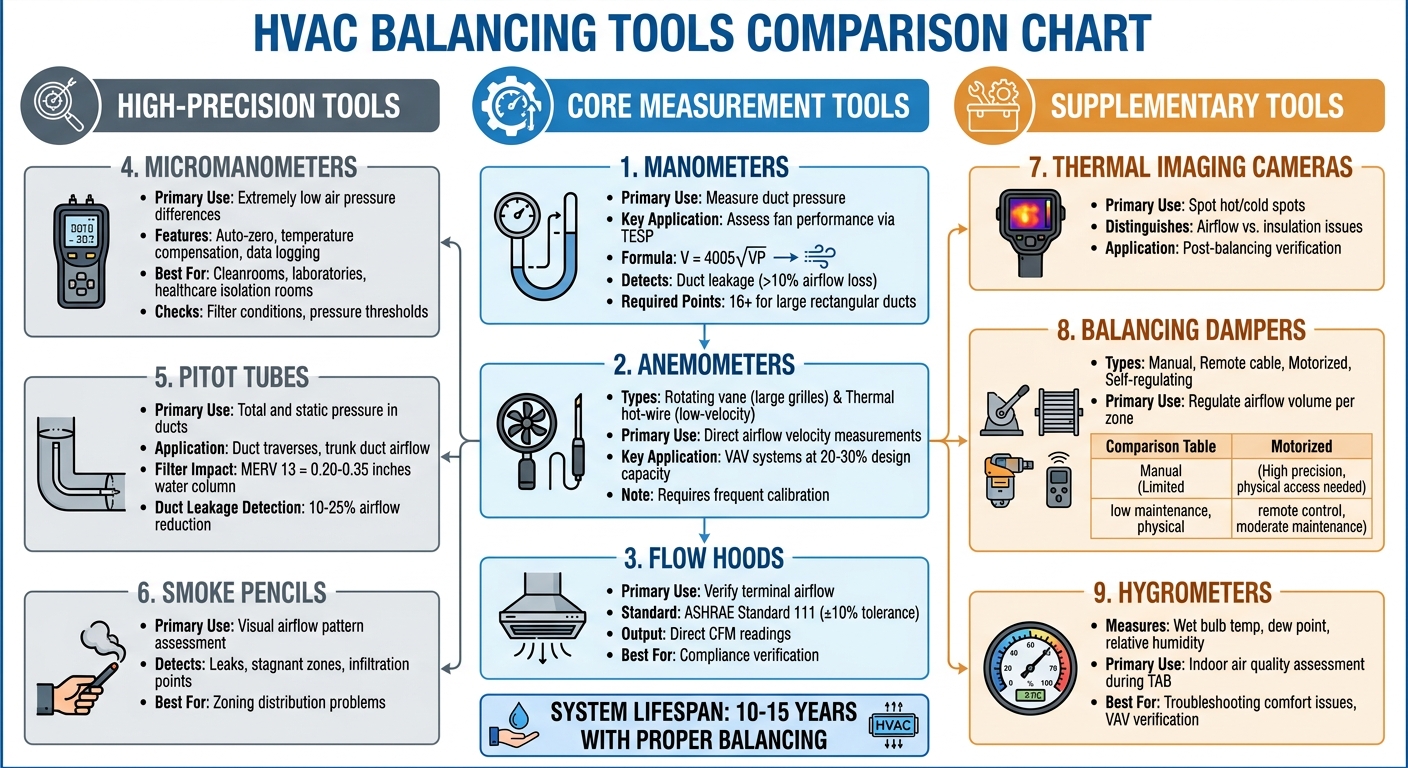
HVAC Balancing Tools Comparison: Features and Applications
Balancing HVAC Designs & Installations: Duct/Grille Airflows & Zoning Choices w/ Alex Meaney
Core Tools for Multi-Zone HVAC Balancing
When it comes to air balancing, three key tools are indispensable: manometers, anemometers, and flow hoods. Each of these instruments plays a unique role in measuring and verifying airflow distribution, helping technicians address specific challenges in HVAC balancing.
Manometers
Manometers, especially those paired with Pitot tubes, are used to measure duct pressure, which is then converted into velocity using the formula: V = 4005√VP. These readings are crucial for assessing fan performance by measuring Total External Static Pressure (TESP). This process can uncover issues like duct leakage, which can lead to airflow losses exceeding 10%. For larger rectangular ducts, accurate trunk duct traversals require at least 16 measurement points, using either the log-linear or log-Tchebycheff method, depending on the duct’s shape.
Anemometers
Anemometers complement manometers by providing direct airflow velocity measurements. There are two main types:
- Rotating vane anemometers: These are well-suited for measuring velocity at large grilles. However, to calculate total CFM, technicians must perform multi-point traversals and manual calculations.
- Thermal (hot-wire) anemometers: These are highly sensitive and ideal for measuring low-velocity airflows. They are particularly useful for ensuring Variable Air Volume (VAV) systems maintain setpoints at 20–30% of their design capacity. However, their sensitivity to temperature and humidity means they require frequent calibration.
Flow Hoods
Flow hoods are used to verify terminal airflow and ensure compliance with ASHRAE tolerances. By fully capturing air from diffusers or grilles, these tools provide direct CFM readings. This makes them invaluable for confirming that each zone meets design specifications within a tolerance of ±10%, as outlined in ASHRAE Standard 111. However, their accuracy can diminish when used with multi-cone or high-induction diffusers, which often have uneven velocity profiles. In such cases, using manufacturer-provided K-factors can improve accuracy.
High-Precision Tools for Air Balancing
When standard tools fall short of delivering the accuracy required for sensitive environments or complex multi-zone systems, specialized air balancing tools step in. These instruments are essential for fine-tuning HVAC performance and meeting strict design requirements.
Micromanometers
Micromanometers are built to measure extremely low air pressure differences, which are crucial for airflow balance, ventilation adjustments, and maintaining room pressurization in spaces like cleanrooms and laboratories. Unlike standard manometers, they use high-resolution, low-noise sensors to provide the stability needed for precise measurements.
Many models come equipped with advanced features such as automatic calculations for volumetric flow rate, air velocity, and density corrections, making the process simpler and more efficient. Functions like auto-zero and temperature compensation ensure consistent readings, even in varying environmental conditions. Additionally, integrated data logging captures measurements with time stamps, job tags, and site identifiers, making it easier to generate professional reports. Some devices even offer wireless connectivity, allowing technicians to sync data directly to mobile apps while on-site.
Micromanometers are particularly useful for checking static pressure at fans, filters, and coils to evaluate filter conditions and the impact of system components on energy consumption. In regulated environments like healthcare isolation rooms or labs, they confirm directional airflow and document pressure thresholds. For accuracy, always apply density adjustments when working in areas with fluctuating temperatures or altitudes.
For even more precise pressure measurements, technicians often incorporate Pitot tubes into their balancing workflow.
Pitot Tubes
Pitot tubes are essential for measuring both total and static pressure within ducts. By calculating velocity pressure, they provide critical insights into airflow in trunk ducts before it reaches terminal points. Before conducting a duct traverse, verify that all system components – such as duct connections, filters, and fans – align with design specifications.
These tools are particularly effective for performing accurate duct traverses, helping technicians assess airflow while making adjustments to branch dampers that influence overall static pressure. Start by identifying the index terminal, which is typically the terminal with the highest design CFM demand relative to available static pressure. This terminal is often the one farthest from the fan.
When interpreting velocity pressure readings, consider factors like pressure drops caused by high-MERV filters (typically 0.20 to 0.35 inches of water column for MERV 13) and duct leakage, which can reduce airflow by 10% to 25%.
Smoke Pencils
Smoke pencils provide a straightforward, visual way to assess airflow patterns. They are invaluable for diagnosing airflow issues and identifying leaks or stagnant zones in multi-zone systems. These tools are particularly helpful for spotting zoning distribution problems that might not be obvious from pressure or velocity data alone.
Technicians use smoke pencils to trace air movement around diffusers, grilles, and duct connections. This helps verify that air is flowing as intended, locate unwanted infiltration points, and identify areas where air stagnates. By complementing numerical data, smoke pencils add another layer of confirmation to ensure the system is performing as expected.
Supplementary Tools for HVAC Balancing
While the primary tools measure airflow and pressure, supplementary instruments play a crucial role in verifying and fine-tuning the performance of a balanced HVAC system. These tools help ensure everything is functioning as intended and allow for precise adjustments.
Thermal Imaging Cameras
Thermal imaging cameras are incredibly useful for spotting hot or cold spots in a building – common signs of system imbalance or deterioration. After completing initial balancing, technicians use these cameras to confirm that temperatures are consistent across all zones.
These cameras also help distinguish between airflow problems and insulation issues. For instance, a cold spot might indicate poor airflow to a specific zone, or it could point to an insulation gap unrelated to the HVAC system. By scanning walls, ceilings, and ductwork, technicians can identify problem areas, making these cameras especially helpful when addressing comfort issues in specific rooms or zones.
When combined with other balancing tools, thermal imaging enhances system performance diagnostics.
Balancing Dampers
Balancing dampers are installed within ductwork to regulate and balance airflow to different zones. These devices allow technicians to fine-tune airflow distribution effectively.
- Manual dampers are adjusted directly by hand and work well in easily accessible areas.
- For harder-to-reach locations, remote control cable systems use flexible cables, enabling adjustments from a wall-mounted control without requiring electricity.
- Motorized dampers provide precise control and can integrate with building management systems for automated adjustments. This level of automation is a hallmark of smart HVAC systems used in modern facility management. However, they do require electrical connections and regular actuator maintenance.
- In specialized environments like hospital isolation rooms or laboratories, self-regulating dampers (e.g., the Precision/Flow™ 0153) automatically maintain constant airflow, even when duct pressure fluctuates.
| Feature | Manual Dampers | Automated/Motorized Dampers |
|---|---|---|
| Control Precision | Limited to manual or cable control | High; motorized settings are repeatable |
| Accessibility | Requires physical access or cables | Controlled remotely via management systems |
| Maintenance | Low; durable mechanical components | Moderate; requires electrical checks |
| Best Use Case | Areas where motorization isn’t needed | Zones needing frequent or automated adjustments |
For monitoring environmental conditions, hygrometers are another key tool.
Hygrometers
Hygrometers measure wet bulb temperature, dew point, and relative humidity, helping assess indoor air quality during the Testing, Adjusting, and Balancing (TAB) process. Often built into multi-function anemometers, they are essential for troubleshooting comfort issues and verifying that Variable Air Volume (VAV) systems meet design standards across various zones.
These devices help determine whether discomfort is caused by airflow issues or moisture imbalances. They also provide accurate data for compliance and performance checks. Some advanced hygrometers can measure air density and barometric pressure, which are critical for calculating precise flow rates and overall system performance. Many systems now integrate with mobile apps, allowing technicians to tag specific zones, take notes, and create detailed digital reports tailored to client needs.
Match the tool to the multi-zone job
Balancing multi-zone HVAC systems requires the right tools to ensure precise airflow regulation. From simple manometers to advanced thermal imaging cameras, each tool plays a critical role. The difference between "good enough" and truly effective balancing often lies in the quality of the tools and how well they are used.
Investing in high-quality equipment pays off in multiple ways: improved energy efficiency, compliance with regulations, and enhanced occupant comfort. Precise airflow regulation significantly boosts energy efficiency, reducing operating costs over the system’s 10–15-year lifespan. Regulatory compliance becomes easier with NIST-calibrated tools that offer documented accuracy – particularly important in environments like hospitals, laboratories, and clean rooms where airflow consistency is crucial. And, of course, occupant comfort improves when hot and cold spots are eliminated, maintaining consistent temperatures across all zones.
"Balancing dampers in ductwork allow technicians to adjust airflow volume for each zone, improving overall system performance and energy efficiency."
Professional-grade tools are an investment that delivers long-term savings. Whether it’s entry-level capture hoods or high-precision models, these instruments provide the accuracy needed to tackle the complexities of modern systems. Designed for daily use, they offer reliable performance even in challenging conditions with turbulent airflow.
For HVAC professionals, the real question is not whether to invest in quality balancing tools, but which combination of instruments best fits their specific needs. Whether you’re working on residential systems or critical commercial environments, having the right equipment ensures systems operate efficiently, meet performance standards, and provide lasting comfort for occupants.
For expert advice on achieving precise airflow balancing, reach out to Air Balance Masters.
FAQs
Which tool should I start with for balancing a multi-zone system?
To get started, you’ll need a precision airflow measurement tool, such as a flow hood or an anemometer. These devices give you accurate airflow readings for each zone, making it easier to spot areas that may need adjustments. Begin by measuring airflow in all zones, then fine-tune dampers or controls based on the data. Using precise measurements from the start sets the stage for a smoother and more effective balancing process.
How can I tell if low airflow is due to duct leakage or a dirty filter?
To figure out why airflow is low, start by inspecting the filter. If cleaning or replacing it makes a noticeable difference, then the filter was likely the problem. If there’s no improvement, the issue could be duct leakage or something else. Tools like flow hoods can help measure airflow at different points in the system, and it’s also a good idea to check duct connections for any leaks.
When do I need a micromanometer instead of a standard manometer?
A micromanometer is used to measure extremely small pressure differences in HVAC systems. These devices are designed with high sensitivity to deliver precise readings, making them perfect for tasks that demand accurate measurement of minimal pressure variations.
More guides on TAB and air balancing
- Air Balance Certification: A Guide for Contractors
- How to Prepare HVAC Systems for Air Balance Testing
- Commercial vs. Residential Air Balance Testing
- Pre-Test Checklist: Air Balance Requirements
Need the full contractor toolkit? See essential air balancing tools for HVAC contractors.


