


NEBB-compliant TAB reports are crucial for ensuring HVAC systems meet design standards and regulatory requirements. Without following NEBB Standards, contractors risk project delays, rejected submissions, and costly rework. This guide simplifies the process by outlining the key steps for compliance.
Key Points:
- Certification Requirements: Confirm NEBB certification for your firm and personnel, including valid certifications for Certified Professionals (CPs) and Technicians (CTs).
- Project Documentation: Gather all necessary documents like construction drawings, design specs, and TAB contract details. Highlight stricter contract requirements if they exceed NEBB standards.
- Instrument Calibration: Ensure all tools have up-to-date calibration certificates submitted on time to avoid penalties.
- Report Essentials: Include firm and personnel details, pre-TAB documentation, field data for air and hydronic systems, and summaries of deficiencies and resolutions.
- Final Submission: Conduct quality checks, verify compliance with NEBB, ASHRAE, and SMACNA standards, and prepare digital reports with supporting analysis and graphics.
By following these steps, you can streamline inspections, secure occupancy approvals, and avoid unnecessary delays or expenses.
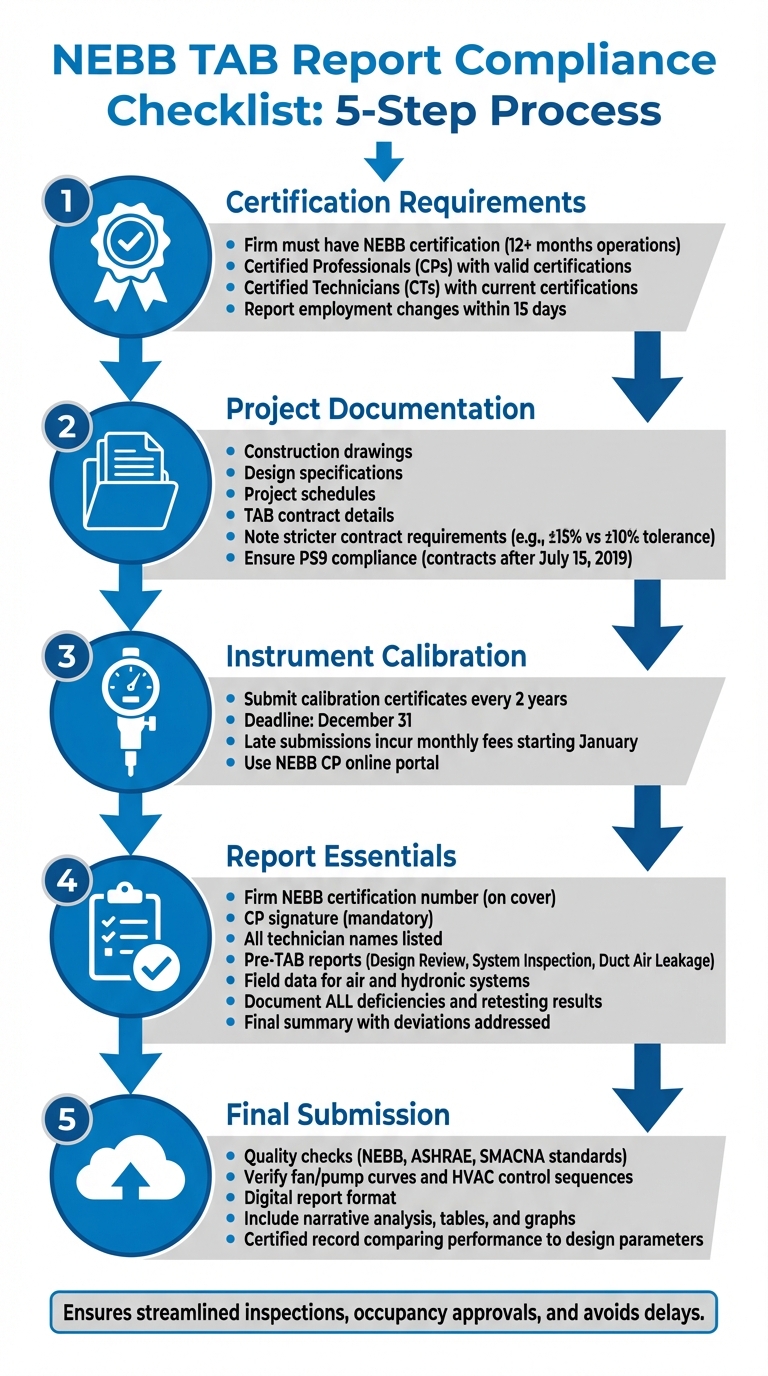
NEBB TAB Report Compliance Checklist: 5-Step Process
5. Testing and Balancing: Why Does it Matter?
Preparation and Documentation Requirements
When drafting a NEBB-compliant TAB report, it’s essential to ensure all certifications and documentation are in order. This helps avoid potential delays or rejections. Below, you’ll find the key steps: confirming certifications, gathering project documents, and verifying instrument calibration records.
Verify NEBB Certification and Personnel Qualifications
First, confirm that your TAB firm holds NEBB certification. This requires at least 12 months of full-time TAB operations, six endorsement letters (five from engineers, architects, or owners, and one from a contractor), active affiliation with a local NEBB Chapter, and all required instruments verified during certification.
Additionally, each Certified TAB Professional (CP) must have a valid certification – for example, one valid through 12/31/2026 – to manage, prepare, review, and sign off on final reports. Certified Technicians (CTs) must also maintain current certifications. If there are changes in employment, these must be reported within 15 days. For firms with multiple office locations, each office offering NEBB services must have a full-time Designated CP in a management role.
Gather Project Documents
Before starting the report, collect all necessary project documents. This includes construction drawings, design specifications, project schedules, and details of the TAB contract. Pay close attention to any specifications that exceed NEBB standards. For example, a contract might specify a ±15% airflow tolerance instead of NEBB’s ±10% or require testing only for AHU capacity without downstream TAB. In such cases, the stricter contract requirements take precedence and must be highlighted in the report summary.
For contracts signed after July 15, 2019, with reports issued after January 1, 2020, ensure compliance with NEBB Procedural Standard 9th Edition (PS9). After gathering all documents, confirm that your TAB instruments meet current calibration standards.
Check Instrument Calibration Records
To maintain data accuracy, submit up-to-date calibration certificates and recertification packages every two years through the NEBB CP’s online portal. These submissions are due by December 31. Late submissions incur monthly fees starting in January, and annual fees must also be paid by December 31 to keep the certification in good standing.
NEBB TAB Compliance Checklist
When your documentation is ready, make sure your TAB report includes all required elements outlined in the NEBB Procedural Standard. According to NEBB, "Unless so delineated, all testing and reporting requirements of this standard are considered mandatory under the reporting criteria section". This means anything not explicitly marked as "recommended" must be treated as mandatory.
Include TAB Firm and Personnel Information
Your report must display the firm’s NEBB certification number prominently, either on the cover or an information page. Additionally, a NEBB Certified Professional (CP) must review and sign the final report. This signature is essential – it confirms compliance and is a required step for certification. Be sure to list the names of all technicians involved in the project and in gathering field data. This level of transparency ensures accountability and fulfills NEBB’s personnel documentation standards. Start by compiling preliminary documentation as part of your HVAC optimization strategy before moving to the final testing phase.
Pre-TAB Reports and Initial Testing Documentation
After recording firm and personnel details, focus on assembling baseline documentation. This includes preliminary reports for Design Review Reports, System Inspection Reports, and Duct Air Leakage Test results. These documents, prepared by the NEBB Certified TAB Supervisor, establish the system’s initial conditions and help identify potential issues early. By addressing these early, you can avoid delays during the final testing process and ensure the system is ready for balancing procedures.
Document Field Data for Air and Hydronic Systems
For air and hydronic systems, record test measurements for equipment like fans, VAV boxes, and pumps according to NEBB standards. Field data reports are broken into two parts: standards (minimum requirements) and procedures (measurement methods). Use instruments that align with NEBB’s accuracy and range standards, as detailed in the "Standards for Instrumentation and Calibration" section. Keep in mind that contract specifications might require stricter standards than NEBB’s minimums.
Report Deficiencies and Retesting Results
It’s essential to document all deficiencies identified during testing. Clearly list each issue, and follow up with retesting data to show how the problems were resolved. This step demonstrates that corrections were made and that the system now aligns with the design specifications. Thorough reporting of deficiencies and their resolution is a critical part of the compliance process.
Summarize Final TAB Report Results
Wrap up your report with a clear summary of all test results. Highlight any deviations from the design specifications and explain how they were addressed. If the project required stricter tolerances than NEBB’s minimum standards, make sure to emphasize these and confirm compliance. This summary provides engineers, architects, and building owners with a straightforward overview of system performance, eliminating the need for them to sift through detailed field data sheets.
Final Submission and Quality Assurance
Once you’ve gathered comprehensive data and completed field documentation, it’s time to finalize the submission. This involves a thorough quality assurance process to ensure your TAB report is error-free and aligns with NEBB standards. Start by confirming that all testing and documentation adhere to the guidelines set by NEBB, ASHRAE, and SMACNA, ensuring accuracy and integrity in your data. Double-check fan and pump curves, as well as HVAC control sequences, to verify they meet these standards.
Make sure all field measurement tools – like capture hoods, pitot tubes, and rotating vanes – are calibrated according to NEBB requirements. During this stage, a NEBB-qualified supervisor must review the report to ensure compliance. Include critical details such as RPM and vibration data to identify any mechanical imbalances before submission. This step acts as the final bridge between field data collection and the digital submission process.
Prepare and Submit Digital Reports
After completing quality assurance, prepare your report for digital submission. Deliver the final report to the Owner and Engineer in the required digital format. Use tools like Proof CxTAB to automate calculations, reducing manual errors and ensuring compliance with standardized NEBB templates. Refer to the latest NEBB Procedural Standards specific to your discipline – whether it’s TAB, Sound and Vibration, or Cleanroom Performance Testing – to confirm that all mandatory specifications are included in the report. Digital TAB management tools also enable stakeholders to track progress in real time, improving transparency and speeding up the review process.
Include Narrative Analysis and Supporting Graphics
To make the data easier to interpret, include written explanations of test results along with tables and graphs. Final reports should feature standardized cover pages, summaries, and charts for clarity. Additionally, provide a certified record comparing system performance to design parameters, noting any tolerances or deviations. This narrative analysis is especially helpful for non-technical stakeholders, offering a clear understanding of system performance without requiring them to sift through raw data.
Air Balance Masters: Your Partner in NEBB Compliance
Air Balance Masters stands out as a trusted NEBB-certified firm, delivering comprehensive TAB (Testing, Adjusting, and Balancing) services across MD, VA, PA, NJ, NY, DE, and DC. From initial field testing to final report stamping, they ensure every step aligns with NEBB compliance standards. Their team of experienced Certified Professionals (CPs) oversees all aspects of compliance, with instrument calibrations adhering to the required biennial recertification schedule.
Their air balance testing services include airflow measurements, pressurization testing, and AHU (Air Handling Unit) capacity verification, all conducted under the NEBB Procedural Standard 2019 (9th Edition). Reports are thorough, including field data, instrument calibration records, and technician signatures on every page, meeting the certification requirements outlined in Section 5.2.
When it comes to reporting deficiencies, Air Balance Masters takes a clear and precise approach. They document airflow tolerance issues – usually within NEBB’s standard of +/-10% or project-specific tolerances of +/-15%. For instance, during a recent project at a Maryland hospital, they performed TAB on new air handling units, noted a +/-15% tolerance in the report summary, and conducted retests to confirm corrections. This meticulous process allowed the contractor to obtain a certificate of occupancy in just two weeks. Their attention to detail and adherence to NEBB standards directly support the compliance checklist described earlier.
Additionally, their digital TAB reports are formatted to comply with PS9 standards, incorporating all required elements. Air Balance Masters also excels in coordinating multi-firm TAB services. They provide Pre-TAB reports, share detailed field data narratives, and ensure system setups are aligned, so the final stamped report accurately reflects collective compliance. Importantly, they avoid misusing the NEBB logo on interim documents, maintaining strict adherence to guidelines. This streamlined approach is particularly beneficial for contractors working in regulated industries like healthcare, where stamped reports are essential for passing FDA audits and securing final inspections.
Check your TAB report against NEBB
Achieving NEBB TAB compliance requires careful attention to detail, thorough documentation, and a commitment to quality assurance. Meeting PS9 standards involves ensuring complete documentation, employing certified professionals, and collecting precise field data. The checklist simplifies this process by covering key steps like confirming NEBB certification, gathering essential project documents, documenting system deficiencies, and submitting final reports with the required CP stamp. Each step – from recording accurate measurements to resolving deficiencies – is vital for securing final inspection approvals and certificates of occupancy.
For contractors, understanding these critical elements can help avoid unnecessary delays and setbacks. This is especially important in regulated environments like healthcare facilities, where stamped TAB reports are essential for meeting strict airflow and pressurization standards. Missing even one required detail can lead to approval delays and added costs.
Air Balance Masters simplifies this process by managing every aspect of compliance. Their NEBB-certified team handles field testing, resolves deficiencies, and prepares digital reports across MD, VA, PA, NJ, NY, DE, and DC. By ensuring all reports meet PS9 requirements, they help contractors avoid delays and secure certificates of occupancy without hassle. This allows contractors to focus on their core projects, knowing their TAB reporting is in expert hands.
FAQs
What’s the fastest way to confirm my TAB report meets NEBB PS9?
To ensure your TAB report aligns with NEBB PS9 standards, double-check that it adheres to NEBB’s Procedural Standards for Testing, Adjusting, and Balancing of Environmental Systems. Make sure all necessary documentation is included, such as:
- Detailed project information
- Credentials of NEBB-certified professionals
- Accurate and thorough system data
Additionally, review NEBB’s checklist to confirm all sections are complete. Pay special attention to calibration and instrumentation data, ensuring everything is properly documented and current.
What documents do I need before starting a NEBB TAB report?
Before kicking off a NEBB TAB report, it’s crucial to submit electronic copies of documentation that confirm compliance with Quality Assurance requirements. These documents should include:
- Certification for Testing, Adjusting, and Balancing professionals and technicians, proving their training and qualifications.
- Proposed sample report forms, outlining the format and structure of the report.
- A detailed list of instrumentation, including information such as the manufacturer, model, description, capacity, and the most recent calibration date.
The Engineer of Record will review these submissions to ensure they meet the necessary standards. They may also request additional information or clarifications during the review process.
What causes NEBB TAB reports to get rejected or delayed?
NEBB TAB reports can face rejection or delays for several reasons. Common issues include incomplete or inaccurate data, discrepancies in documentation, using uncalibrated or incorrectly calibrated instruments, and failing to submit required submittals or final reports by the deadline. Paying close attention to detail, verifying all data, and submitting documents on time can help prevent these setbacks.


