


HVAC can drive 30%–40% of energy use in many U.S. commercial buildings, and machine learning helps cut that waste by making better control choices from live building data.
If I strip this down to the part that matters most, it works like this: the system studies patterns in weather, occupancy, equipment behavior, airflow, and energy use, then uses those patterns to improve schedules, setpoints, ventilation, and fault alerts. When the setup is done right, reported HVAC savings often land between 10% and 45%, with some control projects showing lower peak demand and lower weekly energy use too.
Before any model can help, you need the basics in place:
- A BAS/BMS with read/write control access
- Calibrated sensors for temperature, humidity, CO₂, airflow, and pressure
- Energy metering with live kW and tracked kWh
- Trend logs every 5–15 minutes
- At least 6–12 months of data, and often 12–24 months for training
- Verified air balance, because bad airflow can throw off control results
- Stable network links such as BACnet/IP or TCP/IP
Here’s the short version of what ML does in HVAC:
- Forecasts load so equipment can start, stop, or pre-cool at better times
- Finds faults like stuck dampers, sensor drift, or simultaneous heating and cooling
- Adjusts ventilation to match occupancy while staying within ASHRAE 62.1 limits
- Resets setpoints for supply air, chilled water, and static pressure based on actual need
- Tracks savings and comfort after rollout, not just during setup
A few numbers stand out:
- Demand charges can reach $10–$20 per kW on some utility tariffs
- Cooling demand has been cut by 16.7% in some RL control cases
- Weekly energy use has dropped by up to 22% in some building control tests
- CO₂-based ventilation control has cut supplied air by 21% and ventilation energy by 33%
- AI-based fault tools report 10%–30% energy savings in some commercial HVAC use cases
The main point is simple: machine learning does not fix bad mechanical conditions. If sensors are off, timestamps don’t line up, or airflow is out of balance, the model learns from bad inputs. So the best results usually come from a simple order: verify the system, clean the data, test in a pilot, then measure energy, comfort, and indoor air quality over time.
If you want to use ML in HVAC, that’s the playbook.
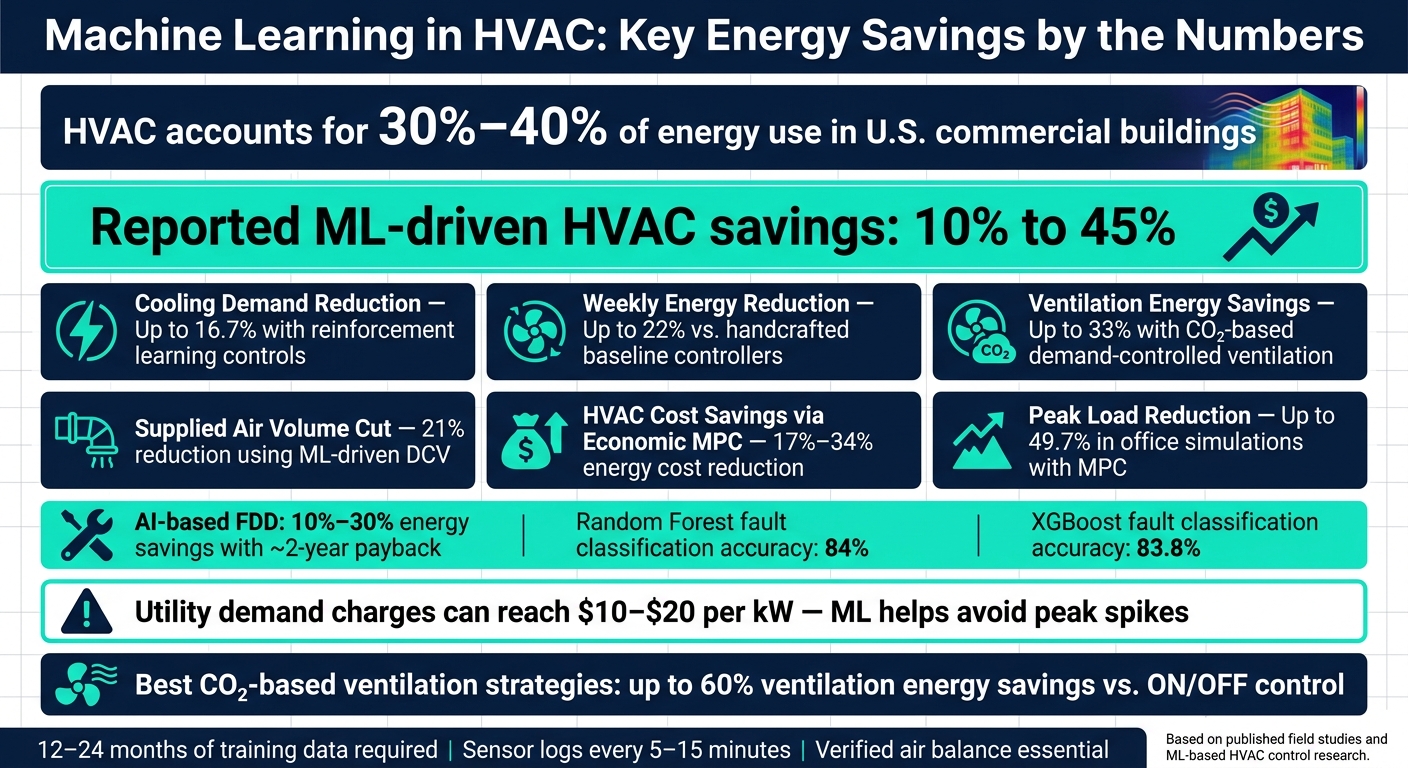
Machine Learning in HVAC: Key Energy Savings Statistics
SBA 479: Role of AI and Machine Learning in HVAC Energy Optimization
How Smart HVAC Systems Use Machine Learning
Once the BAS and sensor setup is in place, the next move is picking the right ML approach for the task. In HVAC energy optimization, machine learning isn’t one thing. It’s a toolbox. Some methods are better for forecasting load, some for finding faults, and some for changing control decisions.
Supervised Models for Load Forecasting and Fault Detection
Supervised learning trains a model on past data where the outcome is already known – past energy use, past faults, and past comfort results. The model learns how inputs connect to outputs, then uses that pattern on new data.
For load forecasting, models such as gradient boosting and random forest can predict hourly chiller or rooftop unit demand using outdoor temperature, humidity, time of day, and occupancy signals. That gives facility teams time to pre-cool a building before peak utility pricing kicks in, which can help avoid demand charges of $10–$20 per kW on some U.S. utility tariffs. Neural networks can also estimate zone temperature or comfort risk before occupants even notice something is off.
For fault detection, supervised models can do much more than fire off a basic alarm. A classifier trained on labeled cases of stuck dampers, fouled coils, or sensor drift can output fault probabilities, confidence scores, and estimated energy penalties. That gives engineers a clearer view of what matters most. In simulated tests for sensor faults, valve leakages, and pump malfunctions, ensemble methods such as Random Forest and XGBoost reached initial fault classification accuracies of 84% and 83.8%, respectively. That kind of ranking helps teams go after the faults with the biggest energy hit first.
When labeled fault data is hard to find, anomaly detection without labels becomes the next path.
Unsupervised and Reinforcement Learning for Anomaly Detection and Control
When fault labels aren’t available, unsupervised learning looks for operating patterns that don’t fit. Clustering methods such as k-means and DBSCAN group similar AHU or VAV zone states using features like fan speed, damper position, and supply air temperature. One cluster may reflect occupied cooling, another night setback, and another weekend shutdown. If a data point lands outside those groups – like full airflow and low supply air temperature at 2:00 a.m. on a Sunday – it gets flagged as abnormal.
Reinforcement learning works a bit differently. It changes setpoints, fan speeds, or valve positions, then learns from the energy and comfort results. Rewards usually combine energy cost, comfort drift from a target temperature – often 68–75°F during occupied hours – and, in some cases, equipment stress from too much cycling. In real buildings, RL deployments have cut cooling demand by 16.7% compared with fixed-schedule controls. Whole-building use cases have reached up to 22% weekly energy reduction versus handcrafted baseline controllers. Most teams begin with RL in shadow mode, where the system suggests actions but doesn’t touch the equipment yet. Engineers review the outputs first to make sure they’re safe and code-compliant.
Data Inputs That HVAC Machine Learning Models Rely On
Every ML model depends on the data going into it. If the inputs are weak, the model will be too. The table below shows the main inputs and why they matter.
| Input Category | Specific Data Points | Why It Matters |
|---|---|---|
| Zone conditions | Temperature (°F), relative humidity (%RH), CO₂ (ppm) | Drives comfort prediction and demand-controlled ventilation |
| Air system | Supply/return air temperature, airflow (cfm), damper position | Shows how well the system is delivering conditioned air |
| Equipment | Fan speed, valve position, compressor status, VFD output | Needed for fault detection and control optimization |
| Occupancy | Access control logs, CO₂ proxy, calendar schedules, people-count sensors | Cuts unnecessary conditioning in empty spaces |
| Weather | Outdoor dry-bulb temp (°F), humidity, solar irradiance | Needed for load forecasting and optimal start/stop |
| Energy meters | Real-time kW, cumulative kWh, electricity/gas/chilled water/hot water meter data | Measures actual savings and checks model predictions |
These inputs only help if the basics are handled first. Sensors need calibration, airflow needs verification, and BAS trends need to be logged often enough to catch load changes. Without that, even a strong model can miss what’s happening in the building.
Where Machine Learning Improves HVAC Energy Performance
Once your data is clean, ML can start doing the work that matters: cutting HVAC energy use in day-to-day operation. In practice, that usually happens in three places: scheduling, ventilation, and fault response.
The idea is simple. The model takes dependable inputs, makes better predictions, and turns those predictions into lower runtime, less waste, and tighter control.
Predictive Control, Optimal Start/Stop, and Setpoint Reset
The biggest savings usually come from schedule and setpoint optimization.
Optimal start/stop runs equipment only when it needs to, so the building hits setpoint by the time people arrive. That trims runtime that would otherwise get burned early in the day and helps reduce peak demand.
Setpoint reset uses the same basic idea for supply air temperature, chilled water temperature, and duct static pressure. Instead of sticking with fixed, conservative settings, the system adjusts those values in real time based on what zones actually need.
That matters because HVAC systems often run with more pressure, colder air, or lower water temperatures than the building needs at that moment. ML helps dial that back without losing comfort.
Economic MPC has cut HVAC energy cost by 17%–34%, reduced discomfort by 30%–95%, and in one office simulation cut peak load by 49.7% and energy use by 17.6%.
The same control logic also helps cut fan and ventilation waste.
Ventilation and Airflow Optimization Within Comfort Limits
Ventilation is another place where ML can trim a lot of waste. Many systems condition more air than needed, especially when spaces are partly occupied or empty.
ML adjusts outdoor air, supply airflow, and fan pressure to match actual occupancy while staying within comfort targets and ASHRAE 62.1 limits. In plain terms, it gives the building the air it needs, not the air a fixed schedule assumes it needs.
CO₂-based demand-controlled ventilation, or DCV, is a good example. When ML drives that control, it can cut supplied air volume by 21% and ventilation energy by 33%. The best CO₂-based strategies have reached 60% ventilation energy savings compared with simple ON/OFF control, while still keeping CO₂ within accepted indoor air quality limits.
That’s where ML earns its keep. It works inside comfort and code limits, then looks for efficiency through steady modulation of fan speeds, damper positions, and outdoor air intake based on live occupancy signals and CO₂ readings instead of rigid schedules.
ML can also keep those savings from slipping away over time.
Fault Detection and Diagnostics for Ongoing Efficiency
Even after commissioning, HVAC performance can drift. A system may look fine on the surface while wasting energy every hour in the background.
That hidden waste is a major source of loss. ML-based fault detection and diagnostics, or FDD, catches things like simultaneous heating and cooling, sensor drift, and other control problems by comparing live system signals against learned normal behavior. That lets it spot patterns that rule-based alerts can miss.
AI-driven FDD platforms for commercial HVAC report 10–30% energy savings with payback periods around two years. Those savings come mostly from finding and fixing control and equipment faults, not from major capital projects.
Large-scale deployments tracked through the LBNL Smart Energy Analytics Campaign show that automated analytics often surface scheduling errors and simultaneous heating and cooling that manual review keeps missing.
One practical step helps here: send alerts straight into facility maintenance tickets, so technicians can check the root cause and fix it fast.
Step by Step: Preparing and Deploying Machine Learning in HVAC
After you pick a model, deployment starts with three checks: verify the system, clean the data, and pilot the controls. The sequence stays the same no matter which ML method you use: verify the system, train on clean data, then pilot.
Step 1: Verify BAS Points, Sensor Quality, and Air Balance
Before training starts, verify BAS points, sensors, and timestamps. Make sure every BAS point the model will use is mapped to the right equipment and calibrated within manufacturer tolerances. BAS, meter, and weather timestamps also need to line up, with daylight saving time handled the same way across every feed.
Use TAB to confirm that supply, return, and exhaust airflow match design before ML control begins. Those TAB results set the baseline the model will learn from. For projects in MD, VA, PA, NJ, NY, DE, and DC, Air Balance Masters provides certified air balance testing and reporting to document design compliance before ML control goes live.
Once that physical baseline is confirmed, collect enough clean history to train the model.
Step 2: Collect, Clean, and Train on Building Data
With the physical system verified, data collection can begin. Gather at least 12–24 months of time-series data so the model sees seasonal changes, occupancy patterns, and different operating modes.
Cleaning the dataset comes down to four actions:
- Align timestamps to one consistent U.S. local time zone
- Remove impossible values, such as humidity above 100% or fan status that conflicts with airflow and power data
- Fill short temperature gaps
- Leave longer gaps out of training
Document each cleaning step. That record helps later if you retrain the model or need to support an audit.
For labeling, use meter data for load labels and work orders or commissioning notes for fault labels. Evaluate models with RMSE in physical units and MAPE for cross-building comparison.
Use the cleaned dataset to test the model in one controlled pilot before any broader rollout.
Step 3: Integrate Models with BAS and Run a Pilot First
With verified points and trained models in place, start small. Pick one AHU, RTU, or a small zone group where the data is clean and the control boundaries are clear. Set pilot goals up front, and define hard limits such as minimum outdoor air rates and allowed static pressure ranges.
Start with manual review. The model reads BAS data and generates recommendations, and operators apply those recommendations by hand. If the results hold up, move to closed-loop control in the pilot zone. Set safety overrides so the BAS falls back to conventional control if ML outputs disappear or land outside defined bounds. Log every BAS write with its timestamp and value.
Run the pilot through enough weather variation before making a call. Bring facility engineers into weekly reviews so odd behavior gets caught early, not months later. Document pilot settings, overrides, and faults before expanding to more equipment.
Measure Results and Maintain Performance Over Time
Once the control strategy is live, the job shifts from rollout to proof. At this stage, you need to show that the model cuts energy use without hurting comfort or indoor air quality.
Track Savings, Comfort, and Indoor Air Quality
Start with a weather-normalized baseline built from 12 to 24 months of pre-deployment data. Then compare actual energy use with predicted use through IPMVP Option C. From there, convert the savings into dollar terms so owners and finance teams can see what the results mean in plain business language.
Comfort and IAQ need the same level of attention. Track zone temperature, humidity, and CO₂ on a continuous basis against each space’s design limits. Space pressure, measured in inches of water column, is especially important in healthcare facilities, labs, and commercial kitchens. In those spaces, supply, exhaust, and transfer air volumes need to stay in balance to hold the right positive or negative pressure conditions. Weekly exception reports help flag repeat misses before they turn into bigger problems.
Field studies show that automated analytics and AI controls can deliver measurable energy savings while keeping comfort within accepted limits.
When Certified Air Balance Support Is Needed
If performance starts to drift, don’t assume the model is at fault. The issue could come from the model, the BAS data, or the air balance itself. Airflow balance should be checked again after new construction, renovations, or unresolved comfort complaints. ML can’t fix a mechanical imbalance.
That’s a big deal because buildings with unmanaged airflow balance in multi-zone systems can use 20% to 35% more HVAC energy than design intent. If the system is out of balance, ML doesn’t remove the problem. It just optimizes around it.
For projects in Maryland, Virginia, Pennsylvania, New Jersey, New York, Delaware, and Washington, DC, Air Balance Masters provides certified air balance testing, reporting, and certification. Their formal TAB reports document measured airflow versus design airflow, point out deficiencies, and record corrective actions. That paperwork supports final inspection approvals and certificates of occupancy, and it gives ML teams a verified as-left baseline for tuning.
Key Takeaways for Successful ML-Based HVAC Optimization
These checks help turn short-term savings into performance that holds up over time. Strong ML optimization depends on clean BAS data, verified airflow, and steady tracking of energy, comfort, and IAQ. When conditions change, recommission the system and retrain the model.
FAQs
How much data does HVAC machine learning need?
HVAC machine learning relies on both historical data and real-time sensor inputs to power predictive analytics.
When you put those two data sources together, smart systems can monitor temperature, humidity, pressure, vibration, and overall equipment performance. That leads to better predictions and improved energy use. Air Balance Masters also stresses that accurate, high-quality data matters for peak performance and compliance with design specifications.
Can machine learning work with bad sensors or poor air balance?
Not very well.
Machine learning runs on good data. If sensors are off or airflow is out of balance, the system can spit out shaky insights, weaker performance, and wasted energy.
It does its best work when the HVAC system is operating the way it was designed to operate. Professional Testing, Adjusting, and Balancing services help keep data-driven HVAC systems accurate and properly calibrated.
How do you safely pilot ML controls in a building?
Start with close coordination among engineers, IT, and facility managers. First, make sure the network can support the system. At the same time, put strong cybersecurity controls in place to deal with IoT-related risks.
Before rollout, set a reliable baseline with certified Testing, Adjusting, and Balancing services. That step helps confirm the system meets design specs from day one.
From there, use real-time sensor data and past performance metrics to make precise, proactive adjustments. And as you fine-tune the system, stay aligned with standards such as ASHRAE 180.


