


If your TAB report is missing a stamp, field data, or calibration records, closeout can stall. In most cases, the report needs to follow NEBB PS9 unless the project specs set a tougher rule. And if the specs and NEBB do not match, the project specs control.
Here’s the short version:
- TAB documentation is the field record of what was measured and adjusted in the HVAC system.
- The final TAB report is the closeout document used by engineers, commissioning teams, owners, and code officials.
- Only the final stamped report is certified. Pre-read, readiness, and DALT reports are part of the process, but they are not certified TAB reports.
- Common tolerance is ±10% under NEBB, though some jobs require ±5%.
- A compliant report usually includes:
- Cover page with project and firm details
- Certification page with CP stamp and date
- Summary with deficiencies and variances
- Instrument list with calibration dates
- Airside and waterside test data
- Terminal unit data
- Equipment IDs tied to plans or schematics
- Formatting matters too. Missing page references, vague labels, and unclear revisions can slow review.
If I were checking a TAB package, I’d ask one question first: Can I trace each reading, each piece of equipment, and each variance without guessing? If the answer is no, the report likely needs work before final approval.
That’s the main point of this article: TAB standards are not just about testing; they are also about how air balancing impacts building performance and how the proof is recorded, certified, and handed over at closeout.
AABC TAB Talk: TAB Best Practices from the ACG Building Systems Commissioning Guideline

What TAB Documentation Is and How It Works in Commissioning
TAB documentation is the formal record of TAB measurements and final adjustments made during the testing, adjusting, and balancing of an HVAC system. In plain terms, it shows what was measured in the field and what was adjusted to get the system in line with the design.
That includes airflow, water flow, static pressure, and temperature readings. These numbers show whether the installed system matches the design intent and the Owner’s Project Requirements (OPR). In commissioning, that matters because the team needs measured data, not guesswork, to check system performance.
The report also flags design deviations and records any correction that was needed. If a measured value falls outside the allowed tolerance, the variance should be listed along with the corrective action taken or any deficiency that still remains.
What TAB Reports Are Used For
Commissioning relies on field-verified data, so TAB reports serve more than one purpose across a project. Owners, engineers, contractors, commissioning providers, and AHJs use them to confirm performance before occupancy.
One of the main jobs of the report is deficiency tracking. If a design quantity is missed by more than the allowed tolerance, that variance needs to be recorded. Under NEBB standards, the common tolerance is +/- 10%, though project specifications may call for tighter limits such as +/- 5%. When that happens, the condition must be documented in the report’s summary or remarks section with a clear description of the issue.
How TAB Fits Into the Commissioning Process
TAB work takes place after technicians measure performance at diffusers, grilles, fans, pumps, and coils, then adjust the system until it operates within tolerance. Those field readings are then compiled into the final TAB report.
After submission, the design team reviews the report to confirm that the HVAC systems are operating as intended.
"Upon receipt of the completed testing and balancing report, the design team will review it to verify that the HVAC systems are operating as designed."
The commissioning provider then uses the TAB report as a base document during final review and project closeout. That review depends on the report being prepared in line with recognized TAB standards.
Key TAB Documentation Standards and Guideline Sources
TAB documentation standards spell out who can issue the report, what the report needs to include, and how conflicts are handled. In practice, TAB reporting follows both the project specifications and published procedural standards. If those two don’t match, the contract rules.
NEBB Procedural Standards
The National Environmental Balancing Bureau (NEBB) publishes the Procedural Standard for Testing, Adjusting and Balancing of Environmental Systems. The 9th Edition (PS9), issued in 2019, sets the minimum requirements for report structure, certification language, and firm and technician qualifications.
Under NEBB, the report must be issued by a NEBB Certified Firm (CF) and supervised by a NEBB Certified Professional (CP). A CP or a NEBB Certified Technician also has to be on site during HVAC testing and TAB work.
One detail matters a lot here: the NEBB TAB stamp applies only to the final TAB report. It cannot be used on pre-read reports, survey reports, system readiness reports, duct air leakage test (DALT) reports, or commissioning reports.
When project specifications are stricter than NEBB, the project specifications take control. If they are less strict, the project specification still controls, and that difference must be noted in the TAB Report Project Summary. NEBB also states that project TAB requirements take precedence when they go beyond the procedural standard.
Other guideline sources follow this same basic reporting setup, but each one spells out its own documentation details.
What a TAB Report Should Contain
A complete TAB report is a structured record of test results, adjustments, and compliance. In practice, that means the report follows a set format reviewers can scan and verify without digging around. Commissioning reviewers use these sections to check that the system was tested and balanced the way it was designed.
A compliant TAB report turns field data into a package that is easy to review. The sections below show what that final deliverable should include.
| TAB Report Section | Key Data Elements |
|---|---|
| Report Title / Cover | Heading "Certified Test, Adjust and Balance Report", project name and address, engineer name, HVAC contractor name, TAB firm name and address, and certification number |
| Certification Page | Signed and dated CP stamp, firm name, certification number, expiration date, and the required certification statement |
| Summary / Remarks | System setup narrative, deficiency list, variance explanations, items not tested, and items beyond the firm’s control |
| Instrumentation | Instrument type, manufacturer, model number, serial number, most recent calibration date, and intended use |
| Airside Data | Design vs. actual CFM, static pressure (in. w.g.), fan RPM, motor amperage and voltage, and inlet/outlet temperatures (°F) |
| Waterside Data | Design vs. actual GPM, pump head, RPM, motor amperage, and entering and leaving coil temperatures and pressures |
| Terminal Units | Unit ID, location, design vs. actual CFM, minimum and maximum setpoints |
| Supporting Docs | Table of contents, abbreviation list, schematic diagrams, and mechanical plans identifying equipment locations |
Cover Page, Certification, and Project Details
The cover page should identify the project by name and address, along with the engineer, the HVAC contractor, and the TAB firm, including its TAB certification number. The report title should appear exactly as "Certified Test, Adjust and Balance Report".
The certification page carries the signed and dated CP stamp, plus the firm’s certification number and expiration date. It also includes the required certification statement saying the report data was obtained under the governing procedural standard and that any variances outside tolerance are listed in the summary.
Measured Performance Data and Supporting Records
Every data form needs to show design values next to final measured values. For airside systems, that includes CFM, static pressure in. w.g., fan RPM, motor amperage and voltage, and inlet/outlet temperatures in °F. For waterside systems, it includes GPM, pump head, RPM, motor amperage, and entering and leaving coil temperatures and pressures.
Each form also needs the name of the person who collected the data and the date it was collected. Every tested item must have its own ID. That ID should tie back to schematic diagrams, mechanical plans, or a detailed written description showing where the equipment is located.
Deficiencies, Variances, and Corrective Notes
Any variance from design quantities that goes beyond the governing tolerances must be called out in the TAB report summary. NEBB’s typical tolerance is ±10% for airflow and water flow measurements, but if the project specs call for something tighter, such as ±5%, those specs control.
The summary section should also explain system setup and the reasoning behind it, then list deficiencies and any items not obtained due to field constraints. Each deficiency should point back to the related data sheet or page number.
After content, the next requirement is clean formatting and traceable data.
Formatting, Data Quality, and Compliance in TAB Reports
Formatting is what turns TAB data into a closeout record people can actually review. Clear labels, traceable IDs, and a consistent layout help reviewers check compliance without digging through a mess. That matters most during commissioning closeout, when field data is being checked against design documents to ensure intent is realized.
A weak report usually shows itself fast: can each value be traced without guesswork? If not, review slows down.
| Feature | Incomplete Report | Compliant Report |
|---|---|---|
| Equipment ID | Vague labels such as "Fan 1" without location context | Unique designations tied to schematics, mechanical plans, or narrative descriptions |
| Navigation | No Table of Contents; sequential pages only | Table of Contents with page numbers or clickable digital links |
| Deficiency summary | Buried within data pages | Narrative summary with page references |
| Collector and date | Missing names or collection dates | Each data form lists the collector and date |
| Calibration | Missing or expired instrument records | Dedicated calibration section listing manufacturer, model number, serial number, and most recent calibration date |
| Abbreviations and units | Undefined acronyms or inconsistent units | Comprehensive abbreviation list and standardized legends |
Units, Labels, and Decimal Precision
Every abbreviation should be defined. Units need to stay consistent from page to page. Page numbering should run continuously, not restart in different sections. For digital PDFs, add bookmarks or linked table-of-contents entries so reviewers can move through the report without wasting time.
Calibration Records, Retesting, and Version Control
The calibration section should list every instrument along with its manufacturer, model number, serial number, and most recent calibration date. That way, anyone reviewing the report can tie the readings back to the tool that produced them.
It also helps to separate preliminary submittals from the final TAB report. Revision dates should be tracked clearly so there’s no mix-up about which copy is current, and only the approved final issue stays in circulation.
These formatting controls help cut delays when the TAB package moves into project closeout.
TAB Documentation in Project Closeout
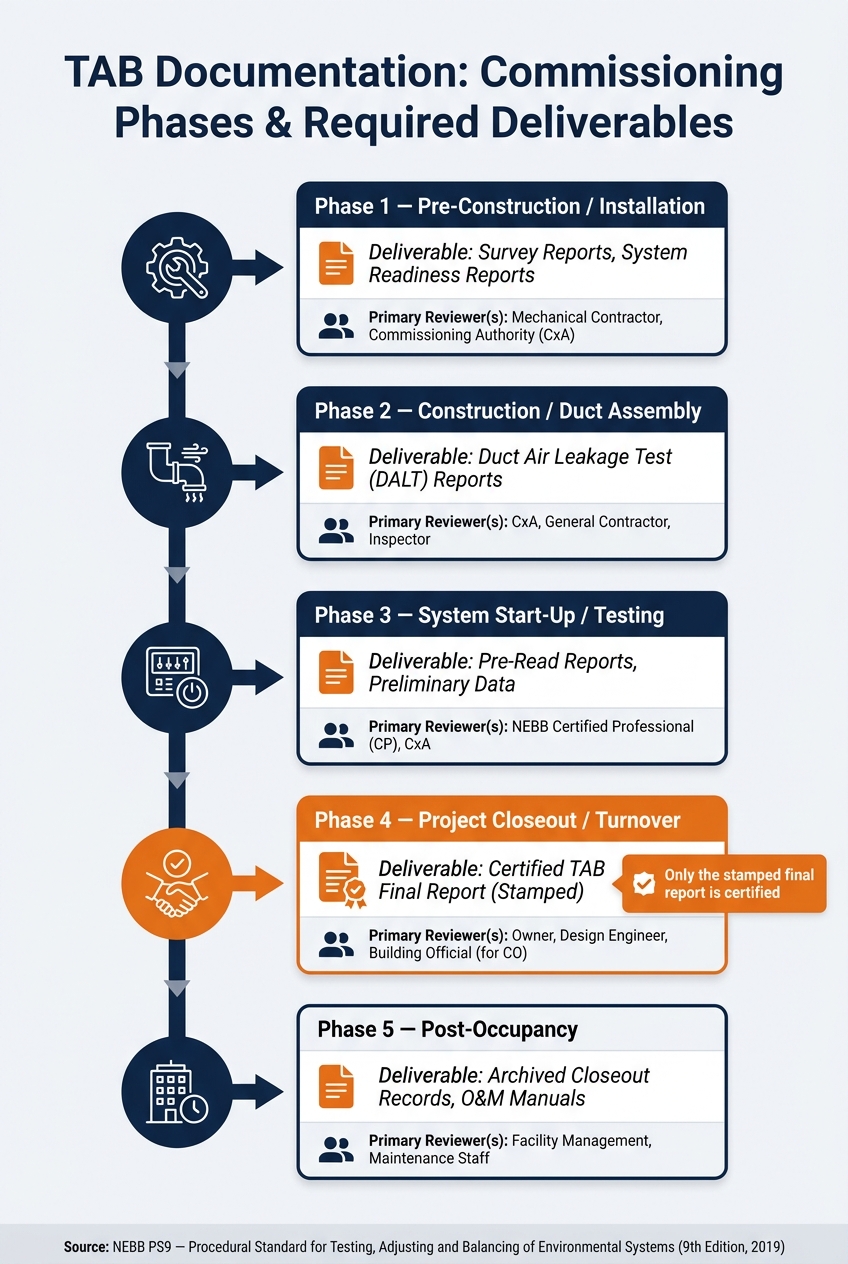
TAB Documentation: Commissioning Phases & Required Deliverables
After formatting and compliance checks, TAB documentation moves into project closeout. This is the handoff stage. The TAB report becomes part of the turnover package and needs to match the O&M manuals and maintenance documentation, as-builts, and the plans that show where the tested equipment is located.
The system setup narrative matters here too. It gives facility staff a starting point for troubleshooting and maintenance once the building is turned over.
When TAB Deliverables Are Reviewed
Closeout review usually follows a straightforward sequence:
| Commissioning Phase | TAB Documentation Deliverable | Primary Reviewer(s) |
|---|---|---|
| Pre-Construction / Installation | Survey Reports, System Readiness Reports | Mechanical Contractor, Commissioning Authority (CxA) |
| Construction / Duct Assembly | Duct Air Leakage Test (DALT) Reports | CxA, General Contractor, Inspector |
| System Start-Up / Testing | Pre-Read Reports, Preliminary Data | NEBB Certified Professional (CP), CxA |
| Project Closeout / Turnover | Certified TAB Final Report (Stamped) | Owner, Design Engineer, Building Official (for CO) |
| Post-Occupancy | Archived Closeout Records, O&M Manuals | Facility Management, Maintenance Staff |
One point is worth making clear: only the final stamped TAB report is certified. Pre-read reports, readiness reports, and DALT reports come earlier and support the process, but they are not certified.
At closeout, small paperwork issues can turn into approval problems fast. A missing CP stamp, an incomplete deficiency list, equipment labels that don’t match, a missing setup narrative, or calibration records that are no longer current can all hold up approval.
Conclusion: Key Takeaways on TAB Documentation Standards
HVAC compliance starts with NEBB PS9 for TAB reports unless the project specifications set a tougher bar. It shapes both what goes into the report and how the report gets checked. If the project specs ask for more than PS9, the specs win.
A compliant report needs a few non-negotiable items: the signed CP stamp, the required certification statement, the system setup narrative, the deficiency log, and instrument calibration records. Leave out even one of these, and review and closeout can slow down fast.
Just as important, reviewers get through clean documents with less back-and-forth. Clear formatting helps. So do unique equipment identifiers, sequential page numbers, and a defined abbreviation list. Those details make the data easier to verify without forcing someone to hunt through the report.
The more complete and organized the TAB report is, the smoother final inspection and occupancy approval tend to be. Contractors who treat documentation as part of the job, not something to patch together at the end, often close out faster and with fewer surprises. For contractors in MD, VA, PA, NJ, NY, DE, and DC, Air Balance Masters provides certified TAB testing, reporting, and certification.
FAQs
Who can certify a TAB report?
A TAB report must be certified by a qualified professional, such as a certified TAB supervisor or engineer, who works for a firm with active certification from a recognized trade association like AABC, NEBB, or TABB.
That professional reviews the report, then signs and seals it with an official stamp. By doing that, they accept responsibility for the test methods, the conditions observed during testing, and the data recorded in the report.
What happens if TAB data is outside tolerance?
If TAB data falls outside the stated tolerances, those deviations need to be formally documented in the project report summary.
When standards aren’t met because of system or construction issues, the TAB firm submits written test results to the responsible parties so the design engineer can put corrective actions in place.
If a field acceptance recheck shows a flow deviation of 10% or more, the report may be rejected and the system may need to be readjusted and retested at no added cost.
Why do calibration records matter in closeout?
Calibration records matter at project closeout because they show that testing instruments were accurate and calibrated within the recommended timeframe, usually within the last year. That matters for one simple reason: it backs up the reliability of the final TAB report.
This paperwork also helps confirm that the HVAC system meets the design specs. In turn, it supports final inspection approvals and the certificate of occupancy.


