


HVAC systems waste energy quietly, not dramatically. Small issues like leaky ducts or misaligned dampers can increase energy use by up to 40%. Testing, Adjusting, and Balancing (TAB) fixes these inefficiencies by fine-tuning the system to match its original design.
Here’s what TAB does:
- Testing: Measures airflow, pressure, and temperature to locate inefficiencies.
- Adjusting: Tweaks components like dampers and fan speeds to reduce strain.
- Balancing: Ensures even air and water distribution for consistent heating and cooling.
What is TAB in HVAC Systems?
TAB stands for Testing, Adjusting, and Balancing – a structured process aimed at ensuring an HVAC system operates according to its original design specifications. The process involves evaluating and fine-tuning key performance metrics across the building to align with the intended design.
"TAB isn’t just proportionally balancing a few registers. In fact, TAB is effectively and efficiently tuning building systems to perform optimally as per the engineer of record’s (EOR) design intent." – Jonathan Lloyd, NEBB Certified Professional
Grasping the concept of TAB highlights its critical role in maintaining HVAC efficiency.
The Purpose of TAB
HVAC systems are engineered to deliver precise amounts of air at specific temperatures to designated zones. However, real-world factors – like changes in duct layout, equipment swaps, or construction tolerances – can cause deviations from these design goals. TAB bridges that gap, fine-tuning the system to meet its original intent.
When an HVAC system is properly balanced, it operates efficiently. Fans and motors run at optimal speeds, equipment avoids unnecessary wear, and indoor temperatures remain consistent without constant thermostat adjustments. As Anthony Kocurek, Owner of Energy Balance and Integration, explains: "When you can make a whole system work more efficiently that’s where the real energy savings come in."
Key Components of TAB
TAB focuses on three interconnected elements:
| TAB Component | Primary Action | Energy Impact |
|---|---|---|
| Testing | Measuring airflow, pressure, and temperature | Identifies discrepancies between actual and intended performance |
| Adjusting | Modifying dampers, valves, and fan speeds | Reduces strain on motors and prevents overuse of equipment |
| Balancing | Distributing air and water proportionally across zones | Removes temperature inconsistencies throughout the building |
In addition to these core elements, TAB also addresses duct integrity, ensuring that ductwork is sealed so conditioned air reaches its destination. It manages air mixture ratios, maintaining the proper balance of outdoor and return air to achieve desired temperatures efficiently. For specialized environments like hospitals, TAB plays a crucial role in managing pressure gradients between rooms, which helps maintain sterile conditions and reduce infection risks.
How TAB Cuts Energy Waste
TAB (Testing, Adjusting, and Balancing) tackles HVAC inefficiencies head-on by addressing airflow issues and reducing equipment overuse. Surprisingly, most HVAC energy waste doesn’t stem from broken equipment. Instead, problems like excessive fan speeds, leaky ducts, and uneven airflow are the main culprits. TAB focuses on fixing these to save energy and reduce costs. Here’s how it works.
Fixing Airflow Imbalances
Uneven airflow creates a domino effect of inefficiency, impacting overall building performance. Some areas get too much conditioned air, while others are left struggling. This imbalance forces HVAC systems to run longer than necessary, and when you factor in leaky ducts – potentially increasing energy use by up to 40% – the waste adds up fast.
TAB technicians tackle this by measuring airflow at every supply and return point. They adjust dampers and registers to restore proper distribution, ensuring the system matches its original design. They also test for duct leaks, addressing them before they become long-term energy drains.
But that’s just part of the equation – equipment performance also needs attention.
Preventing Equipment Overrun
When systems are out of balance, fans, pumps, and compressors end up working harder than they should. This overuse not only wastes energy but also causes unnecessary wear and tear. TAB steps in with tools like tachometers to fine-tune fan and pump speeds. They also adjust static pressure setpoints in variable air volume (VAV) systems, keeping everything running as intended.
The result? A balanced HVAC system that can cut energy consumption by as much as 20%, while also extending equipment life.
The TAB Process: Step by Step
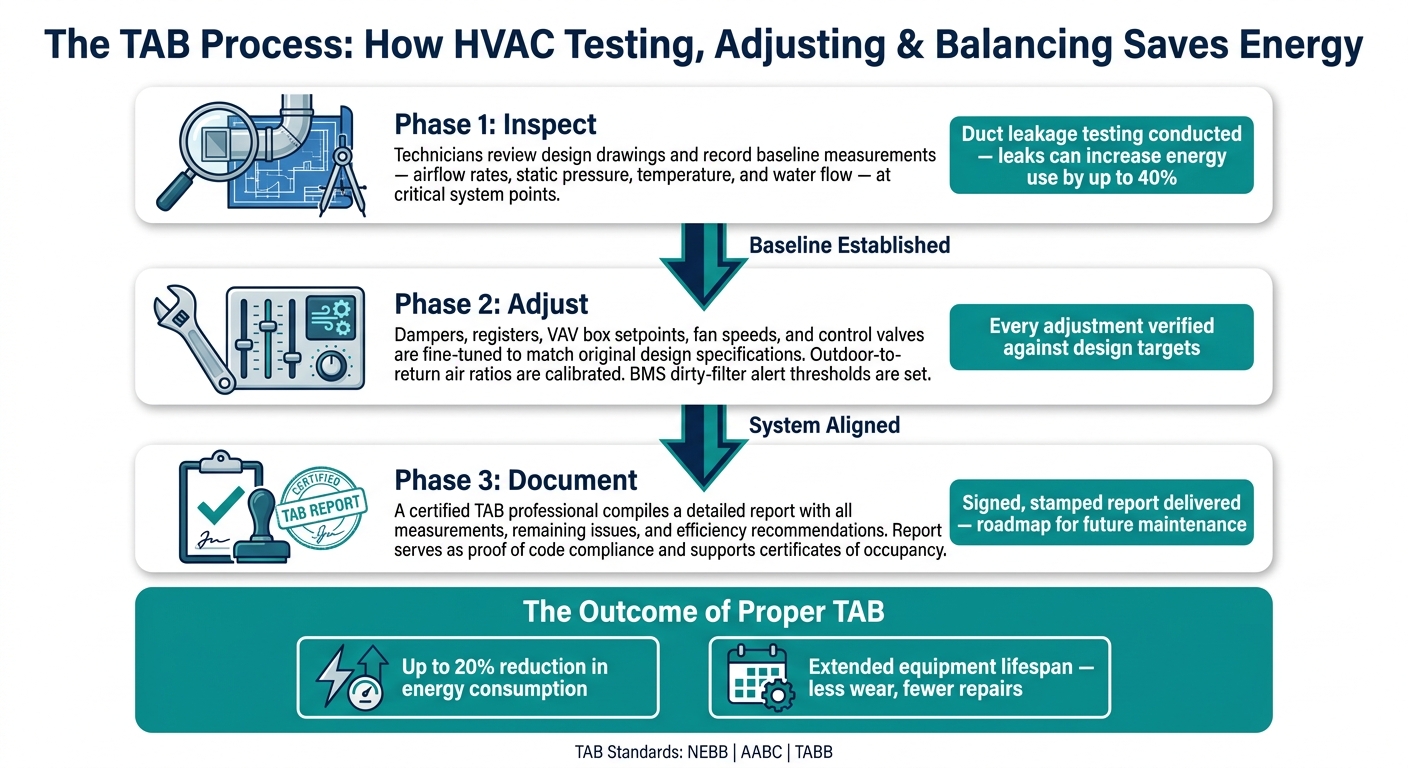
The TAB Process: How HVAC Testing, Adjusting & Balancing Works
The TAB process is a structured, three-phase approach – inspection, adjustment, and documentation – designed to ensure systems achieve measurable energy efficiency. Each phase builds on the previous one, creating a pathway to verified and lasting performance improvements.
Inspection and Pre-Testing
Before making any changes, TAB technicians thoroughly assess the system as installed. This begins with a review of the design data, ductwork drawings, and project specifications to confirm the system aligns with the engineer’s original design intent. Technicians then record baseline measurements, such as airflow rates, static pressure, temperature, and water flow, at critical points across the system. Leakage testing is also conducted to determine how much conditioned air is lost before reaching its intended destination.
Did you know? Duct leakage alone can increase energy consumption by up to 40% beyond what’s necessary.
Adjustments and Verification
Once the initial measurements are recorded, technicians move on to fine-tuning. Adjustments are made to components like dampers, registers, VAV box setpoints, fan speeds, and control valves to align the system’s actual performance with its design specifications. Each adjustment is verified to ensure it meets the intended targets.
A key part of this phase involves calibrating the outdoor-to-return air ratio. If this ratio is off, the system has to work harder to maintain indoor conditions, leading to unnecessary energy use. Additionally, technicians set thresholds for "dirty filter" alerts within the Building Management System (BMS) to prevent excessive fan speed increases. This integration highlights the role of smart HVAC systems in modern facility management. As Jonathan Lloyd explains:
"TAB isn’t just proportionally balancing a few registers. In fact, TAB is effectively and efficiently tuning building systems to perform optimally as per the engineer of record’s (EOR) design intent."
Final Documentation
After adjustments are complete and verified, a certified TAB professional compiles a detailed report. This document includes all recorded measurements, highlights any remaining issues, and offers recommendations for further efficiency improvements. It also serves as official proof that the system operates as designed, which is invaluable for contractors during final inspections and when obtaining certificates of occupancy. Beyond that, the report becomes a helpful resource for future maintenance and system upgrades.
This final report not only confirms that the system is performing optimally but also provides a roadmap for maintaining and improving energy efficiency over time.
Energy Efficiency Gains from Proper TAB
TAB fine-tunes HVAC systems to reduce energy waste while promoting longer equipment life. This dual benefit not only cuts down on energy costs but also ensures systems operate as intended for years to come.
Lower Utility Bills
One of the leading causes of energy waste in HVAC systems is unnecessary overexertion. Issues like duct leakage, misaligned dampers, and improper air mixtures force fans and motors to work harder than they should.
"When you can make a whole system work more efficiently that’s where the real energy savings come in." – Anthony Kocurek, Owner of Energy Balance and Integration and SMACNA National Vice President
Inefficient sealing and balancing can drive energy use well beyond optimal levels. By addressing these inefficiencies, TAB directly contributes to lower monthly utility bills while also laying the groundwork for improved system longevity.
Longer System Life
When HVAC systems are out of balance, key components – such as fans, VAV boxes, dampers, and control valves – are pushed beyond their limits to compensate for inefficiencies. This constant strain leads to faster wear, increased repair needs, and early equipment replacement.
"Lots of times energy efficiency relates back to making sure the building is operating as intended."
Through TAB, systems are restored to their intended load conditions. Fans operate at proper speeds, and VAV boxes no longer need to overcompensate for upstream imbalances. This reduces mechanical stress across the system, allowing equipment to achieve its full lifespan instead of succumbing to premature failure.
Why Certified TAB Services Matter
The energy savings from Testing, Adjusting, and Balancing (TAB) services hinge on the quality of execution. Even the best-designed systems can fall short if the work isn’t done by trained professionals using calibrated tools and standardized methods. Without these, measurements may be off, leading to wasted energy and unresolved issues. Certification plays a crucial role in bridging this gap.
"The purpose of NEBB’s TAB certification program is to offer tangible proof of competent firms and professionals qualified in the proper methods and procedures for testing building systems for optimum performance." – National Environmental Balancing Bureau (NEBB)
Certified TAB professionals adhere to strict industry standards set by organizations such as the National Environmental Balancing Bureau (NEBB), the Associated Air Balance Council (AABC), and the Testing, Adjusting and Balancing Bureau (TABB). They rely on calibrated instruments, follow rigorous protocols, and provide signed, stamped reports that align with building codes. These reports aren’t just formalities – they’re concrete evidence that the system is functioning as intended. This level of precision also determines when certified TAB services are a must.
When to Hire a Certified TAB Service
There are specific situations where certified TAB professionals are not just helpful but essential.
Certified TAB services are critical in three key scenarios: new construction, system retrofits, and ongoing performance issues.
For new construction projects, TAB ensures that the system operates according to its design before the building is occupied. After system upgrades – like installing new VAV boxes, replacing ductwork, or swapping out equipment – TAB ensures the new components integrate seamlessly with the existing system. Persistent issues, such as uneven temperatures, high energy costs, noisy doors, or poor indoor air quality, also call for certified TAB services. In these cases, precise airflow and pressure measurements help identify the root cause.
In specialized settings like hospitals and labs, the stakes are even higher. Maintaining proper room pressure differentials is critical to infection control and safety. A certified TAB contractor serves as an impartial expert, ensuring these conditions are met and properly documented.
About Air Balance Masters
Air Balance Masters is a certified air balance company serving HVAC and general contractors across Maryland, Virginia, Pennsylvania, New Jersey, New York, Delaware, and Washington, D.C. Founded by Ghazi Hussain, B.Eng. (Hons), M.Sc., the company holds certifications from NEBB, NCI, BPI, and the Association of Energy Engineers (AEE). Since 2016, they’ve specialized in air balance testing, reporting, and certification services.
The company delivers TAB reports within 48 hours, helping projects stay on track and securing Certificates of Occupancy without delays. With a 5.0/5 rating across 33 Google reviews, Air Balance Masters is praised for their responsiveness and ability to meet tight deadlines, ensuring contractors pass final inspections with ease.
Conclusion: The Case for TAB in Every HVAC Project
Through thorough inspections, precise adjustments, and careful verifications, Testing, Adjusting, and Balancing (TAB) ensures that HVAC systems perform according to their original design. When an HVAC system is properly calibrated, it operates efficiently, avoids unnecessary strain, and provides consistent comfort. Without TAB, the gap between a system’s intended performance and its actual output can lead to energy waste, equipment wear, and persistent comfort problems.
By addressing issues like airflow imbalances, duct leakage, and equipment misalignment, TAB ensures that systems meet design specifications from the very start. This proactive approach prevents inefficiencies from turning into long-term, expensive headaches.
Whether you’re wrapping up a new construction project or diagnosing a poorly performing system, partnering with a certified TAB provider guarantees accurate results. Certified professionals use calibrated tools, follow standardized methods, and provide detailed documentation. For example, Air Balance Masters offers reliable TAB services across MD, VA, PA, NJ, NY, DE, and DC. They deliver fast turnaround times and have a strong track record of helping projects pass final inspections smoothly. These inspections not only confirm compliance but also ensure energy efficiency and extend equipment life.
TAB isn’t just a nice-to-have – it’s a critical step for making sure your HVAC system functions as it was designed to.
FAQs
How do I know my building needs TAB?
Your building might benefit from TAB (Testing, Adjusting, and Balancing) if you’re dealing with uneven airflow, poor ventilation, or looking to boost energy efficiency. It’s particularly useful for new construction projects, retrofits, or when you need to verify your HVAC system’s performance. TAB ensures your system operates as intended, aligns with design specifications, and enhances indoor comfort and air quality. Plus, it can help lower energy bills and extend the lifespan of your equipment.
How long does a TAB job usually take?
A TAB (Testing, Adjusting, and Balancing) job can range from a few hours to several days. The time needed depends on various factors, including the complexity of the HVAC system, its size, and the scope of adjustments required. System design and any specific modifications also play a role in determining how long the process will take.
How often should TAB be done?
Testing, adjusting, and balancing (TAB) is typically done during the initial installation of a system, after any modifications, or periodically to ensure everything runs smoothly. There isn’t a one-size-fits-all timeline for TAB. Building owners should evaluate factors like how the building is used, the system’s age, and its overall condition to decide how often it’s necessary.


