


If TAB is off, your HVAC system can waste a lot of energy fast. In many U.S. commercial buildings, HVAC uses 45%–60% of total building energy, and fan issues, duct leaks, bad airflow balance, high static pressure, and wrong VAV settings can push that number even higher.
If I had to sum up the article in plain English, it’s this: most TAB-related energy waste comes from air going where it should not, fans working harder than they should, and boxes or controls calling for more heating and cooling than the building needs. That leads to higher utility bills, comfort complaints, and project closeout delays.
Here are the main problems the article covers:
- Duct leakage: lost supply air and dirty or hot return air can drive up fan, cooling, and heating energy
- Airflow imbalance: zones running 20%–30% above or below design can create temperature imbalances
- High static pressure: fans use more power when filters, coils, dampers, or duct paths add extra resistance
- Wrong VAV settings: high minimum airflow and bad sensor readings can cause extra cooling and then extra reheat
- Too much outdoor or exhaust air: the system ends up heating or cooling more air than needed
- Poor follow-through after TAB findings: if teams do not fix, retest, and document the same points, problems stay in the building
A few numbers stand out:
- 5% duct leakage can increase fan energy by about 17%
- 10% duct leakage can push fan energy up by about 37%
- Cutting static pressure from 1.30 in. w.g. to 0.77 in. w.g. has been tied to 25% fan energy savings
- Lowering VAV minimum damper positions to about 10%–20% of design flow has been linked to about 14% whole-building energy savings
- In a 150,000-sq.-ft. building, fan-static fixes can save about $5,000–$20,000 per AHU per year
| Issue | What it does | Energy result |
|---|---|---|
| Duct leakage | Air escapes or gets pulled in from the wrong place | More fan, cooling, and heating use |
| Airflow imbalance | Some zones get too much air, others not enough | Hot/cold spots, longer runtimes, more reheat |
| High static pressure | Fan pushes against extra resistance | Higher electric use |
| Bad VAV settings | Too much cold air, then reheat | Cooling and heating waste at the same time |
| Poor correction process | Problems stay unresolved | Higher costs and closeout delays |
Bottom line: if you want to cut HVAC waste, TAB issues worth fixing first are duct leaks, airflow balance, static pressure, and VAV box settings. The article then explains how each problem shows up, how it wastes energy, and what teams should do to fix and document it.
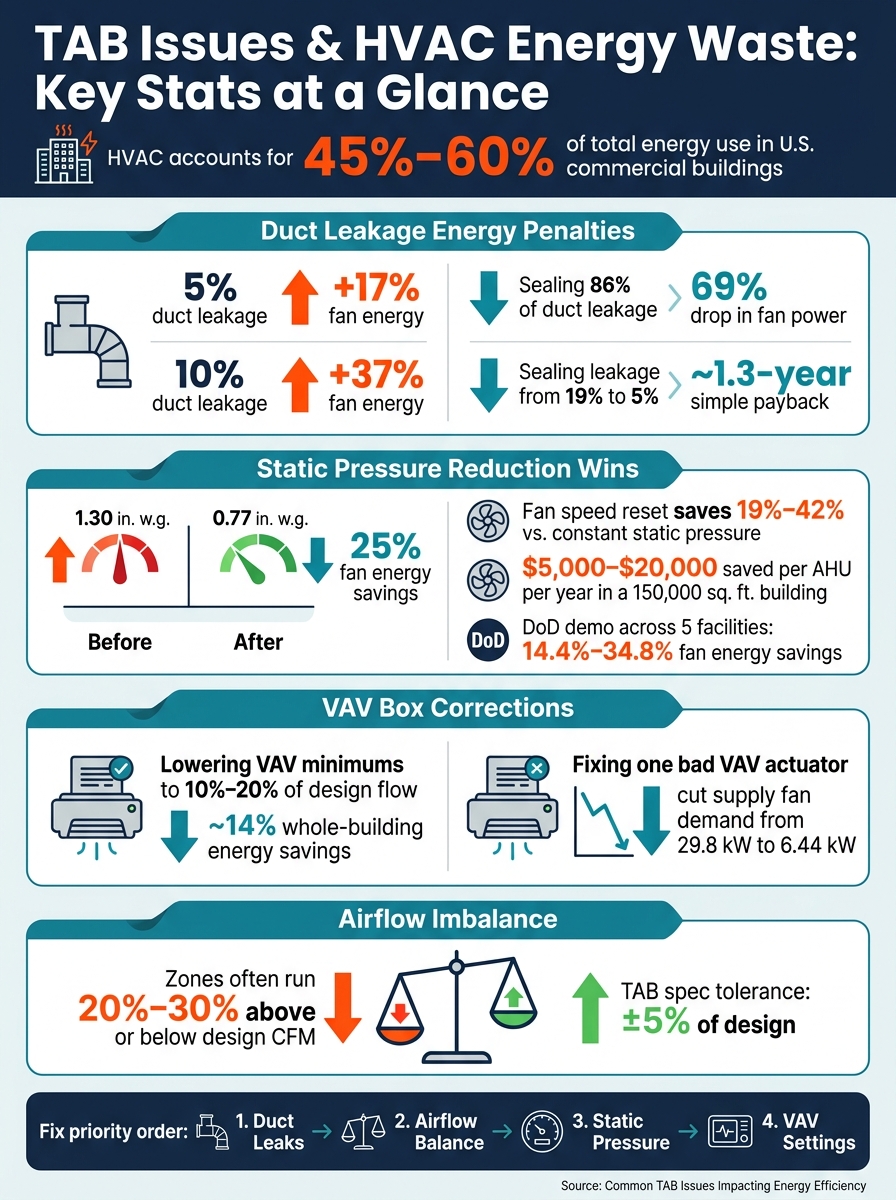
TAB Issues & HVAC Energy Waste: Key Stats at a Glance
AABC TAB Talk: Diagnosing System Effect Common Causes & Where to Start
Duct Leakage and Airflow Imbalance
The first losses usually come from duct leakage and poor air distribution. These are common TAB findings, and they waste a lot of energy.
How Duct Leakage Increases Fan and Conditioning Energy
Supply duct leaks push conditioned air into ceiling plenums or mechanical rooms instead of the spaces people actually use. That air never makes it to the occupied zone. To get diffuser flow back up, teams often increase fan speed or bump up static pressure setpoints. That’s when the cost starts to bite: fan power scales roughly with the cube of airflow, so even a 10% to 15% increase in fan output to make up for leakage can push fan power up by 30% to 50%.
Return duct leaks cause a different kind of problem. They pull unconditioned air from ceiling cavities, equipment rooms, or outside. In summer, that means warm, humid air gets pulled into the return side. Now the cooling system has to deal with both latent and sensible load, which leads to longer compressor runtimes. In winter, cold air entering the return path drives heating demand higher. If just 10% of return air comes from a hot attic space, system capacity and efficiency can drop by as much as 30%.
Even small leaks can hit fan energy hard:
- At 5% leakage, fan energy use can increase by about 17%.
- At 10% leakage, it can jump to around 37%.
For a mid-size commercial building, that can mean thousands of dollars in extra utility costs each year. And the cause isn’t broken equipment. It’s air moving to the wrong place.
Why Hot and Cold Spots Often Point to TAB Deficiencies
Those leakage and distribution issues usually show up fast in occupied areas. Hot and cold spots are often a clear sign of airflow imbalance. TAB technicians often find zones operating 20% to 30% below or above design CFM, which is far outside the ±5% tolerance most TAB specs call for.
When a zone doesn’t get enough supply air, it can’t meet its cooling setpoint in summer. People notice right away. They lower the thermostat, and staff may end up lowering setpoints across the whole floor. That drives cooling energy use higher.
BAS trend data often tells the same story: longer equipment runtimes, constant heating or cooling calls, and high reheat demand at VAV boxes. All of that can trace back to air distribution issues that proper TAB should have found and fixed. These are airflow problems, not equipment failures. And they often start with TAB corrections that were missed. Later on, the same imbalance tends to show up again as excess static pressure and mis-set VAV boxes.
Static Pressure, Fan Power, and VAV Terminal Problems
Airflow faults don’t just stay in the ductwork. They often show up downstream as high static pressure and badly set VAV terminals, which can push up fan energy, cooling load, and reheat use all at once.
How Excess Static Pressure Makes Fans Use More Electricity
Static pressure goes up when the duct system resists airflow more than it should. In plain terms, the fan has to work harder to move the same air.
Common causes include:
- Restrictive duct layouts
- Fouled coils and filters
- Undersized branch ducts
- Dampers left too far closed
TAB readings taken before and after cleaning or replacing parts often show static pressure drops of 0.3 to 0.6 in. w.g. across the AHU alone.
The energy hit can be large. In a Midwest U.S. field study of a multi-zone VAV system, cutting average duct static pressure from 1.30 in. w.g. to 0.77 in. w.g. led to 25% fan energy savings during the test period. A U.S. Department of Defense demonstration of tiered trim-and-respond static pressure reset across five Iowa Army National Guard facilities found fan energy savings from 14.4% to 34.8%, with simple payback periods from 1.7 to 14.9 years.
There’s also a direct cost angle. Reducing average supply fan static by 0.5 in. w.g. and allowing a 10% to 15% drop in fan speed can save $0.20 to $0.50 per sq. ft. per year in electricity costs. In a 150,000-sq.-ft. building, that works out to $5,000 to $20,000 per AHU per year.
And that same pressure problem doesn’t stop at the fan. It can also throw off terminal airflow and drive reheat.
How Incorrect VAV Box and Terminal Settings Waste Cooling and Reheat Energy
When terminal airflow is off, the controls can start wasting cooling and reheat energy at the same time. Typical problems include minimum airflow setpoints that are too high, maximum setpoints that don’t match duct capacity, flow sensors that read wrong, and dampers that stick.
If minimum flow is set too high, the box sends more cold air than the zone needs. Then the reheat coil has to warm that air back up. That’s a costly tug-of-war: cooling first, heating right after. It’s one of the biggest energy penalties in VAV systems, and it hits both electric and fuel use.
Bad flow sensor calibration can make things worse. If a box reads actual airflow lower than it is, the controller opens the damper more to make up for the supposed shortfall. The result is extra cold air in the zone and more work for the chiller or compressor.
One case study found that lowering VAV minimum damper positions to about 10% to 20% of design flow improved comfort and cut whole-building energy use by about 14%. TAB should reset minimum and maximum flow, calibrate the sensor so the controller reading matches actual airflow, and check that reheat only comes on when the zone actually needs it.
How TAB Findings Should Be Corrected and Documented
The best fixes go after air leakage, excess pressure, and control problems first. When TAB finds a deficiency, the job is not done after a single adjustment. Fix the issue, then retest the same points to make sure airflow, pressure, and temperature are back where they should be.
That means confirming those readings return to within ±5% of design. If you don’t retest the same points, you’re guessing. And in TAB work, guessing is how small problems turn into long punch lists.
Which Corrections Deliver the Fastest Efficiency Gains
Duct sealing should come first. It usually gives the fastest payoff. Sealing duct leakage from 19% down to 5% has shown a simple payback of about 1.3 years, based on an assumed cost of $0.20 per sq. ft. of duct surface area. In one studied system, sealing 86% of duct leakage led to a 69% drop in fan power, plus about 10–15% cuts in heating and cooling loads.
After that, move to fan speed and static pressure resets. Set the fan to the lowest speed that still serves the critical zones. That one change can cut fan energy by 19–42% compared with constant static pressure operation.
Outdoor air reset is another direct fix. Bring outdoor air back to the design minimum. Any extra outdoor air adds conditioning load for every hour the system runs, which means the system works harder than it has to.
Then deal with VAV box recalibration. Check damper actuation, verify airflow sensor accuracy, and set the right minimum and maximum flow positions. In one documented case, fixing a bad VAV damper actuator that was keeping duct static pressure at a high setpoint cut supply fan demand from 29.8 kW to 6.44 kW.
After retesting, the TAB report should show the before-and-after numbers clearly.
Why Certified TAB Reporting Matters for Approvals and Long-Term Performance
Each correction should connect back to the exact deficiency it fixed. A solid TAB report should include:
- The original deficiency
- The corrective action taken
- Before-and-after measurements
- Final test results
- Test conditions
- Dates
- The technician or firm responsible
That record gives contractors and facility teams a clear paper trail. It also helps with closeout, occupancy approval, and later warranty review.
For long-term operations, that baseline can save a lot of time. If a comfort complaint or unexplained energy spike shows up months or years later, a detailed TAB report helps facility managers tell whether the issue is new or whether the system was off from day one.
It also helps sort out problems that can look the same at first glance but need different fixes, such as equipment drift, filter loading, or control failure. Air Balance Masters provides air balance testing, reporting, and certification services that help projects meet design specs and close out faster.
Conclusion: The TAB Issues with the Biggest Effect on Energy Efficiency
Across the most common TAB findings, duct leakage, airflow imbalance, excess static pressure, and VAV or terminal misadjustment usually have the biggest effect on HVAC energy use. These problems don’t just sit on their own. They often stack up. Leakage and imbalance can push static pressure higher, and misadjusted terminals can lead to extra cooling and wasted reheat.
Put simply, duct leakage, airflow imbalance, excess static pressure, and misset VAV terminals drive much of the TAB-related energy waste by increasing fan power and forcing cooling and reheat that the system doesn’t need.
The good news is that these issues can be fixed, and the savings can be measured. Sealing duct leakage, correcting airflow imbalances, and resetting static pressure and terminal settings can cut HVAC energy use in systems where those faults are present.
A system that’s balanced the right way usually holds temperature better and runs quieter. A certified TAB report also gives contractors the documentation needed for final inspections and certificates of occupancy. At the same time, it gives facility teams a starting point for long-term performance management. Air Balance Masters provides certified air balance testing, reporting, and certification to support final inspection approvals and certificates of occupancy.
FAQs
How can I tell if TAB issues are raising energy costs?
Look for signs that the HVAC system is under strain: uneven room temperatures, frequent occupant complaints, noisy operation, poor ventilation, longer run times, and monthly utility bills that come in higher than expected.
You might also spot a gap between the design specs and actual airflow (CFM) readings. Other red flags include dirty filters, misaligned dampers, inaccurate sensors, and motor amperage that runs above the manufacturer’s specs.
Which TAB problem should be fixed first for the fastest savings?
Fix duct leakage and other airflow distribution issues first. In many cases, TAB shows these problems are a major source of HVAC energy waste. Leaky ducts can push energy use up by as much as 40% and reduce delivered airflow by 10–20%, which forces the system to run longer and work harder.
Start by checking airflow at the supply and return points. Then compare terminal CFM with the design target. After that, fix leakage and other pressure-loss issues before turning up fan speeds or making any other changes.
How often should a building be retested after TAB corrections?
There’s no one-size-fits-all retesting schedule. It depends on how the building is used, how old the system is, and the shape it’s in.
A full re-TAB is recommended after major changes, especially renovations that shift airflow patterns or system updates that affect more than 30% of duct or piping capacity.
For routine upkeep, ASHRAE Standard 62.1 recommends a TAB audit every five years. It also calls for seasonal checks in both winter and summer.


