


Testing, Adjusting, and Balancing (TAB) services ensure HVAC systems in critical spaces like cleanrooms, operating rooms, and biosafety labs meet design and regulatory standards. These spaces demand precise control of airflow, temperature, humidity, and pressure to maintain safety and compliance. Here’s what you need to know:
- What TAB Does: Measures, fine-tunes, and balances HVAC systems to align with design specifications.
- Why It Matters: Ensures compliance with standards like ISO 14644, USP <797>, and ASHRAE 170, critical for air quality, containment, and sterility.
- Key Metrics: Air Changes Per Hour (ACH), differential pressures, and airflow patterns are tested and adjusted for accuracy.
- Specialized Tools: Instruments like manometers, anemometers, and flow hoods are used to gather precise data.
- Reporting: Detailed reports verify compliance and are essential for regulatory approvals and Certificates of Occupancy.
TAB services are foundational for maintaining the performance and safety of critical environments. Partnering with certified providers ensures accurate results and smooth project approvals.
Key Environmental Design Parameters for Critical Spaces
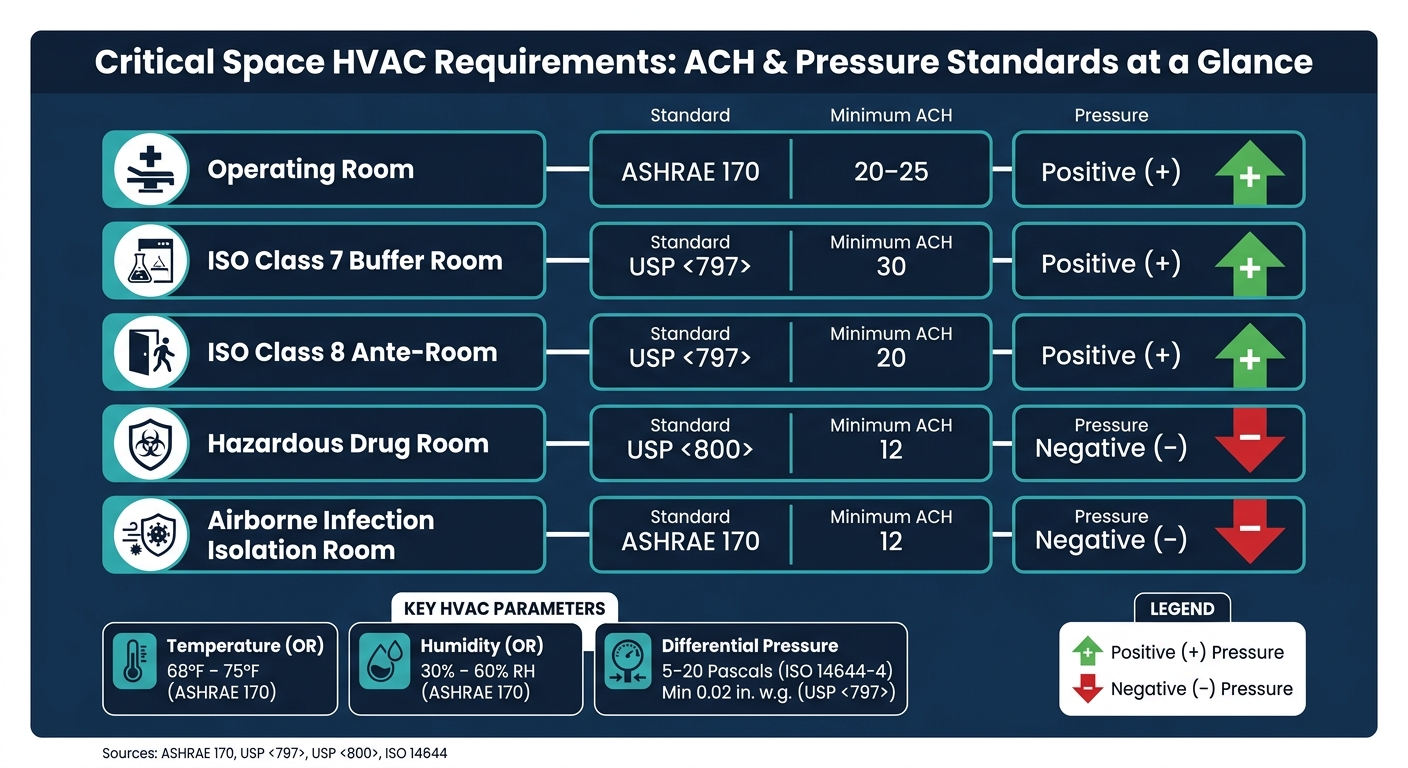
Critical Space HVAC Requirements: ACH & Pressure Standards at a Glance
TAB services play a crucial role in ensuring that every environmental parameter in critical spaces aligns with stringent design standards and regulatory requirements. Even a minor deviation can disrupt compliance and compromise the entire environment.
Temperature, Humidity, and Pressure Control
Research from the University of Córdoba highlights:
"Heating, ventilation, and air conditioning (HVAC) systems for critical areas must ensure stable parameters for temperature, relative humidity, differential pressure, airflow directionality, and air velocity."
To meet these demands, ASHRAE Standard 170 specifies that operating room temperatures should range between 68°F and 75°F, with relative humidity maintained at 30%–60%. This balance is essential for controlling microbial activity while ensuring equipment functions properly. TAB technicians rely on high-accuracy digital manometers to verify differential pressures, ensuring airflow moves in the correct direction. According to ISO 14644-4, differential pressures should fall between 5 and 20 Pascals, depending on the process. For pharmaceutical compounding, USP <797> requires a minimum differential pressure of 0.02 inches of water column (w.g.) between controlled areas to prevent cross-contamination.
In addition to temperature and humidity, precise airflow metrics are critical for diluting contaminants and maintaining system efficiency.
Airflow Rates and Air Changes Per Hour (ACH)
Once temperature and pressure are stabilized, achieving proper airflow becomes the next key focus. One of the most critical metrics here is Air Changes Per Hour (ACH). TAB technicians calculate ACH using a simple formula: total supply air in cubic feet per minute (CFM), multiplied by 60, then divided by the room’s volume in cubic feet. Achieving the desired ACH requires detailed measurements and iterative adjustments for accuracy.
ACH requirements vary depending on the type of space. For example:
- USP <797> mandates at least 30 ACH for ISO Class 7 buffer rooms.
- Operating rooms, as per ASHRAE 170, typically require 20 to 25 ACH.
These rates ensure that airborne contaminants are diluted and removed quickly following any disruption. TAB technicians use tools like capture hoods to measure terminal CFM at ceiling diffusers and thermal anemometers for the low-velocity airflow often found in cleanrooms. Adjusting even one damper can impact static pressure across the entire system, making repeated measurements and fine-tuning essential.
U.S. Standards and Compliance Frameworks
Critical spaces are governed by a web of overlapping standards, each specifying what TAB professionals must verify. For example:
- ASHRAE Standard 170 focuses on ventilation requirements in healthcare settings.
- USP <797> and <800> set guidelines for sterile and hazardous drug compounding, respectively.
- ISO 14644-1 defines cleanroom classifications based on particle limits and ACH requirements.
Additionally, procedural standards like NEBB and AABC outline how TAB technicians should conduct measurements and document their findings.
| Critical Space | Key Standard(s) | Minimum ACH | Pressure Relationship |
|---|---|---|---|
| Operating Room | ASHRAE 170 | 20–25 | Positive (+) |
| ISO Class 7 Buffer Room | USP <797> | 30 | Positive (+) |
| ISO Class 8 Ante-Room | USP <797> | 20 | Positive (+) |
| Hazardous Drug Room | USP <800> | 12 | Negative (−) |
| Airborne Infection Isolation | ASHRAE 170 | 12 | Negative (−) |
To ensure accurate measurements, all TAB instruments – such as particle counters, air data multimeters, and manometers – must have valid calibration certificates traceable to the National Institute of Standards and Technology (NIST). This ensures that results meet regulatory scrutiny.
Step-by-Step TAB Process for Critical Spaces
Pre-TAB Preparation and System Readiness
Before any measurements begin, the system must be fully prepared. A pre-balancing conference brings together the TAB agency, mechanical engineers, and installers to confirm alignment on the design intent and ensure the system is physically ready. Technicians then conduct a thorough walkthrough of the entire system – from the air handling unit (AHU) to every terminal unit – to identify any installation issues that could affect results. At this stage, they inspect components like filters, dampers, and motors to confirm they meet design specifications. Air systems are always tested first, before hydronic, steam, or refrigerant systems, to establish a stable baseline. Once the system is verified, technicians proceed to testing and adjustments with precision.
Testing and Adjusting Environmental Parameters
Precise measurements are critical to meeting standards like ASHRAE 170 and USP guidelines. Technicians use specialized tools tailored to each application to gather accurate data:
| Instrument | Primary Use |
|---|---|
| Pitot Tube | Measuring static and velocity pressure inside ductwork |
| Rotating Vane Anemometer | Measuring airflow at grilles, registers, and filter faces |
| Flow Hood | Balancing airflow at terminal units |
| Digital Manometer | Measuring differential pressure between spaces |
| Electronic Temperature Probes | Recording entering and leaving air and water temperatures at coils |
Fan performance is assessed on both the suction and discharge sides. If field conditions differ from design parameters, technicians convert the data to rated conditions before comparing it to the specifications – an essential step for maintaining accuracy. Airflow variation must stay within ±10% of design targets for supply, return, and general exhaust systems. For pharmaceutical environments, local exhaust systems require a tolerance between 0% and +10%.
Balancing and Validation for Compliance
After completing precise measurements, technicians move on to proportional balancing to align system performance with design requirements. This ensures critical environments meet and sustain compliance, which is essential for patient safety and operational efficiency. Dampers are adjusted starting with the branch at the lowest design flow and progressing upward, maintaining balanced airflow ratios throughout. This method prevents over-correction in one branch from causing imbalances in others.
Pressure cascades in critical spaces must also be verified and maintained consistently. For instance, in a compounding pharmacy, the pressure relationships between ISO Class 5, 7, and 8 spaces must remain stable under operating conditions.
Engineered Air Balance emphasizes this point:
"TAB is the foundation. Certification is the proof. You cannot have reliable certification results if the underlying systems are imbalanced."
Once the balancing process is complete, final settings – such as damper positions, valve adjustments, and fan speeds – are permanently marked to prevent accidental changes. In regulated environments, preserving these settings is absolutely essential.
Documentation and Reporting for Compliance
Key Components of TAB Reports
A TAB (Testing, Adjusting, and Balancing) report plays a crucial role in confirming that critical spaces meet their design specifications. These reports offer a direct comparison between field-measured airflow (measured in cubic feet per minute or CFM) and the engineering design criteria. They also document fan performance metrics, such as RPM, amperage, and static pressure readings. For critical environments, the report must verify Air Changes Per Hour (ACH) and room pressure differentials to ensure compliance with ASHRAE 170 standards.
Accurate documentation of testing instruments is essential. Each report must list all instruments used, including their calibration details. If an imbalance is identified during testing, the report should clearly document the issue and the corrective actions taken. This level of detail strengthens the report’s credibility during inspections or audits.
| TAB Report Component | Purpose |
|---|---|
| Field vs. Design Data | Ensures measured airflow and performance align with design specifications |
| Fan Performance Data | Confirms that equipment operates safely and within expected parameters |
| Pressure Differentials | Verifies cascading room pressurization for containment |
| Instrument Calibration | Confirms the accuracy of all measurements |
| Corrective Action Notes | Records deficiencies and the steps taken to address them |
Supporting Regulatory and Audit Approvals
Comprehensive and compliant documentation is vital for regulatory approvals. TAB reports are often required to secure a Certificate of Occupancy and are closely reviewed during audits by organizations like The Joint Commission (TJC) and the Centers for Medicare & Medicaid Services (CMS). For pharmaceutical facilities, the reports must demonstrate adherence to USP <797> and USP <800>, while cleanroom environments must comply with ISO 14644 standards.
One critical requirement is that the TAB firm must operate as an independent third party, free from any affiliation with the installing contractor. Regulatory bodies and city inspectors only recognize reports from firms certified by organizations like NEBB, AABC, TABB, or NCI.
"Air balance reports provide documented proof that airflow, ventilation rates, and system performance comply with approved plans." – Delo HVAC
For example, Air Balance Masters functions as an independent, certified agency. They ensure their reports meet the credibility standards required by inspectors and regulators. For critical projects, they deliver TAB reports within 48 hours of testing, helping to maintain tight timelines for Certificates of Occupancy. These reports also serve as a foundation for ongoing system performance evaluations.
Long-Term Monitoring and Re-TAB Planning
Once a TAB report is completed, it becomes the baseline for future system evaluations. As Kazi Hasan, an expert in the pharmaceutical industry, highlights:
"The data [in report forms] should also form the permanent record to be used as the basis for required future testing, adjusting, and balancing."
Over time, systems may drift from their original performance due to aging equipment, space repurposing, or renovations that alter airflow patterns. To maintain efficiency and compliance, ASHRAE Standard 62.1 recommends conducting a TAB audit every five years. Additionally, significant changes – such as adding a new exhaust hood in a lab or modifying a cleanroom layout – require a full re-TAB to ensure the system continues to meet its design goals. Seasonal testing is also critical; heating systems should be evaluated during winter, while cooling systems should undergo testing in summer to assess performance under peak load conditions.
For smoother re-TAB cycles, the original report should include as-built schematic diagrams of ductwork and piping. These diagrams give technicians a clear understanding of the system’s actual configuration, which proves invaluable for troubleshooting or adjustments years later.
Challenges and Best Practices in TAB for Critical Spaces
Common TAB Challenges
The TAB (Testing, Adjusting, and Balancing) process in critical spaces often uncovers various issues that need to be resolved before testing can even begin. One frequent problem is the mismatch between design plans and actual installations. During the initial system inspection, technicians might find ductwork in unexpected locations, dampers locked in incorrect positions, or fans rotating improperly. These discrepancies must be addressed immediately to ensure accurate testing.
Another common issue is pressure cascade misalignment. Critical spaces, such as cleanrooms and hazardous drug compounding areas, rely on precise pressure relationships – positive pressure for clean environments and negative pressure for containment areas. Even minor imbalances in supply, return, or exhaust airflows can compromise the entire system. Adding to the complexity, inadequate straight duct lengths near fans can distort airflow measurements, a phenomenon known as the "system effect."
Best Practices for Reliable TAB
One of the most effective strategies for avoiding these challenges is holding a pre-balancing conference before testing begins. This meeting brings together TAB professionals, engineers, and mechanical installers to review the system’s readiness and address potential issues upfront.
"The objective of the [pre-balancing] conference is to achieve coordination and verification of system operation and readiness for testing, adjusting, and balancing." – Kazi Hasan, Pharmaceutical Industry Professional
After the pre-balancing conference, the following steps are essential for reliable results:
- Air systems should always be tested and balanced before addressing hydronic, steam, or refrigerant systems.
- Ensure all filters are clean, motors are lubricated, and automatic controls are operational prior to testing.
- Perform air conditioning system balancing during summer and heating system balancing during winter to test under peak load conditions.
- Once the system is balanced, permanently mark damper positions and fan speed settings to prevent unintended adjustments.
For regulated environments like pharmaceutical facilities, airflow tolerances are critical. Supply, return, and general exhaust systems must stay within ±10%, while local exhaust systems must remain between 0 and +10%. Achieving these precise tolerances requires calibrated tools and a systematic testing approach.
By following these practices, TAB not only meets compliance requirements but also ensures the long-term performance of critical environments.
How Air Balance Masters Addresses These Challenges
Air Balance Masters streamlines the integration of TAB and certification processes, avoiding the pitfalls of treating them as separate tasks. When TAB and Critical Environment Certification (CEC) are handled independently, misaligned data and missed deadlines often result. By combining these processes from the start, Air Balance Masters ensures a smoother workflow.
Their team verifies pressure differentials in ISO-classified spaces – such as ISO 5, ISO 7, and ISO 8 zones – and confirms their stability before finalizing reports. They also validate HEPA filter integrity and airflow patterns to ensure containment devices function properly under real-world conditions. Clients in states like Maryland, Virginia, Pennsylvania, and New York have praised the company for identifying complex airflow issues that others overlooked. Remarkably, they deliver TAB reports within 48 hours of testing.
Conclusion: Compliance and Performance in Critical Spaces
Key Takeaways
Testing, Adjusting, and Balancing (TAB) is the cornerstone of ensuring that critical spaces function as intended. It verifies that airflow rates, pressure differentials, and filtration systems align with the original design and meet stringent regulatory requirements. This applies to environments like ISO 14644 cleanrooms, USP <797> and <800> compounding pharmacies, and ASHRAE 170 healthcare facilities.
"TAB is the foundation. Certification is the proof." – Engineered Air Balance
But TAB isn’t just about meeting regulations. When done correctly, it boosts long-term efficiency by reducing energy waste, extending the lifespan of HVAC systems, and minimizing the risk of airflow issues that could lead to expensive downtime. These advantages highlight why partnering with a certified TAB provider is so important.
Working with Air Balance Masters
The success of TAB hinges on how thoroughly the process is carried out from the beginning. For engineers and contractors managing critical spaces across Maryland, Virginia, Pennsylvania, New Jersey, New York, Delaware, and Washington, D.C., Air Balance Masters offers certified TAB services backed by extensive expertise. Their team integrates TAB and Critical Environment Certification early in the process – ensuring pressure cascades, HEPA filter integrity, and airflow patterns are verified before any report is finalized.
With a stellar 5.0 rating from 33 reviews and certified reports often delivered within 48 hours of testing, Air Balance Masters helps contractors navigate final inspections and obtain Certificates of Occupancy with ease. In environments where performance is absolutely essential, their reliability makes all the difference.
FAQs
When should TAB be done in a project schedule?
TAB (Testing, Adjusting, and Balancing) should take place after all equipment has been installed, is fully operational, and performing under the intended design conditions. This process must be completed prior to the final inspection and certification to verify system compliance and performance.
How often should a critical space be re-TAB’d?
Critical spaces need re-TAB (Testing, Adjusting, and Balancing) whenever system changes affect over 30% of duct or piping capacity. This process is also essential to maintain compliance and ensure performance standards are met. Regular re-TAB checks help systems in critical environments, such as cleanrooms and laboratories, stay within required specifications.
What should I look for in a compliant TAB report?
A proper TAB report needs to document airflow measurements, include instrument calibration records, and outline detailed testing procedures. This report confirms that the system’s performance aligns with its design specifications, ensuring precise airflow, system safety, and adherence to local codes. These components are crucial for maintaining optimal performance in sensitive environments such as cleanrooms and laboratories.


