


Skipping proper Testing, Adjusting, and Balancing (TAB) services can delay occupancy approvals, increase costs, and compromise HVAC performance. TAB ensures HVAC systems meet design standards, improve airflow, maintain building pressure, and comply with ANSI/ASHRAE codes – requirements for obtaining a certificate of occupancy. Without certified TAB reports, building inspectors may reject applications, leading to project delays and penalties.
Key Takeaways:
- What TAB Does: Measures and adjusts HVAC performance (airflow, pressure, temperature, etc.) to meet design and code requirements.
- Why It’s Required: Many U.S. states mandate TAB reports for occupancy approval, ensuring systems meet energy and ventilation standards.
- Consequences of Skipping TAB: Failed inspections, delays, fines, and unresolved HVAC issues like poor air quality or uneven temperatures.
- Solution: Certified TAB professionals, like Air Balance Masters, provide unbiased, sealed reports that inspectors accept, avoiding delays and ensuring compliance.
Certified TAB services streamline the approval process while improving HVAC performance, energy efficiency, and indoor air quality. Partnering with experienced providers early in construction ensures smoother inspections and long-term system reliability.
The Problem: Why Certificate of Occupancy Approvals Get Delayed or Denied
HVAC Compliance Requirements in the United States
To secure a certificate of occupancy, a building must pass a final inspection that ensures it complies with Building Energy Efficiency Standards. This inspection acts as the last legal hurdle before a structure can be occupied, with HVAC systems being a key focus during the evaluation.
HVAC systems are required to align with the technical specifications outlined in the Residential and Nonresidential Compliance Manuals. These manuals set performance benchmarks, including airflow rates, ventilation requirements, and pressure testing standards. If an HVAC system falls short of these benchmarks, inspectors cannot approve the certificate of occupancy.
Legislation like the Warren-Alquist Act mandates that energy efficiency and performance standards are met before a building can be occupied. Without proper documentation proving compliance with these standards, the project stalls. In cases where guidelines are not followed, the inspection process shifts to identifying issues and implementing necessary corrections.
What Happens When HVAC Inspections Fail
When an HVAC system fails to meet the required performance standards, the certificate of occupancy approval is delayed. The building cannot be occupied until the system is brought into compliance. This often involves making adjustments, retesting, and scheduling follow-up inspections, which can significantly extend project timelines. These delays highlight how essential proper Testing, Adjusting, and Balancing (TAB) services are in avoiding such setbacks.
Fundamentals of Test, Adjust, & Balance for Engineers, Cx & Energy Providers
The Solution: How TAB Services Achieve HVAC Compliance
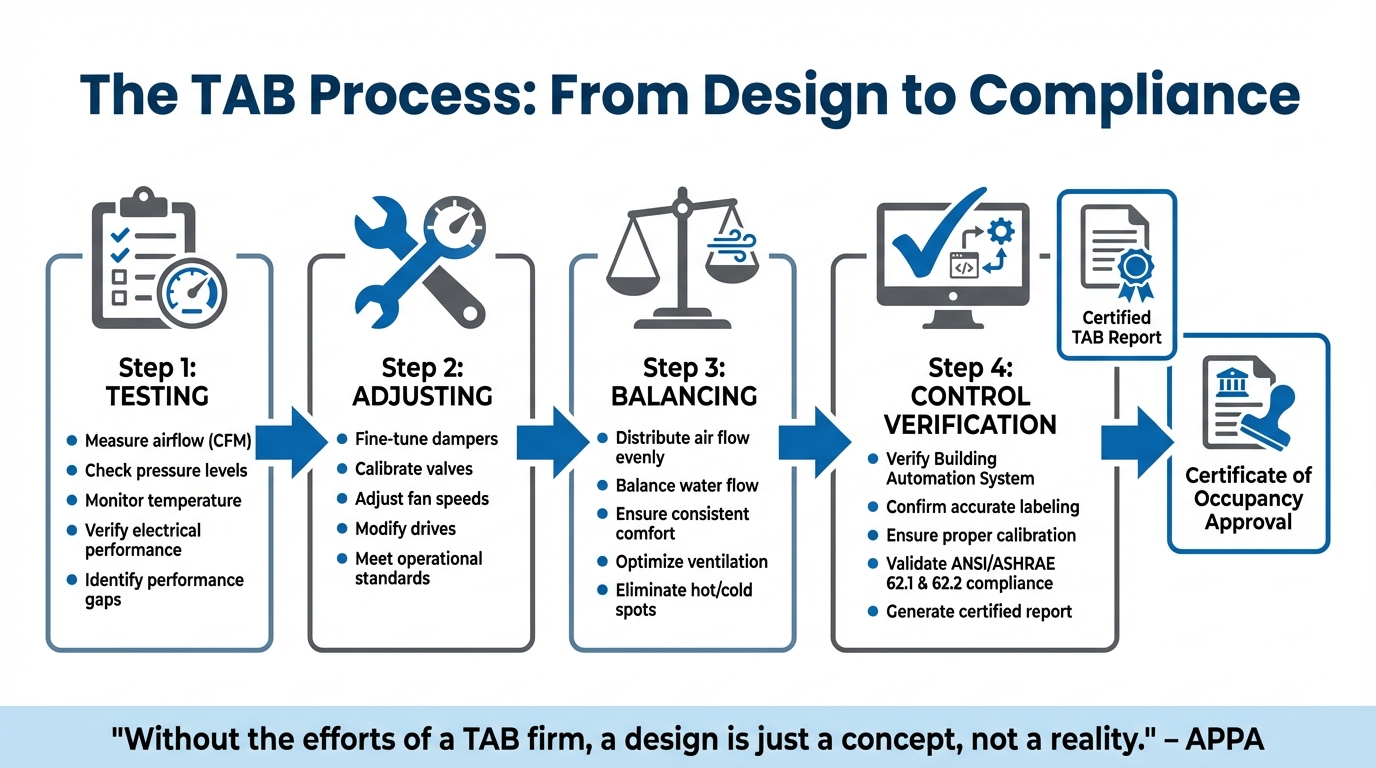
4-Step TAB Process for HVAC Compliance and Occupancy Approval
TAB services play a crucial role in closing compliance gaps that can delay occupancy approvals. Instead of relying on assumptions or visual inspections, these services ensure HVAC systems are performing as designed. This thorough process directly tackles the issues that often lead to delays in occupancy approvals.
The TAB process transforms design plans into measurable outcomes. Technicians collect data on airflow, pressure, temperature, and electrical performance to uncover any discrepancies between what was planned and what’s actually happening. When issues are identified, they make real-time adjustments – tweaking dampers, valves, fan speeds, and drives to bring the system in line with the design. The final balancing step ensures air and water flow are evenly distributed, delivering the expected heating and cooling to every part of the building.
"Without the efforts of a TAB firm, a design is just a concept, not a reality." – APPA
This systematic approach involves four essential components.
What TAB Services Include
TAB services consist of Testing, Adjusting, Balancing, and Control Verification:
- Testing: Technicians measure key parameters like airflow, pressure, temperature, and electrical performance to pinpoint gaps in system performance.
- Adjusting: System components, such as dampers, valves, and fan speeds, are fine-tuned to meet operational standards.
- Balancing: Air and water flow are evenly distributed, ensuring consistent comfort and ventilation throughout the building.
- Control Verification: This step ensures that every part of the Building Automation System is operational, accurately labeled, and properly calibrated.
TAB services also confirm that outside-air ventilation complies with ANSI/ASHRAE 62.1 and 62.2 standards. All measurements follow strict calibration and testing protocols. State regulations further emphasize the importance of TAB, as the certified TAB report – signed and sealed by a professional – is often required before inspectors can issue a certificate of occupancy.
Why Certified Professionals Matter
Certified professionals ensure that testing is accurate and reporting is unbiased, which is critical for meeting compliance standards. Certified air balance companies adhere to strict guidelines set by organizations like NEBB, using calibrated instruments and standardized reporting formats to demonstrate their expertise.
"The purpose of NEBB’s TAB certification program is to offer tangible proof of competent firms and professionals qualified in the proper methods and procedures for testing building systems for optimum performance." – NEBB
Air Balance Masters provides certified TAB services across MD, VA, PA, NJ, NY, DE, and DC, helping contractors secure final inspection approvals and certificates of occupancy. Their team ensures HVAC systems meet design specifications through rigorous testing, adjusting, and balancing, all while adhering to regulatory standards. This certification is vital, as uncertified reports can be rejected by inspectors, causing delays and requiring retesting.
Hiring an independent TAB firm, rather than relying on the mechanical contractor for testing, eliminates potential conflicts of interest. Independent firms deliver unbiased evaluations of system performance. Additionally, TAB firms provide detailed deficiency reports or punch lists, which highlight mechanical issues that need to be addressed before the final inspection for the certificate of occupancy.
Why Choose Air Balance Masters for TAB Services
Air Balance Masters offers certified Testing, Adjusting, and Balancing (TAB) services that help secure certificate of occupancy approvals. Their process combines precise testing methods, quick report delivery, and in-depth knowledge of compliance requirements across the Mid-Atlantic and Northeast regions. Let’s take a closer look at what makes their services stand out.
Detailed Testing and Reporting
Air Balance Masters ensures all testing and reporting meet the rigorous standards required by building inspectors. Their technicians measure critical HVAC performance metrics like airflow (CFM), water flow, static pressure, temperature, humidity, and electrical data to confirm that systems align with design specifications. If issues arise during testing, they provide deficiency reports – or "punch lists" – to help contractors address problems quickly, avoiding delays during final inspections.
Once testing is complete, Air Balance Masters delivers a certified TAB report that includes:
- An executive summary of findings
- Full performance data
- A record of all calibrated instruments used during testing
Each report is signed and sealed by a professional, which is often a required step for final mechanical inspections and obtaining a certificate of occupancy.
Service Areas and Specialization
Air Balance Masters operates in Maryland, Virginia, Pennsylvania, New Jersey, New York, Delaware, and the District of Columbia. Their team is well-versed in state-specific regulations, including the 2021 International Energy Conservation Code (IECC) and ASHRAE 62.1 and 62.2 standards. This expertise ensures their services comply with the unique regulatory requirements of each state in the Mid-Atlantic and Northeast regions.
Benefits of Working with Air Balance Masters
Their streamlined approach helps contractors avoid compliance issues that could delay occupancy approvals. Certified PDF reports are typically ready within 24 hours for submission to building departments, and same-day reporting is available for time-sensitive tenant build-outs.
Beyond compliance, Air Balance Masters enhances HVAC system performance by addressing issues like hot and cold spots, resolving negative building pressure (e.g., doors that are difficult to open), and balancing kitchen hood exhaust with make-up air systems. They also get involved early in projects, offering design reviews and pre-testing to prevent scheduling bottlenecks.
"You cannot receive your keys until a third-party agency… verifies that your ventilation rates meet the 2021 International Energy Conservation Code (IECC)."
– Northwest Energy LLC
The Results: How TAB Services Speed Up Occupancy Approvals
How TAB Services Speed Up CO Approvals
Professional TAB services take the guesswork out of final inspections. When Air Balance Masters completes their testing, they provide a certified, sealed report that building inspectors can easily verify. This report confirms that the HVAC system complies with ANSI/ASHRAE standards 62.1 and 62.2 for ventilation rates, which is a critical requirement for obtaining a certificate of occupancy.
These reports include executive summaries, detailed performance data, and calibrated instrument records, giving inspectors all the compliance information they need. Air Balance Masters ensures quick delivery – reports are provided within 24 hours, or even the same day for urgent projects like tenant build-outs. This fast turnaround allows inspectors to review the documentation promptly, often enabling certificates of occupancy to be issued on the same day or the next.
Another key advantage is the early detection of system issues. TAB technicians create punch lists to identify deficiencies before the final inspection, giving contractors time to address problems right away.
"Successful TAB completion and documentation is a prerequisite for starting HVAC system functional performance testing. No amount of commissioning can make an unbalanced system work."
– Rebecca T. Ellis, P.E., President, Questions & Solutions Engineering, Inc.
This thorough documentation not only speeds up the approval process but also ensures the HVAC system is set up for long-term performance. Faster approvals pave the way for operational and financial benefits down the line.
Long-Term Benefits of Proper TAB Services
The advantages of professional TAB services go beyond just speeding up CO approvals – they also contribute to better system performance and cost savings over time. A properly balanced HVAC system reduces energy waste, which translates to lower monthly utility bills.
Improved indoor air quality is another major benefit. Verified ventilation rates ensure that occupants get enough fresh air to meet health and safety standards. TAB services also address common comfort issues like uneven temperatures and negative building pressure, which can make doors hard to open or close.
Additionally, balanced systems help extend the lifespan of HVAC equipment. By maintaining proper airflow and hydronic flow, the system experiences less wear and tear, reducing the risk of premature failures and costly repairs. Properly managing building pressure – set to 0.05" water column – also prevents moisture problems and keeps unpleasant odors, like sewer smells, from entering occupied spaces.
"The true value TAB represents is energy optimization over the life of a building. When a building goes unbalanced, critical HVAC systems can run unchecked for years, conditioning air unnecessarily and wasting money."
– APPA (Leadership in Educational Facilities)
Why TAB is part of getting occupancy approval
TAB services are a requirement for obtaining a certificate of occupancy under state energy codes like the Pennsylvania Energy Code and New Jersey Energy Code for commercial buildings and larger multifamily properties. Without a certified TAB report, HVAC compliance with ANSI/ASHRAE standards cannot be verified, which prevents CO approval.
Partnering with a certified provider such as Air Balance Masters helps avoid inspection delays. Their team of certified professionals delivers signed and sealed reports that inspectors accept without issue, streamlining the CO approval process. Operating across MD, VA, PA, NJ, NY, DE, and DC, they are well-versed in regional code requirements and provide the precise documentation building officials need. This approach encourages early involvement in the project, laying the groundwork for smoother progress.
Getting TAB services involved early doesn’t just prevent delays – it also boosts long-term performance and energy efficiency. Interestingly, around 58% of TAB agencies participate in projects before construction even begins, offering design reviews to identify potential issues. Air Balance Masters creates detailed punch lists to pinpoint deficiencies, giving contractors the chance to address problems before they impact occupancy timelines. Certified TAB services safeguard your investment by reducing energy waste, extending equipment life, and ensuring occupant comfort while maintaining long-term system reliability. As APPA aptly states:
"Without the efforts of a TAB firm, a design is just a concept, not a reality".
For contractors and building owners who want dependable TAB services that meet rigorous industry standards and help keep projects on track, Air Balance Masters delivers the expertise and fast turnaround needed to ensure compliance and timely completion. Certified TAB services bridge the gap between design intent and efficient, lasting performance.
FAQs
When should TAB be scheduled to avoid CO delays?
TAB should be scheduled during or right after the HVAC system is installed but before the building is occupied. This timing ensures the system complies with all necessary standards, helping to avoid delays in getting the Certificate of Occupancy (CO). Scheduling TAB at the right moment keeps inspections on track and prevents interruptions to your project timeline.
What makes a TAB report acceptable to building inspectors?
A TAB report is considered acceptable to building inspectors when it adheres to recognized standards, such as NEBB or TABB procedures. These reports must include thorough documentation of testing, adjusting, and balancing processes. Additionally, they need to clearly show compliance with project specifications and relevant code requirements. When done correctly, these reports confirm that HVAC systems meet the intended design criteria, which can help simplify the approval process for occupancy certificates.
How is TAB different from HVAC commissioning?
TAB, or Testing, Adjusting, and Balancing, zeroes in on the precise measurement, adjustment, and documentation of airflow and water flow within HVAC systems. The goal? To ensure these systems align with the original design specifications and deliver peak performance.
On the other hand, HVAC commissioning takes a broader approach. It involves verifying the entire system – everything from design and controls to overall functionality. While TAB plays a crucial role within the commissioning process, its focus is specifically on balancing the flow of air and water.


