


TAB services – Testing, Adjusting, and Balancing – are essential for ensuring HVAC systems work as intended. They help address HVAC challenges faced by engineers during equipment selection by providing precise data about system performance, such as airflow, pressure, and motor amperage. Here’s why TAB matters:
- Testing: Identifies system performance issues with tools like anemometers and pressure gauges.
- Adjusting: Fine-tunes components (e.g., fans, dampers, valves) to align with design goals.
- Balancing: Ensures even air and water distribution, reducing energy waste and improving system efficiency.
TAB data is critical for equipment selection, helping engineers avoid undersized or oversized units, refine load calculations, and improve system longevity. Early involvement of certified TAB specialists ensures accurate design, proper equipment sizing, and lower energy costs. Skipping TAB input can lead to inefficiencies, higher expenses, and reduced comfort.
Key takeaway: TAB services provide the data needed to make informed HVAC equipment decisions, saving money and improving performance.
Key TAB Processes That Affect Equipment Selection
Testing: Collecting System Performance Data
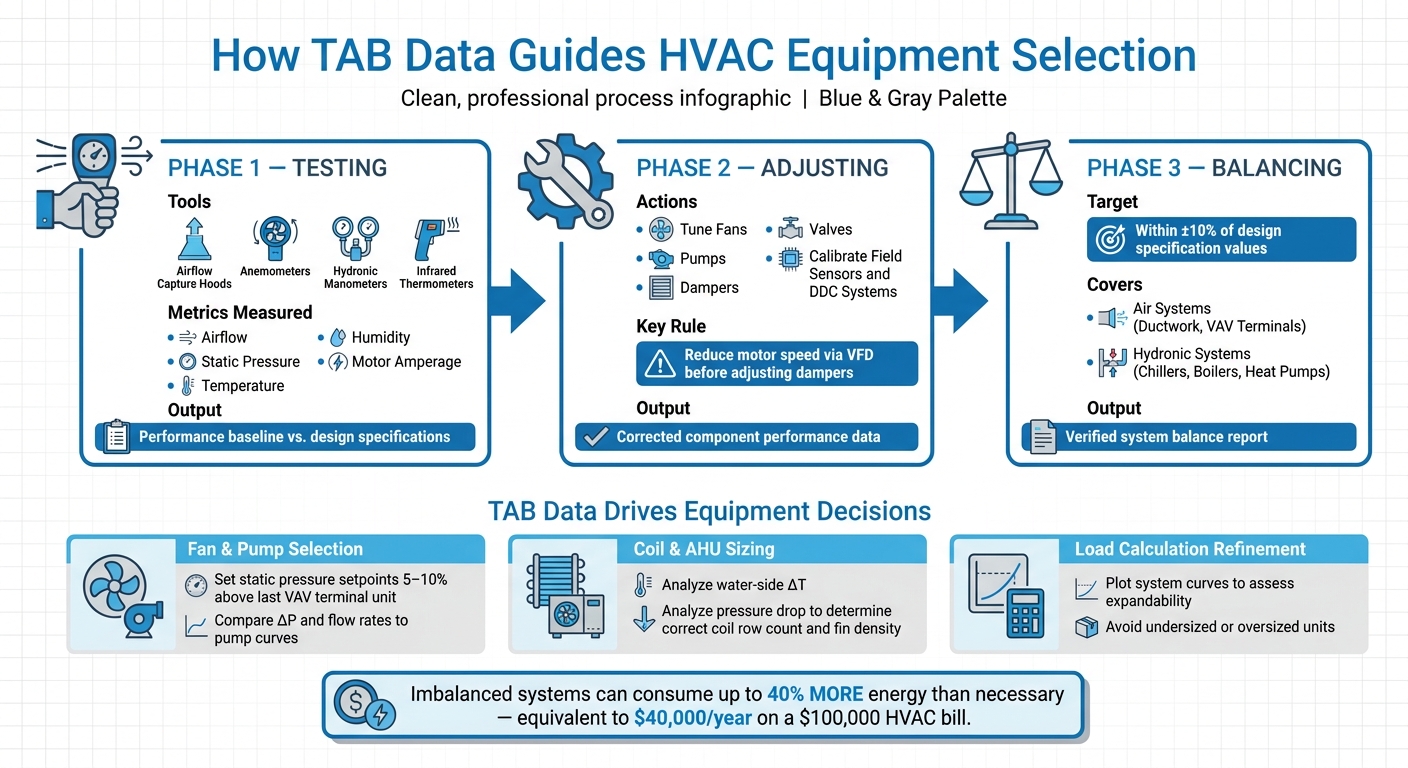
TAB testing starts with the use of calibrated tools like airflow capture hoods, anemometers, hydronic manometers, and infrared thermometers. These instruments measure key metrics such as airflow, static pressure, temperature, humidity, and motor amperage. The goal is to establish a performance baseline and see how closely the system aligns with its original design specifications. Motor amperage readings, for example, can reveal issues like poor installation, excessive pressure losses, or undersized equipment – critical factors when deciding on equipment upgrades or replacements.
For renovation projects, pre-design testing often includes mapping fan and pump performance curves. This helps determine if existing equipment can handle an expansion or if new units are necessary. To ensure accurate results, technicians replace air handling unit filters before testing. This step removes unnecessary external pressure loss, providing a clearer picture of system performance.
"The information contained within the TAB report and building control system will almost always provide the information needed to resolve the problem." – Peter Diperna, Mechanical Technical Specialist, Fitzmeyer & Tocci Associates Inc.
These precise measurements guide the necessary adjustments to system components.
Adjusting: Correcting System Components
Adjustments focus on aligning system components – such as fans, pumps, dampers, and valves – with the Engineer of Record’s design intent. A key practice is reducing motor speed via a variable frequency drive (VFD) before adjusting dampers. This prevents artificially increasing static pressure, which wastes energy. Additionally, field sensors and DDC systems are calibrated with handheld instruments to ensure the building management system operates with accurate data.
If a motor operates within its service factor, it signals deeper system issues that require attention at the equipment level rather than temporary fixes.
"If the motor is operating in the service factor, it will shorten the life expectancy of the motor. In addition, as the system ages and becomes less efficient there are no means to overcome the loss." – Peter Diperna, Mechanical Technical Specialist, Fitzmeyer & Tocci Associates Inc.
These fine-tuned adjustments ensure that balancing efforts meet design goals while also refining equipment specifications for optimal performance.
Balancing: Distributing Airflow and Water Flow Evenly
Balancing is the final step, ensuring that airflow or water flow is evenly distributed to meet the design specifications for each space. The typical goal is to achieve performance within ±10% of the values outlined in the project documents, a standard importance of air balancing for maintaining system integrity. This process is equally important for both air and water systems. Hydronic balancing, for instance, is essential for systems like water-source heat pumps, chillers, and boilers, just as it is for ductwork.
When imbalances persist, they can lead to energy consumption that’s up to 40% higher than necessary – an avoidable cost. Such inefficiencies often indicate the need to reassess equipment sizing and performance specifications during the balancing phase.
Design criteria to settle before you pick equipment
How TAB Data Guides HVAC Equipment Selection
How TAB Services Guide HVAC Equipment Selection
Using TAB Data to Improve Load Calculations and Sizing
TAB (Testing, Adjusting, and Balancing) data bridges the gap between design assumptions and actual system performance. By measuring airflow, temperature differences, and pressure readings, engineers can identify discrepancies from the original design. This information provides a foundation for refining equipment specifications before making purchasing decisions.
This process is especially helpful in renovation projects. A pre-design TAB report offers a clear picture of what the current system can handle, rather than relying on outdated design records. As Peter Diperna from Fitzmeyer & Tocci Associates puts it:
"The design engineer can plot the system curve and determine the system performance and expandability."
Such data allows engineers to make informed adjustments. For instance, if the TAB results show the system is operating near its capacity, they can specify larger or upgraded equipment before installation, avoiding issues down the line.
Selecting Fans and Pumps Based on TAB Results
Fan and pump selection hinges on the actual resistance within the system, which rarely matches the initial design calculations. Factors like extra duct fittings, transitions, or routing changes can increase static pressure beyond what was originally planned. TAB measurements provide clarity on these real-world conditions.
For air handling units, it’s recommended to set static pressure setpoints 5–10% higher than the requirements of the last variable air volume (VAV) terminal unit. This buffer ensures the fan can handle the actual duct resistance without being undersized.
In hydronic systems, TAB technicians measure differential pressure (ΔP) and flow rates, comparing them to pump curves. If the pump struggles to maintain adequate flow under measured conditions, it’s a clear signal that larger equipment is needed – preferably identified before the system goes live.
"Maintaining an artificially high static pressure in a system is a waste of energy." – Peter Diperna, Mechanical Technical Specialist, Fitzmeyer & Tocci Associates Inc.
Motor amperage readings also offer insights. If amperage consistently exceeds design levels, it may indicate excessive pressure losses in ductwork or piping. This data helps engineers refine future fan or pump selections and address installation issues. Additionally, it informs the choice of other components like coils and units to better match the system’s actual demands.
Choosing Coils and Units Based on TAB Findings
When selecting coils, it’s not just about matching heating or cooling loads on paper. TAB findings on air and water temperatures, as well as water-side temperature differentials (ΔT), reveal whether a coil has the heat transfer capacity to meet the system’s actual needs.
Pressure drop measurements further guide decisions on coil row count and fin density. For instance, if the ΔT across a chilled water coil is lower than expected, it might mean the coil is oversized or the flow rate is too high. These insights allow engineers to correct sizing issues before specifying replacement units.
Outdoor air conditions also play a role. TAB measurements of mixed air temperatures and damper performance impact how air handling units are configured. If the system struggles to control the outdoor air ratio, it could lead to cooling problems in summer or frozen coils in winter. Opting for separate minimum and maximum outdoor air dampers, instead of a single oversized one, can enhance measurement precision and improve equipment sizing.
"A system designed to a certain heat capacity will struggle to effectively operate if the mixture [of outdoor and return air] is incorrect." – Jonathan Lloyd, NEBB Certified Professional
Working With TAB Specialists During Design and Equipment Selection
Designing Systems With TAB Requirements in Mind
Many commissioning challenges arise because TAB (Testing, Adjusting, and Balancing) requirements are often overlooked during the design phase. When these critical details are ignored, you may end up with equipment that’s hard to access, ductwork that can’t be accurately measured, or systems that are nearly impossible to balance effectively.
Involving TAB specialists from the outset can prevent these issues. By reviewing architectural plans and duct shop drawings before construction begins, TAB professionals can identify problems like missing test ports on air handling units, diffusers installed in inaccessible spots, or duct layouts that don’t accommodate measurement tools. Fixing these issues on paper is far cheaper than making costly adjustments during construction.
This early collaboration ensures that TAB considerations are integrated into the design, reducing the risk of expensive revisions later.
Early TAB Involvement to Avoid Costly Errors
With multiple projects underway, small but critical design details can slip through the cracks. A TAB design review serves as a second set of eyes, identifying issues like improperly sized ducts or rooms with unique airflow needs – such as high-heat server rooms – before installation begins. Just as TAB data refines load calculations, early design reviews confirm that the system will be ready for accurate testing and balancing.
"Identifying issues at [the design] stage allows for early corrective measures and prevents complications later in the balancing process." – Peter Diperna, Mechanical Technical Specialist, Fitzmeyer & Tocci Associates Inc.
For retrofit projects, early TAB involvement is even more critical. A pre-design TAB report captures the actual performance of existing equipment, documenting flow rates, fan capacity, and pump curves. This eliminates the risk of relying on outdated design documents that may no longer reflect current conditions. As Peter Diperna points out, without this real-world data, design teams risk basing their plans on equipment capacity that doesn’t exist.
How Certified TAB Providers Verify Equipment Performance
Certified TAB providers play a key role in ensuring that equipment meets performance expectations. When engaged early, they review equipment submittals and heat transfer requirements, confirming that selected components can deliver the required performance. If a coil or air handling unit doesn’t meet specifications on paper, it can be replaced before purchase – avoiding costly corrections after installation.
Providers certified by organizations like NEBB (National Environmental Balancing Bureau) independently verify that installed equipment matches the project specifications. This ensures that building owners get the performance they’ve paid for. For example, Air Balance Masters, a NEBB-certified company serving MD, VA, PA, NJ, NY, DE, and DC, offers services like air balance testing, detailed deficiency reports, and certification of HVAC systems. Their work not only ensures systems meet design standards but also helps contractors secure final inspection approvals and occupancy certificates.
Long-Term Benefits of Selecting Equipment With TAB Input
Lower Energy Use and Reduced Operating Costs
Using TAB (Testing, Adjusting, and Balancing) input for equipment selection can lead to major energy savings. For instance, identifying ductwork leakage alone can cut costs significantly – potentially saving up to $40,000 annually on a $100,000 HVAC bill. Jonathan Lloyd, a NEBB Professional, highlights the impact:
"The energy consumed to overcome these leakages can be to the tune of 40% above the required consumption."
By using real performance data, technicians can fine-tune motor speeds with Variable Frequency Drives (VFDs) or electronically commutated motors (ECMs). This is far more efficient than closing dampers to restrict airflow, which only increases static pressure and wastes energy. TAB results help set static pressure setpoints about 5–10% above the last terminal unit, ensuring the fan operates efficiently without unnecessary strain.
TAB input also ensures proper calibration of outside air dampers. When these dampers aren’t set correctly, systems may pull in excessive outdoor air, leading to higher cooling costs in summer and heating expenses in winter. These adjustments not only save energy but also improve indoor comfort and air quality.
Better Comfort and Indoor Air Quality
Energy efficiency directly enhances occupant comfort. Discomfort in buildings often stems from airflow imbalances or improperly sized equipment. With TAB input, every space receives the right amount of conditioned air, maintaining consistent temperatures and improving the experience for occupants.
TAB also plays a key role in maintaining indoor air quality. By verifying the correct ratio of outdoor air to return air, technicians ensure proper ventilation and temperature control. Additionally, they configure Building Management Systems (BMS) to activate dirty-filter alarms only when airflow is significantly impacted. This ensures clean, conditioned air is consistently delivered without overburdening the system.
In specialized settings like hospitals or labs, TAB input is critical for maintaining the pressure gradients needed to control contaminants and protect sterile environments.
Avoiding Problems Caused by Poor Equipment Choices
Skipping TAB input during equipment selection doesn’t eliminate problems – it just delays them. TAB data not only optimizes equipment selection but also prevents inefficiencies down the line. Peter Diperna, Mechanical Technical Specialist at Fitzmeyer & Tocci Associates Inc., explains:
"The experienced reviewer will not only be looking for the less obvious patterns to determine if there are hidden installation issues that may create system component failures in the future or limit modification/expansion of the system."
Using TAB input reduces stress on equipment, which extends its lifespan. Operating beyond rated design loads accelerates wear and tear, especially on motors. Early TAB reviews can catch design flaws, while informed equipment selection avoids costly operational setbacks. Choosing equipment based solely on upfront cost – without proper TAB verification – often results in inefficiencies and higher expenses later on.
To stay ahead of these issues, ASHRAE Standard 62.1 recommends conducting a TAB audit every five years. The smartest strategy? Get it right from the beginning.
Use TAB data to pick better equipment
TAB plays a critical role in ensuring an HVAC system operates as intended. Jonathan Lloyd, NEBB Professional, captures it perfectly: "TAB is tuning building systems to perform optimally as per the engineer of record’s (EOR) design intent." This process not only optimizes system performance but also guides decisions about equipment selection, sizing, and efficiency over time.
The data collected during TAB – such as motor amperage readings, fan and pump curves, and airflow measurements at terminal units – provides engineers and contractors with a solid, factual basis for making equipment decisions. Without this data, choices are often based on guesswork; with it, decisions are grounded in the actual performance of the system. This approach ensures performance thresholds are met with precision.
TAB results are expected to stay within a margin of ±10% of the design values. Skipping this verification step can lead to costly mistakes, such as oversized equipment, undersized ductwork, or overworked fans. These issues not only waste energy but also shorten equipment lifespan and compromise occupant comfort.
"Proper air balancing isn’t just about passing inspection – it’s about reducing energy waste, extending equipment life, and eliminating comfort complaints." – Air Balance Masters
As discussed earlier, involving TAB specialists early in the design process prevents expensive errors and ensures systems meet actual operational needs. Certified TAB professionals – those accredited by organizations like NEBB, AABC, or TABB – should be brought in well before project completion. Waiting until the end often results in systems that merely meet inspection standards rather than truly performing at their best.
Investing in TAB services represents only a small portion of the total system cost, but the benefits are far-reaching. From lower energy consumption to extended equipment life and enhanced occupant comfort, the value of applying TAB data during the design phase cannot be overstated. Early collaboration with certified TAB specialists is the key to achieving these outcomes.
FAQs
When should TAB be involved in equipment selection?
TAB (Testing, Adjusting, and Balancing) should play a role from the very beginning – during and even before system design. Getting TAB involved early allows for the establishment of performance baselines, ensures equipment aligns with design specifications, and optimizes system operation. By delivering essential data, TAB helps confirm and fine-tune HVAC components to ensure they function as intended.
What TAB measurements matter most for sizing fans and pumps?
Key measurements for testing and balancing (TAB) fans and pumps include airflow, static pressure, fan RPM, motor voltage, and amperage. These metrics are crucial for comparing actual performance to fan curves and confirming that the system operates according to design specifications.
How can TAB data prevent oversizing or undersizing HVAC equipment?
TAB data plays a key role in making sure HVAC equipment is properly sized by precisely measuring and adjusting both airflow and water flow to match the system’s design specifications. This ensures the equipment runs at its best capacity, minimizes wasted energy, and maintains consistent, dependable performance.


