


TAB (Testing, Adjusting, and Balancing) technicians play a crucial role in ensuring HVAC systems meet design specifications and regulatory requirements. In 2026, their wages reflect their specialized skills and growing demand in the industry. Here’s what you need to know:
- National Pay Trends: TAB technicians earn more than general HVAC techs, with average annual salaries ranging from $47,739 (entry-level) to over $105,450 (experts with 8+ years of experience). Hourly rates range from $23 to $51, depending on experience.
- Regional Pay Differences: Pay varies significantly by state. Hawaii leads with $53.99/hour, while Mississippi offers the lowest, at $21.49/hour. High-demand areas like California and Alaska also see elevated wages due to stricter regulations and limited workforce.
- Impact of Certifications: Certifications such as NEBB, AABC, or TABB can boost pay by 10–20%. Certified technicians are often required for compliance-heavy projects, especially in states like California, where individual certification is mandatory for TAB work.
- Labor Shortages: A growing shortage of skilled technicians is driving wages up, with demand outpacing supply. This trend is expected to continue, with over 225,000 unfilled positions projected by 2027.
- Contractor Costs: The billable rate for TAB services typically ranges from $165 to $300 per hour, factoring in overhead, labor burden, and profit margins. Contractors must account for these costs when budgeting for projects.
TAB technicians are in high demand due to their expertise, regulatory requirements, and labor shortages. Understanding pay trends, certifications, and regional differences is essential for technicians and contractors navigating this evolving market.
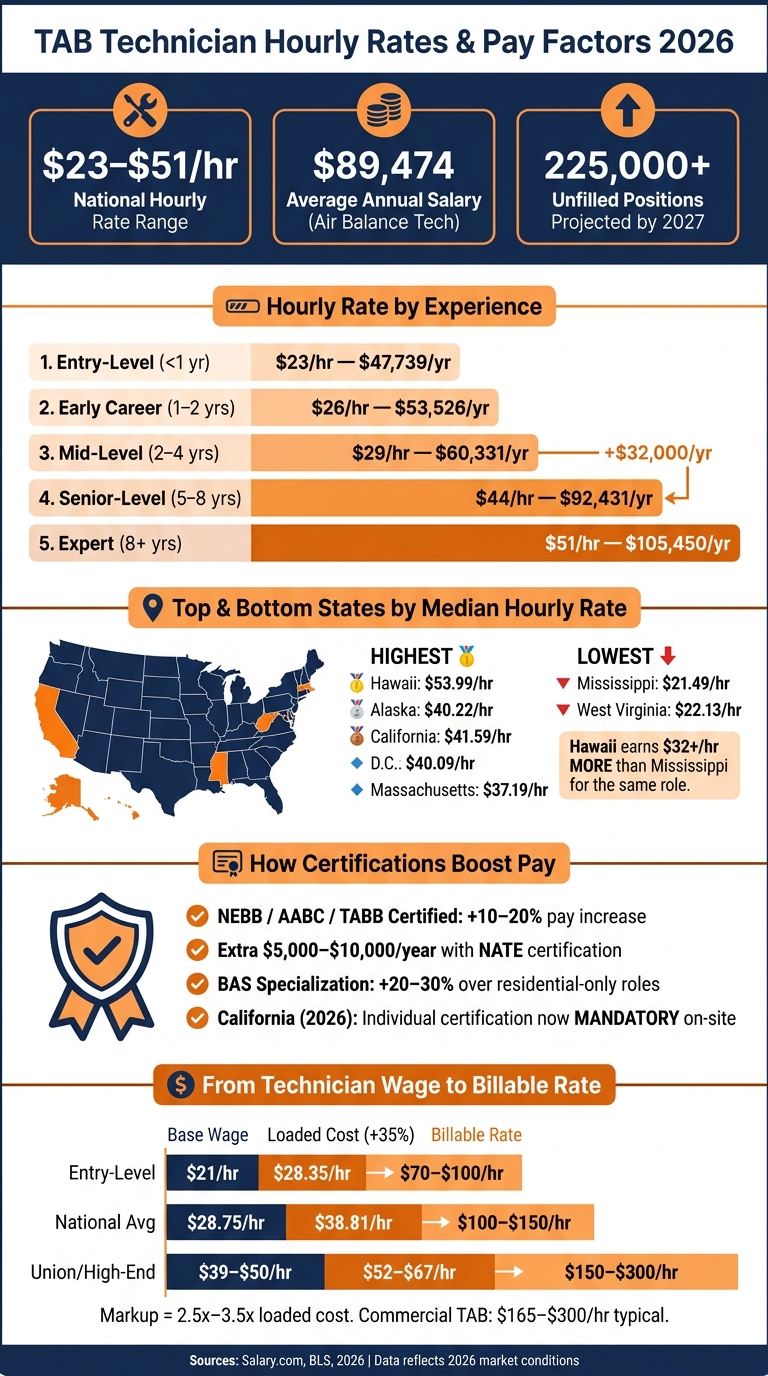
TAB Technician Hourly Rates & Pay Factors 2026
National Overview of TAB Technician Hourly Rates
Across the country, specialized TAB (Testing, Adjusting, and Balancing) technicians earn considerably more than general HVAC technicians. While the national median salary for general HVAC techs is around $57,300 per year, Air Balance Technicians average a much higher $89,474 annually as of 2026. This pay difference highlights the advanced skills and regulatory expertise required in TAB services.
Average Hourly Rates in 2026
Hourly wages for TAB technicians depend heavily on experience. Entry-level technicians typically earn $23/hour, while those with over eight years of experience can make upwards of $51/hour.
| Experience Level | Hourly Rate | Average Annual Salary |
|---|---|---|
| Entry-Level (<1 year) | $23/hr | $47,739 |
| Early Career (1–2 years) | $26/hr | $53,526 |
| Mid-Level (2–4 years) | $29/hr | $60,331 |
| Senior-Level (5–8 years) | $44/hr | $92,431 |
| Expert (>8 years) | $51/hr | $105,450 |
(Source: Salary.com, 2026)
The data shows that wages grow significantly with experience, especially from mid-level to senior roles, where annual salaries increase by nearly $32,000. This jump isn’t just about tenure; it reflects the ability to manage more complex and demanding projects independently.
Key Factors That Affect National Pay Rates
While experience is the most significant factor influencing pay, other elements also contribute. For instance, earning certifications from recognized organizations like NEBB, AABC, or TABB can significantly boost wages. As of January 1, 2026, California has introduced new regulations requiring TAB work on new construction and renovations to be performed by individually certified technicians, not just certified firms. This regulatory change has raised the value of certified professionals across the country.
Project complexity is another major factor. Technicians working in specialized environments – such as hospitals, clean rooms, or data centers – earn higher rates, with senior positions in these settings ranging between $48 and $52 per hour. These roles demand stricter tolerances, more detailed documentation, and greater technical accountability, which justifies the higher pay. These national trends provide a foundation for exploring regional differences and industry-specific influences in the following sections.
Regional Differences in TAB Technician Pay
When looking beyond national averages, it’s clear that where a TAB technician works has a major impact on their earnings. Location isn’t just a factor – it can be the deciding element. For example, Hawaii boasts the highest median pay at $53.99/hr, while Mississippi lags far behind at $21.49/hr. That’s a staggering difference of over $32 per hour for the same job role.
State-by-State Pay Breakdown
The Northeast and West Coast dominate when it comes to higher pay for TAB technicians. This is largely due to their dense commercial infrastructure, stricter energy regulations, and stronger union representation. On the other hand, states in the South and Appalachia tend to offer lower base wages, though this is somewhat balanced by a lower cost of living.
| State / Region | Median Hourly Rate | Annual Median |
|---|---|---|
| Hawaii | $53.99 | $112,300 |
| California | $41.59 | $86,500 |
| District of Columbia | $40.09 | $83,390 |
| Alaska | $40.22 | $83,660 |
| Massachusetts | $37.19 | $77,350 |
| Washington | $33.05 | $68,750 |
| Florida | $27.00 | $56,150 |
| Texas | $25.89 | $53,850 |
| West Virginia | $22.13 | $46,040 |
| Mississippi | $21.49 | $44,700 |
(Source: Salary.com / BLS, 2026)
States in the Sun Belt, such as Texas and Florida, sit in the middle of the pay scale. While their hourly rates are lower than those in the Northeast and West Coast, these states often provide other perks. For instance, their year-round workload and favorable tax conditions can make up for the lower base wages, offering competitive take-home pay.
Why Regional Pay Rates Vary
State-by-state disparities in TAB technician pay come down to a mix of economic, regulatory, and market-specific factors. Cost of living, local demand for projects, and state regulations all play a role. For example, in cities like Chicago, TAB reports are mandatory for final inspections under the local Mechanical Code and Energy Conservation Code. This creates consistent demand for certified TAB technicians, which in turn supports higher wages.
"The amount of money you take home for sweating in an attic or freezing on a commercial roof depends heavily on one thing: your zip code." – James Miller, Editor-in-Chief, HVAC Exam Master
Take Alaska, for instance. Here, wages are 35.4% above the national average due to a combination of critical infrastructure needs and a limited pool of technicians. Urban areas like San Francisco show hourly averages of $33.89/hr, while rural regions such as Mississippi hover closer to $22.73/hr. This difference reflects the concentration of specialized commercial projects in larger markets, giving urban technicians a significant pay advantage.
How Experience and Certification Affect TAB Technician Pay
After exploring national and regional wage trends, it’s time to dig into how certifications and experience can significantly boost the earnings of TAB technicians.
Pay Premiums for Certified Technicians
Certifications are a game-changer for TAB technician salaries. For instance, in 2026, technicians with NATE certification earn 10% to 20% more than their uncertified counterparts. That translates to an extra $5,000 to $10,000 annually. In Texas, the difference is even starker: licensed lead technicians can earn about $15,000 more each year compared to uncertified workers doing similar tasks.
For TAB-specific jobs, NEBB certification stands out as the industry benchmark. Achieving this certification involves mastering six technical domains and passing a rigorous 5-hour closed-book exam. Certified professionals gain access to high-profile building system projects that uncertified technicians can’t touch. Specializing in Building Automation Systems (BAS) can also provide a big boost, with pay increases of 20% to 30% over roles focused solely on residential projects. In areas where TAB reports are mandatory for Certificates of Occupancy, certified technicians are often the only ones qualified to handle such projects.
"Technicians holding NATE certification and EPA 608 Universal credentials consistently command wages well above the sector average." – VantaInsights
How Experience Drives Wage Growth
Experience plays a major role in boosting TAB technician salaries. Entry-level technicians typically earn around $23 per hour, but experts in the field can command over $51 per hour, showing how wages climb steeply with experience.
"The jump from apprentice to journeyman to master-level tech represents the single largest wage escalation in the trade." – VantaInsights
The most dramatic wage increases occur as technicians move from mid-level to senior roles. This reflects the added complexity and responsibility of the projects they handle. Senior and lead technicians often transition from hourly wages to salaried positions, with performance bonuses that reward their expertise and dependability.
These trends highlight the importance of gaining certifications and continuously building experience to maximize earning potential in the TAB field.
Industry Trends Affecting TAB Technician Hourly Rates in 2026
Growth in Construction and Retrofit Projects
The rising demand for TAB technicians is closely tied to the growth in U.S. construction and retrofit projects. Construction activity is outpacing the overall economy, with employment in this sector growing at 0.7% annually, compared to the broader economy’s 0.2% pace. Federal policies encouraging factory construction and retrofit projects for older buildings are sustaining this momentum. These retrofits, which often require optimized HVAC performance, help ensure a steady, year-round need for TAB technicians.
Stricter Energy and Compliance Standards
Changing energy codes are transforming TAB services from optional to essential. For example, Illinois has introduced stricter energy codes that require tighter tolerances and formal TAB reports before final inspections. In regions with high enforcement, skipping this step can delay project completion.
California has taken an even stricter approach. Beginning January 1, 2026, the 2025 California Mechanical Code mandates that TAB technicians working on new construction or renovation projects hold individual certifications from organizations like AABC, NEBB, or TABB. Certification at the firm level is no longer sufficient; the technician on-site must be personally certified. This change reduces the pool of qualified labor for compliance-heavy projects, driving up billable rates for certified professionals.
Skilled Trades Labor Shortages
A growing labor shortage is adding significant pressure to the TAB technician market. Nationally, there are 110,000 unfilled technician positions, a figure expected to climb to 225,000 by 2027. For every available technician, there are approximately 1.8 open jobs. Compounding the problem, five technicians retire for every two who enter the workforce.
The labor shortage is pushing wages higher. By March 2026, average hourly pay for construction workers reached $38.62, reflecting a 5% increase from the previous year. HVAC technician wages saw even steeper growth, climbing 15–25% between 2023 and 2026, with annual increases of 3.4% to 3.6% consistently outpacing inflation.
"The fact construction pay continues to be well above other sectors is a sign firms are struggling to find enough qualified workers." – Ken Simonson, Chief Economist, Associated General Contractors of America
For TAB technicians, these wage pressures are even more pronounced due to the specialized nature of their work. Additionally, cultural trends play a role, as younger workers often opt for gig-economy jobs over skilled trades, even when the pay is less competitive. This combination of factors not only drives wages higher but also increases the overall cost structure for TAB services, further elevating hourly rates for certified, experienced technicians.
TAB Service Labor Costs for Contractors
Understanding how TAB (Testing, Adjusting, and Balancing) labor costs are structured is critical for contractors as they plan their project budgets. These costs go far beyond a technician’s hourly wage, encompassing various additional expenses that ensure the service’s quality and sustainability.
How TAB Labor Costs Are Structured
A technician’s hourly wage is just one piece of the puzzle. The total cost for contractors includes several layers:
- Base Wage: The starting hourly rate for the technician.
- Labor Burden (35%): Covers payroll taxes, workers’ compensation, and health insurance.
- Overhead Costs: Includes vehicles, fuel, tools, and administrative expenses.
- Profit Margin: A target percentage to ensure the business remains profitable.
"The number one mistake I see HVAC contractors make is using their technician’s hourly wage as their labor cost… when you factor in non-billable time like travel and paperwork, the effective cost per billable hour is closer to $55–$65."
TAB firms also deal with additional expenses unique to the industry. Certifications for the firm can cost $10,000 to $15,000 annually. Precision test tools, essential for the job, require yearly calibration at approximately $600 per tool, and most firms operate six to twelve tools. These costs are incorporated into every billable hour.
Another key factor is the disparity between paid and billable hours. While technicians are typically paid for around 2,000 hours annually, only 1,000 to 1,500 of those hours are billable. The rest is consumed by travel, administrative tasks, safety meetings, and training. To set accurate billing rates, contractors must divide their total annual costs by the actual billable hours, not the total hours paid.
This layered structure explains the significant gap between what technicians earn and what clients are billed. The comparison below highlights this difference.
Technician Pay vs. Billable Rates: A Comparison
The markup on a technician’s fully loaded labor cost is substantial, typically ranging from 2.5x to 3.5x. This markup is necessary to cover overhead costs and achieve a net profit margin of 12–20%.
Here’s how wages, loaded costs, and billable rates stack up across different technician tiers in 2026:
| Technician Tier | Base Hourly Wage | Loaded Cost (+35% Burden) | Typical Billable Rate |
|---|---|---|---|
| Entry-Level (e.g., NC market) | $21.00 | $28.35 | $70–$100/hr |
| National Average | $28.75 | $38.81 | $100–$150/hr |
| Union/High-End Tech | $39.00–$50.00 | $52.65–$67.50 | $150–$300/hr |
For commercial TAB services in 2026, hourly rates generally range from $165 to $300, often with a minimum charge of three to four hours per site visit. Residential work tends to be less expensive, around $100 to $200 per hour, as it involves fewer certification and calibration requirements.
Flat-rate pricing is becoming more common, especially in markets like Chicagoland, where TAB reports are mandatory for obtaining a Certificate of Occupancy. Here’s an example of flat-rate costs:
- Rooftop Units (RTUs) and Air Handling Units (AHUs): $1,200–$2,000+ per unit
- Kitchen Hoods and Makeup Air Units: $500–$1,000+ per unit
"The standard markup is 2.5–3.5x the employee’s fully loaded labor cost… If your markup is below 2.5x loaded cost, you’re almost certainly not covering full overhead." – Sam Young, Founder & Fractional CFO, LevelCFO
Contractors who haven’t adjusted their rates in the past two years may find themselves 10–25% behind inflation in labor and overhead costs.
How Air Balance Masters Delivers Skilled TAB Services
Air Balance Masters stands out by showing how top-tier service can justify higher TAB (Testing, Adjusting, and Balancing) rates. Operating across MD, VA, PA, NJ, NY, DE, and DC, this certified air balance company partners with HVAC and general contractors to deliver reliable, certified services that help ensure compliance and prevent costly project delays. Their work is a testament to how expertise and precision can make a real difference.
Certified Technicians and Service Precision
Meeting the rigorous standards set by the National Comfort Institute (NCI), Air Balance Masters ensures that their technicians are skilled across all aspects of HVAC testing and balancing. These certifications require ongoing investment, but it’s this dedication that guarantees accuracy in every test. On top of that, the company calibrates its TAB instruments every year, ensuring every measurement is spot-on. Each report they produce verifies system performance against design specifications, highlighting any deficiencies for contractors to address. This attention to detail helps contractors meet required standards without unnecessary complications.
Supporting Contractors with Compliance Needs
The meticulous calibration and certification process directly benefits contractors, particularly when it comes to passing inspections and securing occupancy approvals. In many areas, TAB reports are essential for final inspections and Certificates of Occupancy. Missing or non-compliant documentation can lead to expensive delays. Air Balance Masters specializes in delivering detailed reports that confirm systems are balanced within ±10% of design flow, meeting the requirements outlined in the International Energy Conservation Code (IECC). Their expertise helps contractors avoid setbacks and keep projects on schedule.
What TAB technicians earn per hour
The pay for TAB technicians in 2026 hinges on factors like location, experience, and certifications. While the national median sits at $28.75 per hour, geography can create significant variations. For instance, technicians in Hawaii earn around $53.99 per hour, whereas those in Mississippi make about $21.49 per hour.
Experience also plays a major role in shaping wages. Entry-level technicians typically earn $47,739 annually, while seasoned experts can see salaries exceeding $105,450. Certifications such as NATE and EPA 608 Universal open doors to higher-paying commercial and industrial roles.
For contractors, the costs go beyond hourly wages. Factoring in labor burden, overhead, and profit margins, a technician earning $25 per hour can translate to a billable rate of approximately $92.81 per hour.
The industry itself is undergoing shifts. A shortage of skilled labor, stricter energy compliance standards, and growing demand for building automation expertise are pushing wages upward. This trend highlights the increasing value of certified and experienced TAB professionals. It’s clear that certifications and an understanding of regional pay trends are crucial for success in this field.
These pay dynamics have a direct impact on contractor budgets and project timelines. Partnering with a certified TAB provider like Air Balance Masters ensures access to technicians with verified qualifications. Their NCI certification and annual instrument calibration guarantee reliable, code-compliant reports and timely project completion. Making informed decisions based on accurate data and certified expertise is essential for managing TAB services efficiently.
FAQs
How do I estimate my TAB pay in my city?
To get an idea of your earnings as a Test and Balance (TAB) technician, several factors come into play. Where you work is a big one – areas with a higher cost of living tend to offer better pay. The type of projects you handle also makes a difference, with commercial and industrial jobs typically paying more than residential ones. Your experience, certifications, and specific skill set can also have a major influence on your paycheck. Don’t forget to look into extras like overtime pay or shift differentials, as these can add a nice boost to your total income beyond your base salary.
Which certification should I get first for higher rates?
To increase your earning potential, begin with the EPA 608 Universal certification. This certification is a legal requirement for working with refrigerants and serves as a critical first step toward higher wages. After that, obtaining a NATE certification could boost your income by as much as 20%. If you’re looking to specialize further in testing and balancing, certifications from organizations like AABC, NEBB, or TABB can help refine your skills and increase your professional value.
Why are TAB billable rates higher than wages?
TAB billable rates account for much more than just wages – they represent the true cost of running a business. Beyond an employee’s base pay, companies need to factor in payroll taxes, insurance, benefits, and paid time off. Then, there are operational expenses like vehicle costs, fuel, tools, equipment calibration, certification upkeep, and ongoing training. When you add these overhead costs to a reasonable profit margin, it ensures that businesses like Air Balance Masters can continue delivering their services efficiently and reliably.


