


When it comes to HVAC systems, two processes – Testing, Adjusting, and Balancing (TAB) and commissioning – are critical for ensuring proper performance. While both aim to improve system efficiency and comfort, they serve different purposes:
- TAB focuses on measuring and fine-tuning airflow and water flow to meet design specifications. It ensures that every room or zone gets the right amount of heating or cooling.
- Commissioning is a broader process that verifies HVAC systems are installed and functioning as intended throughout the building’s lifecycle, from design to occupancy.
Key Differences:
- Scope: TAB ensures specific airflow and water flow targets, while commissioning evaluates the entire system’s installation and operation.
- Timing: TAB occurs during late construction, whereas commissioning starts in the design phase and continues through occupancy.
- Deliverables: TAB provides detailed performance reports, while commissioning includes functional testing records, issue logs, and operational validation.
For simple HVAC setups, TAB may suffice. However, commissioning is necessary for complex systems or buildings with advanced controls, green certifications, or high energy demands. Both processes can work together to optimize system performance, reduce costs, and improve indoor comfort.
| Factor | TAB | Commissioning |
|---|---|---|
| Standard HVAC Install | Yes | Optional |
| Complex Systems | Yes | Yes |
| Green Certifications | Yes | Yes (Required) |
| High Energy Costs | No | Yes (Retro-commissioning) |
| Cleanrooms/Labs | Yes (Critical) | Yes (Critical) |
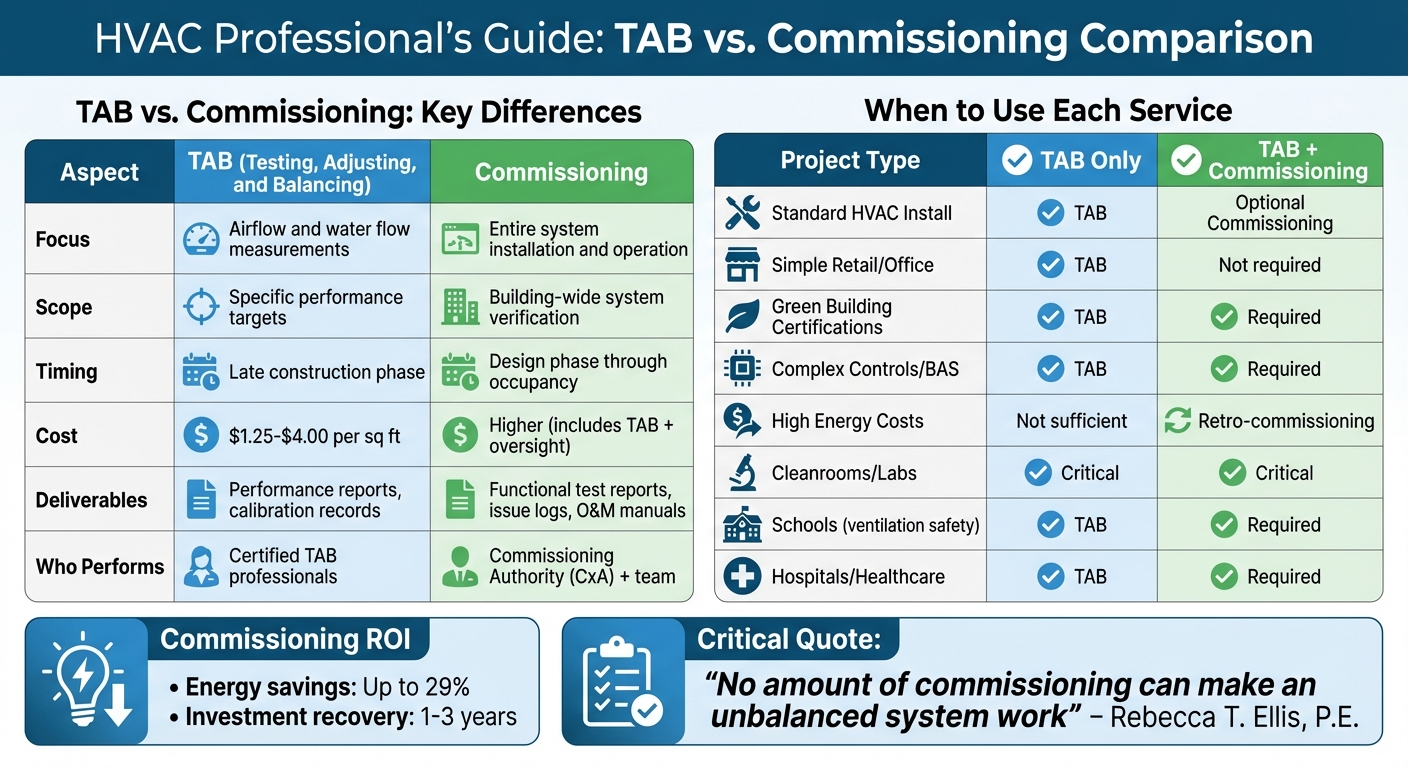
TAB vs Commissioning: Scope, Timing, and When to Use Each Service
𝗛𝗩𝗔𝗖 𝗧𝗲𝘀𝘁𝗶𝗻𝗴 & 𝗕𝗮𝗹𝗮𝗻𝗰𝗶𝗻𝗴 𝘃𝘀. 𝗛𝗩𝗔𝗖 𝗧𝗲𝘀𝘁𝗶𝗻𝗴 & 𝗖𝗼𝗺𝗺𝗶𝘀𝘀𝗶𝗼𝗻𝗶
TAB: Purpose and Scope
This section explains how Testing, Adjusting, and Balancing (TAB) ensures that air and water flows in a building align with the original design specifications. Using specialized instruments, technicians measure factors like airflow, pressure, temperature, and water flow rates throughout the system. They then fine-tune components such as dampers, valves, fans, and variable frequency drives (VFDs) to ensure every room and zone receives the correct levels of heating and cooling as outlined in the design documents. This process eliminates uneven temperatures, minimizes energy waste, and improves overall system efficiency. The following sections outline TAB’s key activities, the standards it follows, and its critical role in HVAC project success.
What TAB Involves
The TAB process is made up of three primary activities:
- Testing: Measuring and documenting performance metrics such as airflow, water flow, and pressure differences.
- Adjusting: Making precise changes to system components – like dampers, valves, fans, VFDs, sheaves, and belts – to correct imbalances.
- Balancing: Ensuring air and water are evenly distributed across the entire building.
Additionally, TAB technicians verify that Building Management System (BMS) control points are labeled correctly and functioning as intended. To ensure accuracy, all instruments used in the process must have been calibrated within the past year.
TAB Certifications and Standards
In the United States, three major organizations regulate TAB standards: the National Environmental Balancing Bureau (NEBB), the Associated Air Balance Council (AABC), and the Testing, Adjusting and Balancing Bureau (TABB). NEBB certification, for instance, requires candidates to master six key subject areas and pass a rigorous five-hour exam. Firms seeking certification must also demonstrate at least one year of continuous operation and provide six endorsements from architects, engineers, or building owners. Employing certified TAB professionals ensures that work is performed according to established methodologies and meets recognized industry benchmarks.
How TAB Supports HVAC Projects
TAB plays a crucial role in providing the necessary documentation for final inspections and certificates of occupancy. A certified final report confirms that the system complies with design specifications and local building codes. During the process, TAB professionals identify any deficiencies through testing and compile punch lists for contractors to address before the project is completed. As Rebecca T. Ellis, P.E., President of Questions & Solutions Engineering, Inc., aptly states:
"No amount of commissioning can make an unbalanced system work".
This underscores why TAB must be completed before any functional performance testing can begin.
HVAC Commissioning: Process and Responsibilities
Commissioning goes beyond the scope of Testing, Adjusting, and Balancing (TAB) by ensuring that building systems are installed and functioning as intended from the design stage through to occupancy. This process verifies that equipment operates correctly, meets minimum outdoor air standards, and validates essential components like air economizers, demand-controlled ventilation, outside air dampers, and exhaust fans. Below, we’ll break down the process step by step.
The Commissioning Process
Commissioning starts during the design phase and carries on through construction and system start-up. Early tasks include defining the Owner’s Project Requirements (OPR), reviewing the design for compliance, and creating a clear Commissioning Plan with detailed functional testing procedures. During construction, activities include observing equipment start-ups, conducting functional tests, and performing walk-throughs to catch issues like blocked air registers that could hinder ventilation. Additional specialized tests may also be performed, such as duct leakage testing, hydrostatic water system testing, and building envelope assessments using air leakage measurements and thermal imaging.
The Role of the Commissioning Authority (CxA)
The Commissioning Authority (CxA) is often an independent professional hired by the building owner to oversee and validate the entire commissioning process. The CxA’s responsibilities include preparing the Commissioning Plan, developing test procedures, witnessing equipment start-ups, and documenting the results. They also coordinate solutions for any identified deficiencies. Importantly, the CxA cannot make changes to design or installation procedures without written approval from both the owner and the architect/engineer.
The CxA collaborates with a commissioning team, which typically includes the architect/engineer, the contractor, the TAB firm, and the Building Automation System (BAS) vendor. To keep everything organized, the General Contractor designates a commissioning coordinator to manage and document the process.
Commissioning Standards and Guidelines
In the U.S., commissioning follows guidelines primarily provided by ASHRAE, along with standards from organizations like the Building Commissioning Association (BCxA), NEBB, and CIBSE. These standards elevate commissioning from a simple equipment check to a comprehensive, building-wide approach. They require specific deliverables, such as Commissioning Plans, Functional Test Reports, system validation documents, and operation and maintenance (O&M) manuals. Certifications like the Certified Commissioning Professional (CCP), accredited by ANAB, help ensure adherence to these best practices.
Additionally, ASHRAE and CDC guidelines emphasize proper ventilation, recommending upgrades such as MERV 13 air filters and ensuring that exhaust fans in spaces like bathrooms, locker rooms, and isolation areas are functioning as intended.
Key Differences Between TAB and Commissioning
TAB (Testing, Adjusting, and Balancing) and commissioning share a common goal: ensuring HVAC systems perform as intended. However, they differ significantly in scope, timing, and deliverables. Understanding these differences is crucial for project teams to select the right service – or combination of services – for their specific needs.
Scope and Objectives
The focus of TAB is on verifying that HVAC equipment meets the design’s airflow and water flow targets. It ensures that individual components work seamlessly with control systems while maintaining energy-efficient ventilation rates. As APPA aptly states, "Without the efforts of a TAB firm, a design is just a concept, not a reality". This process zeroes in on making sure the system delivers the intended performance at the component level.
Commissioning, on the other hand, takes a broader approach. It evaluates the entire HVAC system, ensuring all components are installed and functioning as intended according to the original design and engineering documents. This includes examining how systems interact and integrate. The U.S. Department of Energy notes that commissioning often reveals issues like faulty equipment or errors that waste energy and compromise indoor air quality and comfort. Functional performance testing (FPT) is central to commissioning, as the Associated Air Balance Council (AABC) highlights: it lies "at the heart of the commissioning process".
Project Phase and Responsibilities
The timing and responsibilities associated with TAB and commissioning differ greatly. TAB occurs during late construction, once equipment is operational and controls are finalized. Certified professionals handle this process, identifying deficiencies through punch lists that construction managers must address before the final report is issued.
Commissioning, by contrast, spans the entire project lifecycle, beginning in the design phase and continuing through construction and occupancy. A Commissioning Authority (CxA) oversees the process, collaborating with architects, engineers, contractors, and TAB professionals at various stages. This comprehensive involvement allows commissioning to identify and resolve potential issues early, preventing costly problems down the line.
Deliverables and Outcomes
TAB provides a certified final report that includes detailed performance metrics, system setpoints, calibration records, and any system quirks. It also confirms compliance with ANSI/ASHRAE standards 62.1 and 62.2.
Commissioning delivers a broader set of documentation. This includes functional performance testing records, issue logs, and evidence that systems operate as intended. The documentation may also cover test procedures, witnessed equipment start-ups, identified problems, and how they were resolved.
When to Use TAB, Commissioning, or Both
Deciding whether to use Testing, Adjusting, and Balancing (TAB), commissioning, or a combination of both depends on your project’s complexity, compliance requirements, and performance expectations.
When TAB Alone is Sufficient
For simpler HVAC installations, TAB services are typically enough to ensure that air and water flows meet the intended design specifications. Examples include small retail spaces, basic office buildings, and standard commercial projects. In these cases, TAB verifies that mechanical systems are functioning as planned.
TAB costs generally range from $1.25 to $4.00 per square foot, depending on factors like location and system complexity. Simpler projects, such as small retail stores or offices, tend to fall on the lower end of this range.
In new construction projects with straightforward designs and no green building certification requirements, TAB plays a key role. It confirms that the engineered design is implemented correctly by documenting airflow rates, temperatures, and system setpoints in accordance with ANSI/ASHRAE standards 62.1 and 62.2. However, for more intricate systems or when higher energy performance is needed, a full commissioning process becomes necessary.
When Full Commissioning is Required
For complex facilities, commissioning provides the in-depth oversight needed to ensure all systems work together seamlessly. Facilities like ISO 3/class 1 cleanrooms, laboratories, hospitals, and buildings aiming for LEED or other green certifications benefit greatly from combining TAB with commissioning. Schools and other high-occupancy buildings often also require commissioning to confirm that ventilation rates meet CDC and ASHRAE guidelines for safe indoor air quality.
If a building experiences high energy costs or thermal discomfort, retro-commissioning can help identify and resolve system inefficiencies.
Projects involving advanced Building Automation Systems (BAS), air economizers, or demand-controlled ventilation (DCV) also necessitate commissioning. This ensures that components like outside air dampers and occupancy-based setpoints are functioning as intended.
How TAB and Commissioning Work Together
TAB and commissioning are not competing services – they complement each other. TAB focuses on collecting precise measurements of airflow, water flow, and temperatures, which are critical for functional performance testing during the commissioning process. Commissioning authorities rely on this data to confirm that systems operate according to the owner’s design intent.
"The TAB process cannot be skipped, diminished, or compressed in favor of commissioning activities, building inspections, or owner occupancy."
- APPA: Leadership in Educational Facilities
For the best results, involve your TAB firm early – during the design document review phase. This ensures systems are designed to be testable, reducing the risk of expensive surprises during construction. Additionally, hiring TAB and commissioning firms independently, rather than through the mechanical contractor, helps maintain objectivity and avoid conflicts of interest.
The table below outlines when each service is recommended based on specific project factors:
| Factor | TAB Recommended | Commissioning Recommended |
|---|---|---|
| Standard HVAC Install | Yes (to confirm flows) | Optional |
| Green Building Certs | Yes | Yes (Required) |
| Complex Controls/BAS | Yes | Yes |
| High Energy Costs | No | Yes (Retro-commissioning) |
| Cleanrooms/Labs | Yes (Critical) | Yes (Critical) |
| School Reopening | Yes | Yes (for ventilation safety) |
Conclusion: Choosing the Right Service for Your Project
When deciding between TAB, commissioning, or both, it’s essential to consider the complexity of your project, compliance needs, and performance expectations. For simpler setups like retail spaces or standard office buildings, TAB services focus on ensuring mechanical systems meet design specifications for airflow and water flow. On the other hand, for more intricate facilities – such as hospitals, laboratories, or schools – commissioning ensures that all systems work together as intended. Selecting the right service is key to achieving efficient and reliable HVAC systems.
TAB plays a crucial role within the commissioning process by providing the precise measurements and adjustments needed to validate system performance. As the Associated Air Balance Council explains:
"Testing and balancing (TAB) is an integral part of the commissioning process. It is therefore recommended that an independent third party be retained to perform testing and balancing services on commissioning projects".
To maximize the benefits of these services, early involvement of TAB and commissioning professionals is essential. Hiring these experts independently preserves objectivity and ensures systems are designed to be testable. Additionally, project specifications should include full BMS access and require certifications from recognized agencies like AABC or NEBB for the individuals working on your project.
The financial advantages of proper commissioning are hard to ignore. Studies have shown energy savings of up to 29% and significant cost reductions, with initial investments often recovered within 1–3 years.
As APPA aptly puts it:
"Without the efforts of a TAB firm, a design is just a concept, not a reality."
Whether you opt for TAB alone or combine it with commissioning, verification ensures your HVAC systems deliver the comfort, efficiency, and safety your building occupants need and deserve.
FAQs
What are the advantages of combining TAB and commissioning for complex HVAC systems?
Combining Testing, Adjusting, and Balancing (TAB) with HVAC commissioning creates a unified process that ensures systems are both properly balanced and functioning as intended. TAB focuses on verifying that air and water flows align with design specifications – an essential step for commissioning to confirm the system operates as it should. Together, these processes tackle both the technical and performance needs of HVAC systems.
This integrated method brings several advantages, including better energy efficiency, enhanced indoor air quality, and the ability to catch design or installation issues early. It also simplifies documentation, making the system handover process smoother. By meeting the Owner’s Project Requirements (OPR), this approach ensures greater reliability, comfort, and cost-effectiveness for large-scale installations like schools, hospitals, and commercial buildings.
How does commissioning help reduce energy costs in HVAC systems?
Commissioning plays a key role in cutting energy costs by making sure HVAC systems operate as intended and addressing issues that waste energy. During this process, a commissioning authority evaluates system performance, verifies control settings, and checks if equipment is sized appropriately. This thorough inspection helps pinpoint and resolve problems like malfunctioning equipment, miscalibrated sensors, or poorly adjusted dampers – issues that can lead to excessive heating, cooling, or fan use, driving up utility bills. Many facilities see a quick payback on their investment, often within 1 to 3 years.
Beyond fixing inefficiencies, commissioning ensures that energy-saving features – such as variable-speed drives, advanced controls, and optimized airflow – are functioning correctly. Research indicates that buildings without commissioning can cost 8–20% more to operate. By validating system performance, training staff, and establishing a baseline for ongoing monitoring, commissioning not only boosts energy efficiency but also helps reduce long-term operating expenses.
Why should you hire independent professionals for TAB and commissioning services?
Hiring independent professionals for Testing, Adjusting, and Balancing (TAB) and HVAC commissioning plays a key role in ensuring your building’s systems are assessed objectively. These experts bring specialized certifications and hands-on experience to confirm that your HVAC systems align with the intended design and operate as efficiently as possible. By working with an independent party, you avoid potential conflicts of interest that can occur when the same contractor handles both installation and evaluation.
These professionals are skilled at identifying and addressing problems like faulty equipment, uneven airflows, and control system errors. Fixing these issues can lead to better energy efficiency, improved indoor air quality, and adherence to building codes. Plus, the energy savings achieved through these adjustments often offset the costs within just a few years, safeguarding your investment and ensuring your systems perform well over the long term.


