


Want to save up to 30% on energy costs while enjoying a smarter home? IoT-enabled HVAC systems are transforming how we control heating, cooling, and air quality. These systems combine smart thermostats, sensors, and advanced communication protocols like Wi-Fi, Zigbee, and Matter to deliver automated, efficient climate control.
Here’s what you’ll learn in this guide:
- Core components like smart thermostats, sensors, and gateways.
- Top protocols for device communication, including Wi-Fi, Z-Wave, and Thread.
- How to integrate IoT HVAC systems into designs with smart homes for seamless operation.
- The energy savings and maintenance benefits of these systems.
- Solutions to common challenges like compatibility and security issues.
IoT in HVAC: Lessons from Rheem, Mitsubishi Electric Trane & Comfort Systems USA
Core Components of IoT HVAC Systems
To design effective IoT HVAC installations, it’s essential to understand the hardware and software driving these systems. These components work in harmony to gather data, make informed adjustments, and deliver precise climate control across various zones in a building. Let’s break down the key elements that make these systems tick.
Smart Thermostats and Controllers
Smart thermostats act as the brain of an IoT HVAC system, collecting data from sensors and even external sources like weather forecasts to adjust settings in real time. Unlike traditional thermostats, which simply turn systems on or off, these advanced devices use machine learning to adapt to user preferences and occupancy patterns.
Several popular models showcase the range of capabilities available today. For instance:
- Nest Learning Thermostat: Uses machine learning to create automated schedules based on user habits.
- ecobee Smart Thermostat: Features remote room sensors to monitor multiple spaces, eliminating hot and cold spots.
- Honeywell Home T9: Utilizes geofencing to adjust temperatures based on the location of a linked smartphone.
- Carrier Infinity Control: Goes beyond temperature control by managing indoor air quality, including humidification and ventilation.
When installing these devices, contractors should prioritize safety and compatibility. Using a multimeter to confirm the power is off, checking for system support, and adding C-wire adapters if needed are all critical steps to ensure proper installation.
Sensors and Smart Vents
Sensors are the backbone of data collection in IoT HVAC systems. They monitor key metrics like temperature, humidity, occupancy, and indoor air quality (including CO₂ levels and particulate matter). This real-time data enables the system to make precise adjustments.
Smart vents take this a step further by enabling zoning for multi-zone systems. These vents use automated dampers to direct airflow only to occupied rooms, reducing energy consumption in unused spaces. This dynamic approach replaces the one-size-fits-all model of traditional systems, offering a more efficient and responsive solution.
By combining sensors and vents, IoT HVAC systems can adapt on the fly to changes in both internal and external conditions.
Gateways and Connectivity Devices
Gateways are the communication hubs of IoT HVAC systems. They enable devices to talk to each other by translating protocols, such as converting Zigbee to Wi-Fi, giving you the flexibility to choose the best hardware for the job.
Modern gateways often come with local processing capabilities, reducing reliance on cloud services. This not only speeds up response times but also ensures automation continues even if the internet goes down. For commercial setups, universal data connectors facilitate server-to-server and machine-to-machine communication, allowing seamless integration of equipment from manufacturers like Allen Bradley or Siemens.
Edge-to-cloud technology plays a crucial role here, connecting all nodes and centralizing data for real-time access. Before installation, it’s vital to evaluate your network for potential dead zones. Adding mesh network nodes or range extenders can help gateways reach all sensors and vents. For long-term compatibility, look for hubs that support multiple protocols – such as Z-Wave (908 MHz for reliability) and Zigbee (2.4 GHz for low-power sensors) – alongside standard Wi-Fi. These features ensure smooth communication and integration with broader smart home ecosystems.
Communication Protocols for IoT HVAC Integration
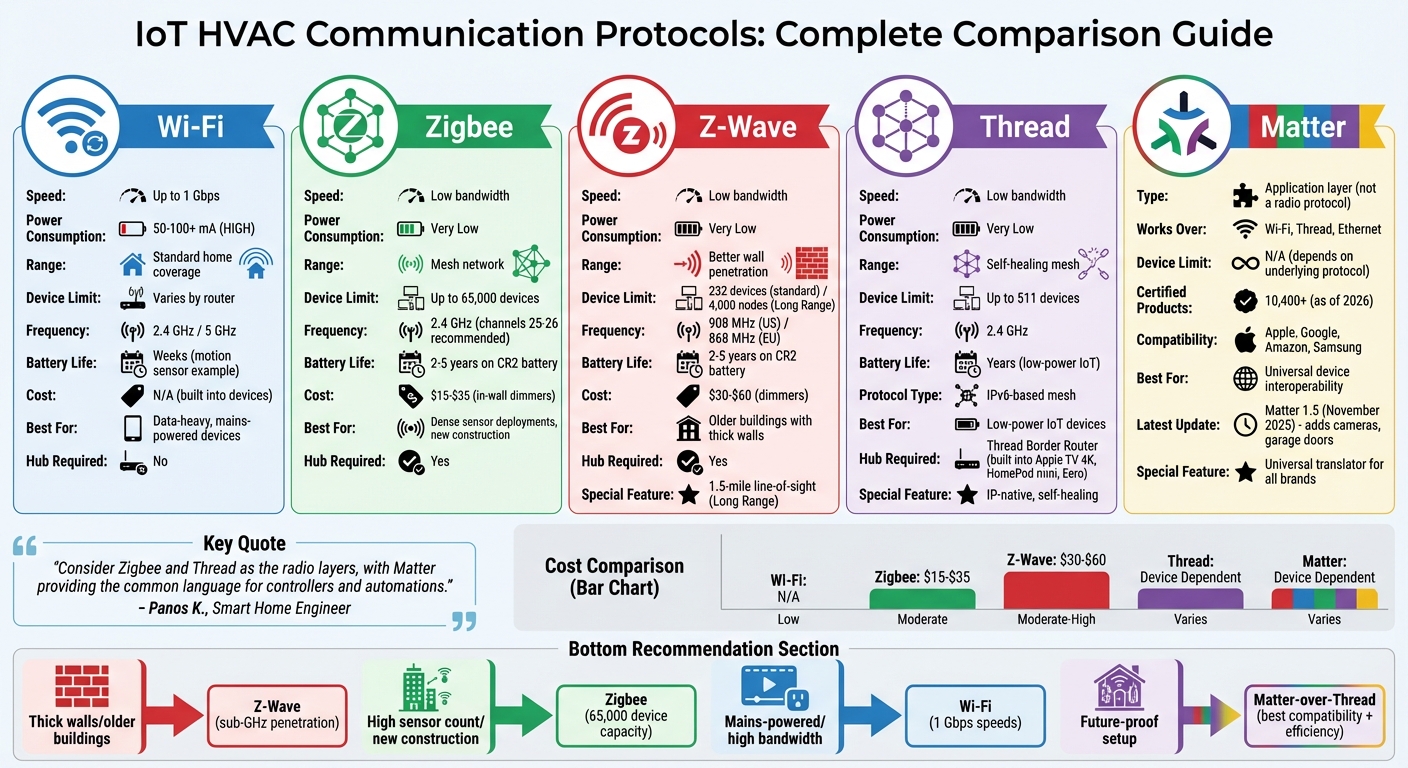
IoT HVAC Communication Protocols Comparison: Wi-Fi, Zigbee, Z-Wave, Thread, and Matter
Choosing the right communication protocol is critical when integrating IoT with HVAC systems. These protocols dictate how devices interact, their energy usage, and the overall dependability of the system. As SmartHomeWizards puts it:
"Wireless protocols establish the technical rulebook – defining frequencies, data transmission methods, network structures, and security measures that enable device communication."
Wi-Fi, Zigbee, and Z-Wave
Wi-Fi delivers speeds of up to 1 Gbps, making it suitable for data-heavy devices, and its straightforward setup eliminates the need for additional hubs. However, Wi-Fi’s power consumption, with radios drawing 50–100+ mA, limits its practicality for battery-powered devices. For instance, a Wi-Fi motion sensor might need recharging every few weeks, whereas Zigbee or Z-Wave sensors can run for 2–5 years on a single CR2 battery.
Zigbee operates on a mesh network capable of supporting up to 65,000 devices. This makes it ideal for dense sensor deployments, though its use of crowded frequencies can lead to interference with Wi-Fi and Bluetooth. To avoid this, using channels 25 or 26 – outside standard Wi-Fi overlaps – is recommended. Zigbee devices are also affordable, with in-wall dimmers priced between $15 and $35.
Z-Wave, on the other hand, uses sub-GHz frequencies (908 MHz in the U.S., 868 MHz in Europe), which allows it to penetrate walls made of dense materials like concrete. Its strict certification process ensures compatibility across devices but often results in higher costs, with dimmers ranging from $30 to $60. A standard Z-Wave mesh supports 232 devices across four hops, while the Long Range version expands this to 4,000 nodes and offers a 1.5-mile line-of-sight range.
For older buildings with thick walls, Z-Wave’s sub-GHz frequency is a strong choice. Meanwhile, Zigbee’s scalability and lower costs are better suited for new constructions with a high number of sensors. Wi-Fi, with its high bandwidth, remains a solid option for mains-powered devices. Together, these protocols lay the groundwork for integrating advanced technologies like Thread and Matter into modern IoT systems.
Thread/Matter and BACnet/Modbus
Beyond basic radio protocols, advanced solutions improve device interoperability. Thread, an IPv6-based mesh protocol, is designed for low-power IoT devices. Its IP-native design assigns each device a unique address, eliminating the need for proprietary translation layers. Thread networks can handle up to 511 devices and are self-healing, rerouting traffic if a node fails. A Thread Border Router connects these devices to the broader network, and many devices like Apple TV 4K, HomePod mini, and Eero routers now include this functionality at no extra cost.
Matter, unlike Thread, is an application layer that works on top of Wi-Fi, Thread, and Ethernet. It acts as a universal translator, enabling seamless communication between devices from major brands like Apple, Google, Amazon, and Samsung. By 2026, over 10,400 Matter-certified products are available, with the November 2025 Matter 1.5 update adding support for cameras (via WebRTC) and closures like garage doors. For long-term compatibility, contractors should prioritize Matter-over-Thread devices, which combine Thread’s efficient mesh networking with Matter’s broad compatibility.
As Panos K., a Smart Home Engineer, explains:
"Consider Zigbee and Thread as the radio layers, with Matter providing the common language for controllers and automations."
Thread 1.4, released in January 2026, now requires credential sharing to prevent the creation of separate, incompatible mesh networks – a critical step for improving reliability and building performance.
BACnet and Modbus cater to different needs. BACnet, developed by ASHRAE, is tailored for building automation in commercial and institutional settings. It uses a master-slave/token-passing protocol and offers native device discovery, simplifying the integration of multi-vendor components.
Modbus, originally designed by Modicon, operates over RS-232, RS-485, and TCP/IP networks. Its minimal overhead makes it ideal for resource-limited HVAC components like sensors and actuators. In commercial environments where systems like lighting, security, and climate control must work together, BACnet is the go-to choice. Meanwhile, Modbus provides a simple, reliable connection for industrial-grade devices. Protocol gateways can bridge these legacy systems with modern IoT controllers, though integrating industrial hardware with IP-based devices can pose challenges.
Understanding these protocols is key to ensuring smooth communication across IoT HVAC and smart home systems.
How to Integrate IoT HVAC Systems with Smart Homes
Integrating IoT HVAC systems into a smart home setup involves evaluating your current infrastructure, ensuring proper installation, and thoroughly testing the system to confirm it works seamlessly. Skipping any of these steps can lead to compatibility issues or inefficiencies.
Assessing Infrastructure Compatibility
Start by identifying your HVAC system type – whether it’s forced-air, heat pump, boiler, or multi-stage – and confirm the presence of a C-wire. If your system lacks a C-wire, you may need an adapter or professional rewiring to proceed.
Consider the "5,000 Rule" when deciding whether to upgrade or replace your system: multiply the system’s age by the estimated repair cost. If the total exceeds $5,000, replacing the unit might be more economical. For reference, installing a new HVAC system in a 1,500-square-foot home typically costs between $5,000 and $12,000. Keep in mind that traditional HVAC systems usually last 10 to 15 years.
Ensure your network can handle the added devices. For larger properties, a mesh network can help maintain connectivity, preventing disruptions to automated schedules. As noted by Varsity Zone HVAC of Fishers:
"A robust network connection is the linchpin for seamless communication among various smart home devices and the HVAC system."
Before removing old components, take a photo of the current wiring and label each wire for easy reinstallation. Additionally, check if legacy components can receive firmware updates to address security concerns. For commercial projects, consult the local Authority Having Jurisdiction (AHJ) to confirm compliance with specific ASHRAE standards, such as 90.1 or 62.1.
Once you’ve confirmed compatibility, you can move on to installation and configuration.
System Installation and Configuration
Before starting, turn off the power and verify with a multimeter. For advanced systems like VRF (Variable Refrigerant Flow), use a universal HVAC gateway that supports two-way communication rather than one-way IR-based controls, which lack real-time feedback. Opt for components that use open protocols like BACnet or Modbus to ensure flexibility and scalability.
| Integration Method | Communication Type | Best Use Case |
|---|---|---|
| Manufacturer BACnet Gateway | Bi-directional | Commercial sites; brand-specific setups |
| Universal HVAC Gateway | Bi-directional (Native) | Multi-brand VRF systems; high-end home automation |
| IR-based Gateway | One-directional | Simple, low-cost retrofits; split/mini-split systems |
After installation, use the manufacturer’s app to connect the system to Wi-Fi, configure schedules, and enable geofencing for automatic adjustments based on occupancy. In larger homes, zoning systems with individual sensors in each area can help eliminate temperature inconsistencies and reduce energy use in unoccupied rooms. Upgrading to a smart HVAC system can cut energy consumption by up to 30%.
Once the system is installed, the next step is to test and fine-tune its performance.
Testing, Adjusting, and Balancing (TAB)
Testing and balancing the system ensures everything runs as intended. Start by calibrating IoT sensors for temperature, humidity, and air quality to ensure accurate real-time data. Test geofencing and remote access features to confirm that the system responds correctly to user location.
For larger commercial projects, formal HVAC commissioning may be required under ASHRAE Guideline 0 and Guideline 1.1. During inspections, verify that duct systems meet leakage and insulation standards outlined in ASHRAE 90.1 Section 6.
Certified providers like Air Balance Masters offer professional air balance testing and certification services across MD, VA, PA, NJ, NY, DE, and DC. Their expertise ensures systems meet design specifications, helping contractors secure final inspection approvals and occupancy certificates. These services also identify deficiencies and ensure compliance with NCI standards.
Lastly, configure the system to monitor sensor analytics, enabling early fault detection. Use energy reports to confirm that adjustments have improved efficiency and reduced energy consumption.
Benefits of IoT HVAC and Smart Home Integration
Bringing IoT-enabled HVAC systems into your smart home setup offers clear perks – like cutting energy costs, improving indoor air quality, and boosting reliability. These systems streamline home performance while keeping expenses in check.
Energy Efficiency and Cost Savings
IoT HVAC systems come equipped with AI-driven thermostats that learn your habits and adjust heating and cooling schedules automatically. Features like geofencing can detect when you’re away and switch to energy-saving modes, trimming runtime by up to 15% without sacrificing comfort. These small, automated tweaks can lead to noticeable reductions in your heating and cooling bills.
Zoning systems take efficiency a step further by focusing on occupied areas. Instead of wasting energy on empty rooms, smart vents direct airflow to spaces where it’s actually needed – like living areas during the day or bedrooms at night. This targeted approach can lower energy bills by as much as 30%. Altogether, IoT integration can cut daily electricity use by nearly half and reduce annual greenhouse gas emissions by up to 65% compared to systems that run constantly.
Another game-changer is predictive maintenance. Real-time monitoring catches issues early – like refrigerant leaks or clogged coils – before they snowball into expensive repairs. This proactive method saves 8% to 12% compared to standard scheduled maintenance and up to 40% compared to waiting for a breakdown. Plus, it reduces equipment failures by 20% to 25%.
| IoT HVAC Feature | Primary Benefit | Estimated Savings/Impact |
|---|---|---|
| Smart Thermostats | Automated scheduling | 10–23% cost reduction |
| Zoning Systems | Room-specific control | Up to 30% energy savings |
| Predictive Analytics | Early fault detection | 8–12% savings over traditional maintenance |
| Geofencing | Location-based adjustments | 15% runtime reduction |
| AI Optimization | Personalized comfort | 10–20% reduction in energy costs |
These features not only save money but also help create a healthier living environment.
Improved Indoor Air Quality (IAQ)
IoT sensors continuously monitor factors like CO₂ levels, humidity, and particulate matter (PM2.5), adjusting ventilation and filtration as needed. For instance, if cooking produces smoke or VOCs, the system can automatically boost fresh air intake. Devices like the Honeywell Home T10 Pro and Daikin One+ thermostats ensure humidity stays between 30% and 50%, which helps prevent mold and reduces allergens like dust mites.
Smart vents also play a role by eliminating stagnant air pockets and maintaining balanced airflow throughout your home. Sensors monitor filter performance and send alerts when it’s time to replace them, ensuring filtration stays effective. Cloud-based analytics provide a broader view of IAQ trends, helping you identify recurring issues and fine-tune ventilation schedules.
Remote Monitoring and Predictive Maintenance
Beyond energy efficiency and air quality, IoT systems offer the convenience of remote access. Whether you’re traveling or managing multiple properties, you can monitor system performance and tweak settings from your smartphone. Cloud-based dashboards give you 24/7 visibility, making it easier to dispatch service technicians with the right diagnostic info upfront.
IoT platforms analyze historical data to predict when maintenance is needed, giving you a heads-up for repairs that can extend the life of your equipment. Businesses that adopt predictive maintenance report ROI increases of up to 545%.
Automated alerts keep you informed about critical issues, like clogged filters or unusual pressure readings. Some systems even take it a step further by forecasting demand for consumables, like air filters, and automatically reordering them – minimizing downtime and keeping everything running smoothly.
Challenges and Solutions in IoT HVAC Integration
IoT-enabled HVAC systems bring a wealth of advantages, yet their integration often presents challenges for contractors and engineers. Navigating these obstacles is essential to achieve seamless operation and avoid costly setbacks.
Compatibility Issues and Legacy Systems
One of the most common hurdles is getting various systems to communicate effectively. For example, HVAC units might use protocols like BACnet, while lighting systems rely on Zigbee or other proprietary languages. These differences create roadblocks to full system integration.
Older equipment adds another layer of complexity. Many legacy systems lack built-in connectivity, requiring retrofitting or the use of protocol converters to enable communication. In fact, studies show that 60–70% of free IoT solutions included with HVAC systems remain unconnected due to installation challenges.
"Installation caused us the most issues. Installers are plumbers or contractors or boiler experts, they don’t have IT backgrounds. Once they have to call IT, it’s game over."
- Peachie Maher, Connected Product Development, Rheem Commercial Water
To tackle these compatibility challenges, gateway devices can bridge older systems with modern IoT platforms. For installations where Wi-Fi is unreliable or unavailable, cellular connectivity modules provide a direct link to cloud services, bypassing local network issues. When selecting new equipment for projects involving legacy systems, prioritize manufacturers that offer simple, intuitive installation processes. Systems requiring more than five minutes or significant IT involvement are more likely to fail in the field.
Network Security and Data Privacy
Once compatibility is addressed, securing the network becomes critical. IoT devices can serve as entry points for cyberattacks. For instance, the 2013 Target breach exploited HVAC vendor credentials, and in 2021, a vulnerability in the KNX protocol allowed attackers to remotely disable HVAC systems.
To mitigate these risks, strong encryption and secure authentication methods, like multi-factor authentication, are essential. These measures help protect remote management interfaces and keep data transmissions secure. Additionally, maintaining visibility into active IoT devices is crucial. Implementing a robust firmware update schedule and enabling over-the-air (OTA) updates can quickly address vulnerabilities before they are exploited. Network segmentation – keeping IoT systems separate from corporate or personal networks – adds another layer of security. Regularly monitoring network traffic with automated logging and alert systems can also help identify connectivity issues or suspicious activity early.
These proactive steps ensure that IoT HVAC systems remain secure and reliable over time.
Scalability and Future-Proofing
Planning for growth is another challenge. Systems must be designed to adapt to future needs without requiring a complete overhaul. Dividing spaces into zones with independent controls and choosing devices that integrate with major ecosystems like Google Home or Amazon Alexa can simplify future expansions.
Cloud-based management platforms provide scalability by enabling centralized control and remote updates for multiple properties. Machine learning capabilities further enhance these systems by learning and adjusting to user behaviors and occupancy patterns automatically. For example, the Empire State Building achieved a 38% reduction in energy consumption after implementing an IoT-based energy management system that scaled across its massive infrastructure. Additionally, selecting hardware that supports add-ons like remote sensors – such as those from Ecobee – makes it easy to expand temperature monitoring without replacing existing thermostats.
Proper commissioning is a critical step in ensuring scalability and long-term performance. After installation, thorough testing, adjusting, and balancing (TAB) verifies that airflow, temperature regulation, and sensor accuracy align with design specifications. Certified TAB services, like those offered by Air Balance Masters, can streamline the process, helping contractors secure final inspection approvals and certificates of occupancy efficiently.
"The biggest thing I would have changed: switching partners faster. I was nervous about changing because they already knew where the problems were, but that ended up biting me."
- Mark Adams, IoT Product Manager, Mitsubishi Electric Trane
What IoT HVAC means for your home
Bringing IoT HVAC systems into the mix with smart home devices is changing the game for climate control, maintenance, and energy efficiency. Instead of waiting for things to break, predictive maintenance offers a smarter approach, saving 8%–12% compared to traditional schedules and up to 40% when stacked against run-to-failure methods. By using smart thermostats, sensors, and connectivity protocols like Wi‑Fi, Zigbee, and Matter, these systems adapt to occupant behavior and fine-tune performance.
Today, over 70% of HVAC systems include Wi‑Fi and Bluetooth capabilities. Upgrading to IoT-enabled equipment can cut energy use by as much as 30%, while smart thermostats alone can trim annual heating and cooling costs by 10%–23%. These advancements are reshaping how buildings consume energy, with numbers that clearly highlight the practical benefits of IoT integration.
However, the key to unlocking these benefits lies in proper installation and commissioning. As Sarah Lee, an AI Analyst, explains:
"The integration of these components into a unified system is crucial for achieving optimal performance, energy efficiency, and reliability".
This is where professional testing, adjusting, and balancing (TAB) services become indispensable. Without precise calibration, even the most advanced system can falter, making poor decisions based on inaccurate sensor data. Certified TAB services ensure that systems function as intended, delivering compliance and efficiency.
For contractors in MD, VA, PA, NJ, NY, DE, and DC, teaming up with certified experts like Air Balance Masters guarantees that IoT HVAC systems meet design specs and pass regulatory inspections. Their TAB services confirm proper airflow, temperature control, and sensor accuracy, ensuring smooth final approvals and occupancy certifications. Professional oversight like this ensures systems perform reliably and consistently over time.
FAQs
Do I need a C-wire to install a smart thermostat?
Whether or not you need a C-wire largely depends on your thermostat model and the wiring in your home. Many smart thermostats rely on a C-wire to provide steady power for features like Wi-Fi connectivity and digital displays. If your home doesn’t already have a C-wire, you can consider solutions like a C-wire adapter or other alternative setups. To ensure smooth operation and avoid problems like Wi-Fi drops, having a C-wire is generally recommended whenever possible.
Which protocol should I choose for HVAC sensors: Wi-Fi, Zigbee, Z-Wave, or Thread/Matter?
When choosing the best protocol, it all comes down to what you prioritize: reliability, power efficiency, or long-term compatibility. For HVAC sensors, Thread with Matter support stands out as a top choice. It offers low power consumption, supports mesh networking for better coverage, and integrates effortlessly with other devices.
On the other hand, Wi-Fi can lead to interference issues and drains batteries more quickly, making it less ideal for such applications. While Zigbee and Z-Wave are dependable options, they’re not as prominent in modern, scalable solutions when compared to Thread and Matter.
When should I hire a TAB firm to commission an IoT HVAC system?
Hiring a TAB (Testing, Adjusting, and Balancing) firm during the final stages of installation – or just before occupancy – is a smart move to confirm that your IoT HVAC system is functioning as intended. These firms specialize in ensuring that sensors and controls are calibrated correctly, which helps your system deliver optimal performance and energy efficiency. Plus, they play a key role in helping you secure final inspection approvals and occupancy certificates, particularly for commercial projects.


