


Leaky HVAC ducts waste energy and money. If your ductwork isn’t sealed properly, it can lose up to 30% of conditioned air, driving up energy bills and reducing system efficiency. There are two main ways to measure this: Total Duct Leakage (TDL) and Leakage to Outdoors (LTO).
- TDL measures all air escaping from your duct system, whether inside or outside your home.
- LTO focuses only on air leaking into unconditioned spaces like attics or crawlspaces.
Both tests are vital for energy efficiency and meeting building codes. TDL is simpler and often done during construction, while LTO is more specific and typically performed when ducts run through unconditioned spaces.
Key takeaway: TDL is about overall system performance, while LTO pinpoints wasteful leaks outside the home. Proper testing ensures lower energy costs and better HVAC performance.
What is Total Duct Leakage?
Definition and Scope
Total duct leakage refers to the amount of air escaping from an HVAC duct system. This includes air leaking into both conditioned spaces, like wall cavities or floor joists, and unconditioned areas, such as attics or crawlspaces. It provides a detailed look at the duct system’s overall performance by evaluating the air handler, supply and return ducts, and all their connections.
"The ‘total’ duct leakage test measures how much air leakage there is for all of the ductwork connected to the HVAC system, including ducts located both outdoors and indoors."
The test quantifies the leakage to help assess and address any inefficiencies.
Testing Methodology
To measure total duct leakage, technicians use a duct blaster, which is a specialized fan paired with a manometer. First, all registers are sealed using adhesive plastic, foam plugs, or cardboard to prevent airflow. The fan is then attached to the system – usually at the air handler or a main return – and pressurizes the ducts to 25 Pascals (0.10 in. water column). The resulting leakage is measured in CFM25 (cubic feet per minute at 25 Pascals).
For reference, ENERGY STAR Version 3 Rev 11 sets specific thresholds for total duct leakage:
- At rough-in: ≤ 4 CFM25 per 100 square feet of conditioned floor area
- At final testing: ≤ 8 CFM25 per 100 square feet of conditioned floor area
This process ensures accuracy during different phases of construction and system evaluation.
Applications and Use Cases
Understanding total duct leakage is essential for improving HVAC energy efficiency and meeting building codes. Testing is typically done at two stages during construction:
- Rough-in testing: Conducted after ductwork and the air handler are installed but before drywall is applied. This stage allows for easier detection and repair of leaks.
- Final testing: Performed after construction is complete, ensuring no new leaks or disconnections occurred during the finishing stages.
Total duct leakage testing is also beneficial for existing homes, especially those with uneven indoor temperatures or high energy bills. It helps identify whether duct issues are contributing to energy loss. Additionally, this test is required by several codes and programs, such as the International Energy Conservation Code (IECC), the International Residential Code (IRC), and ENERGY STAR Single-Family New Homes.
For certified testing and reporting in MD, VA, PA, NJ, NY, DE, and DC, reach out to Air Balance Masters.
What is Leakage to Outdoors?
Definition and Purpose
While total duct leakage measures all air loss in an HVAC system, Leakage to Outdoors (LTO) focuses specifically on the air escaping to unconditioned spaces like attics, crawlspaces, or garages. This type of leakage is particularly wasteful because it represents energy loss that doesn’t contribute to indoor comfort. In contrast, some air loss within a home, such as into wall cavities, may still indirectly help maintain a comfortable environment.
The difference is crucial. For instance, air leaking into a wall cavity might still provide some benefit, but air escaping into an attic that can reach 140°F during summer is pure energy waste. As Allison Bailes, Founder of Energy Vanguard, explains:
"Leakage outside – in an unconditioned attic, crawl space, basement, or garage – is what you really pay for…and sometimes you pay twice".
Understanding and isolating this type of leakage is key to improving energy efficiency, which is why specific testing methods are used to measure it.
Testing Procedure
Measuring leakage to outdoors requires a more advanced process compared to total duct leakage tests. Technicians use a combination of a blower door and a duct blaster, employing what’s known as the pressure-neutralization method. Here’s how it works:
- The blower door pressurizes the entire house to 25 Pascals relative to the outdoors.
- Simultaneously, the duct blaster pressurizes the duct system to the same 25 Pascals.
When the house and the ducts are at equal pressure – eliminating any pressure differential – no air can escape into the conditioned space. This setup ensures that any airflow measured reflects leakage exclusively to unconditioned areas. The results are recorded in CFM25 (cubic feet per minute at 25 Pascals), offering a precise measurement of energy-wasting leaks.
This method is essential for regulatory compliance and efficiency improvements.
Applications and Use Cases
LTO testing is a requirement for programs like ENERGY STAR certification, utility rebates, and code compliance when ductwork is located in unconditioned spaces. For example, the ENERGY STAR Single-Family New Homes Version 3 program requires that duct leakage to outdoors not exceed the greater of either ≤ 4 CFM25 per 100 square feet of conditioned floor area or ≤ 40 CFM25. This is half the allowable limit for total duct leakage.
Utility programs often set even stricter standards. For instance, Duke Energy’s Residential New Construction Program requires leakage to outdoors to be no more than 3% to qualify for rebates. In some scenarios, the LTO test can be skipped if total duct leakage is exceptionally low (≤ 4 CFM25 per 100 sq. ft.) or if all ductwork is within the conditioned space.
For those needing certified LTO testing in areas like MD, VA, PA, NJ, NY, DE, and DC, Air Balance Masters provides services that comply with ENERGY STAR and local code requirements.
Duct Tightness Testing- Total Duct Leakage and Leakage To Outside
Key Differences Between Total Duct Leakage and Leakage to Outdoors
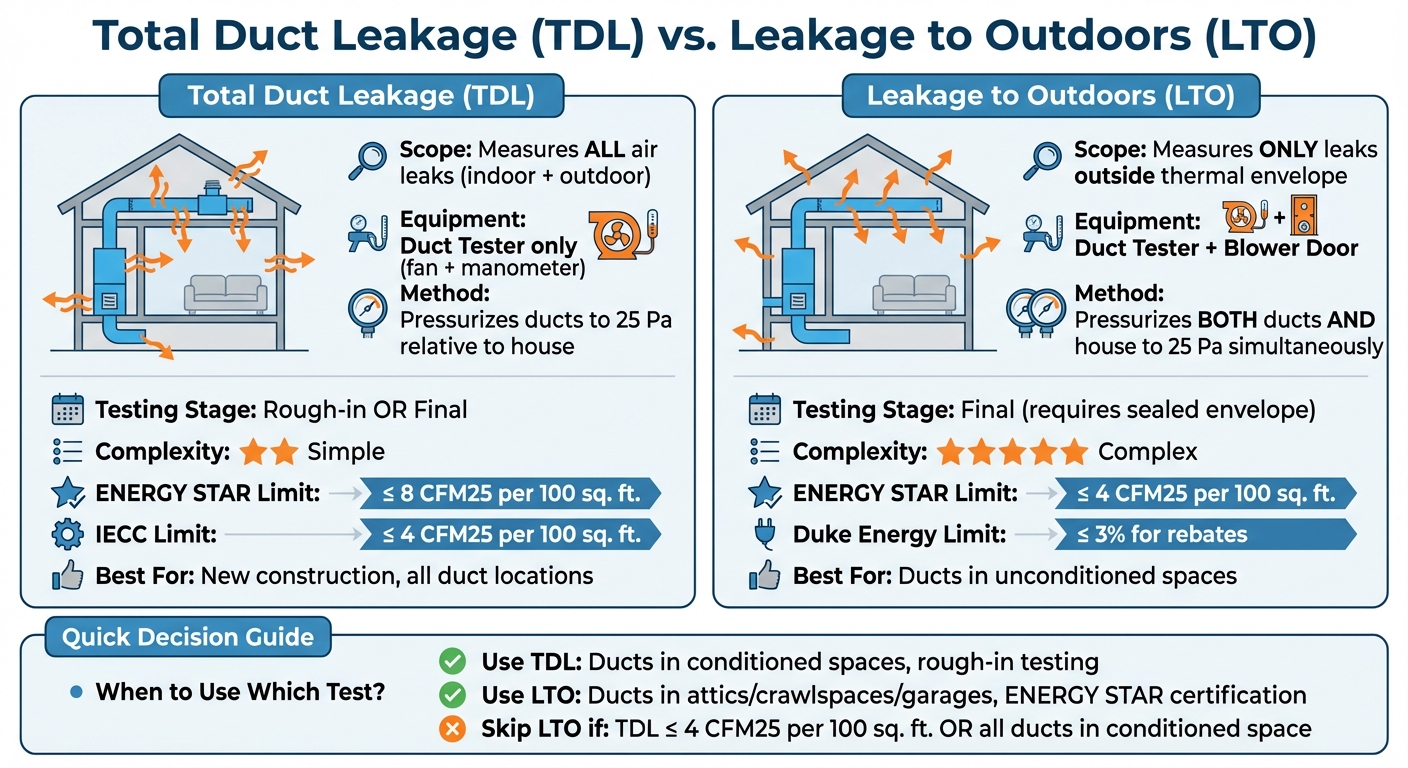
Total Duct Leakage vs Leakage to Outdoors: Key Differences and Testing Methods
Comparison Table
Total duct leakage (TDL) and leakage to outdoors (LTO) testing serve different purposes and require distinct methods and equipment. TDL measures all air escaping from your duct system, whether it ends up inside your home or in unconditioned areas like the attic. In contrast, LTO focuses solely on air escaping beyond your home’s thermal envelope, making it more specific in its scope.
Here’s a quick breakdown of how the two compare:
| Feature | Total Duct Leakage (TDL) | Leakage to Outdoors (LTO) |
|---|---|---|
| Scope | Measures leaks across the entire duct system (indoor and outdoor leaks) | Measures only leaks that exit the thermal envelope |
| Primary Equipment | Duct Tester (calibrated fan + manometer) | Duct Tester combined with Blower Door |
| Methodology | Pressurizes ducts to 25 Pa relative to the house | Pressurizes both ducts and house to 25 Pa simultaneously |
| Testing Stage | Can be performed at rough-in or final stages | Typically performed at the final stage, requiring a sealed building envelope |
| Compliance Use | Commonly used for new construction and code compliance | Required by ENERGY STAR for ducts located in unconditioned spaces |
| Complexity | Simpler; involves sealing registers only | More complex; requires pressurizing both the house and ducts |
When to Use Each Test
Each testing method is suited to specific situations, depending on the stage of construction and the ductwork’s location.
- Use TDL testing when all ducts are located within conditioned spaces or during the rough-in phase. Testing at rough-in is particularly advantageous because leaks are easier to locate and fix before drywall or other finishes are installed.
- Use LTO testing when ducts are in unconditioned spaces like attics, crawlspaces, or garages. This test pinpoints "malignant" leaks – those that truly waste energy by escaping outside the thermal envelope. In cases where total duct leakage is extremely low, the LTO test might not be necessary.
Understanding these differences helps ensure energy efficiency and compliance with building codes. If you’re working on a project in MD, VA, PA, NJ, NY, DE, or DC, Air Balance Masters provides certified TDL and LTO testing services that meet ENERGY STAR and local code requirements.
Compliance Standards for Duct Leakage Testing
Total Duct Leakage Standards
Building codes and energy programs enforce strict limits on duct leakage. For example, the 2012, 2015, and 2018 editions of the IECC mandate that total duct leakage must be ≤ 4 CFM25 per 100 sq. ft. of conditioned floor area during post-construction tests. This is a significant tightening compared to the 2009 IECC, which allowed up to 12 CFM25 per 100 sq. ft..
The ENERGY STAR Single-Family New Homes (Version 3, Rev 11) program sets similar limits, requiring ≤ 4 CFM25 per 100 sq. ft. (or ≤ 40 CFM25 total) at the rough-in stage and ≤ 8 CFM25 per 100 sq. ft. (or ≤ 80 CFM25 total) for final testing. If the air handler is not installed during rough-in, the 2012 IECC specifies a stricter limit of ≤ 3 CFM25 per 100 sq. ft..
California’s 2022 Energy Code takes a different approach by using percentage-based limits. For new single-family homes, total duct leakage must not exceed 5% of the nominal system air handler airflow, or 4% if tested at rough-in without the air handler.
Now, let’s examine how leakage to outdoors is addressed under these standards.
Leakage to Outdoors Standards
Standards for leakage to outdoors are more stringent because this type of leakage directly impacts energy efficiency. ENERGY STAR requires that leakage to outdoors must be ≤ 4 CFM25 per 100 sq. ft. of conditioned floor area.
The 2009 IECC allowed leakage to outdoors up to ≤ 8 CFM25 per 100 sq. ft.. However, the 2012 IECC eliminated this specific requirement, shifting the focus entirely to total duct leakage limits. According to ANSI/RESNET/ICC 380 standards, if total duct leakage is already ≤ 4 CFM25 per 100 sq. ft. or 40 CFM25 (whichever is larger), the leakage to outdoors test may be skipped.
For certified testing services in regions like MD, VA, PA, NJ, NY, DE, or DC, Air Balance Masters offers both total duct leakage (TDL) and leakage to outdoors (LTO) testing, compliant with ENERGY STAR and local code requirements.
Energy Efficiency and Practical Effects
Energy Loss Calculations
Did you know that HVAC systems are responsible for about 40% of a building’s annual energy use? That makes duct leakage a major culprit when it comes to wasted energy.
Take a 2.5-ton cooling system as an example. It moves 1,000 CFM (Cubic Feet per Minute). If there’s 10% leakage – or 100 CFM – you’re losing around 3,000 BTU/h, which is equivalent to ¼ ton of cooling capacity. And where does that lost energy go? Into unconditioned spaces like attics or crawlspaces.
Duct leakage doesn’t just nibble away at efficiency – it can increase a building’s annual HVAC energy consumption by anywhere from 2% to 14%. For fan operation alone (which makes up about 39% of HVAC energy use), the penalties are even steeper. Tight systems (Leakage Class 6) might see a 4% energy penalty, while unsealed systems (Leakage Class 48) could face a jaw-dropping 101% increase.
These energy losses don’t just hurt your wallet – they also compromise the overall performance of your HVAC system.
Impact on System Performance
Duct leakage doesn’t just waste energy; it also throws the entire HVAC system off balance. On average, duct systems lose about 10% of supply air and 12% of return air. This imbalance forces the system to work harder than it should, leading to inefficiencies and wear.
Return leaks are particularly damaging when they occur in unconditioned spaces. As Allison Bailes, founder of Energy Vanguard, puts it:
"Return leaks blow. Supply leaks suck."
- Allison Bailes
When return leaks pull in hot attic air instead of conditioned air, the system’s cooling efficiency takes a nosedive. This forces the compressor to run longer cycles, increasing wear and tear. HVAC professional David E. explains the impact clearly:
"It doesn’t take much 130F air to cripple an otherwise capable AC."
- David E., HVAC Professional
This is why accurate leakage testing is so important, especially for meeting ENERGY STAR standards. Sealing ducts without first measuring airflow can backfire, potentially reducing airflow to the point where evaporator coils freeze, compressors burn out, or heat exchangers crack.
Risks of Leakage to Outdoors
When duct leakage allows conditioned air to escape outdoors, it creates a cascade of problems. Allison Bailes describes this type of leakage as "malignant" because it wastes energy, compromises building durability, and harms indoor air quality.
Unbalanced leakage can also lead to moisture issues. For instance, dominant return leaks create positive pressure inside the house, pushing conditioned air – and its moisture – into wall cavities or attics. This can lead to condensation and, eventually, structural damage. On the other hand, dominant supply leaks create negative pressure, which draws in humid outdoor air or damp crawlspace air. This extra humidity can overwhelm the HVAC system’s dehumidification capabilities.
In crawlspaces, return leaks can bring in enough moisture to encourage mold growth and even structural rot. And in commercial buildings, rectangular ductwork is particularly problematic – it leaks at twice the rate of round ductwork under the same conditions.
These risks highlight why thorough leakage testing is essential. Addressing duct leakage not only improves energy efficiency but also protects the building and its occupants.
For professional duct leakage testing in MD, VA, PA, NJ, NY, DE, and DC, Air Balance Masters offers detailed assessments and reports to help contractors tackle these issues before final inspections.
Conclusion and Key Takeaways
Summary of Differences
When it comes to duct leakage, there are two main types to understand: total duct leakage (TDL) and leakage to outdoors (LTO). TDL measures all leaks, regardless of whether they occur inside or outside the conditioned space. On the other hand, LTO zeroes in on leaks that allow conditioned air to escape outside the building envelope, which directly impacts energy efficiency.
The testing methods differ as well. TDL testing requires only a duct tester, while LTO testing incorporates a blower door to pinpoint leaks outside the thermal envelope. This distinction is reflected in compliance thresholds. For instance, ENERGY STAR Version 3 sets the limit for TDL at ≤ 8 CFM25 per 100 sq. ft., while LTO is capped at ≤ 4 CFM25 per 100 sq. ft.. These variations highlight the importance of choosing the right test for the situation.
Choosing the Right Test
Knowing the differences between TDL and LTO testing helps you select the appropriate method. The location of the ducts is a key factor. If all ducts are within conditioned spaces, TDL testing is sufficient. However, if ducts extend into unconditioned areas, both TDL and LTO testing are necessary to ensure compliance with ENERGY STAR standards.
TDL testing is best performed during the rough-in stage, as it allows for easy access to repair leaks. LTO testing, however, is more suited for final verification in areas outside the conditioned space. Using the correct test not only ensures compliance but also boosts HVAC energy efficiency and overall indoor comfort.
For contractors operating in MD, VA, PA, NJ, NY, DE, and DC, Air Balance Masters provides certified duct leakage testing and reporting. Their services can help you meet compliance requirements and secure final inspection approvals without hassle. Accurate testing is essential for maintaining efficiency and comfort in any building.
FAQs
Do I need TDL, LTO, or both for my project?
When deciding between Total Duct Leakage (TDL) and Leakage to Outdoors (LTO) testing – or opting for both – it all comes down to your project’s specific goals and compliance needs. TDL measures all air escaping from the duct system, regardless of where it goes. On the other hand, LTO zeroes in on leaks that let conditioned air escape outdoors. If energy efficiency or indoor air quality is a priority – especially in projects involving unconditioned spaces or when energy codes demand it – running both tests could be the best approach.
Can I skip an LTO test if my TDL results are low enough?
Skipping an LTO test isn’t a good idea, even if your TDL results are on the lower side. Standard testing protocols usually call for both tests to ensure your HVAC system is compliant and working as it should. Each test serves a specific purpose in confirming regulatory requirements and verifying the system’s overall performance.
What problems besides high energy bills can duct leaks cause?
Leaks in your ductwork can cause more than just high energy bills. They can also result in poor indoor air quality, reduced HVAC efficiency, uneven temperatures from room to room, and even humidity issues. On top of that, they may allow pollutants or irritants to enter your home. All of these problems can affect your comfort, health, and the overall performance of your system.


