


Testing, Adjusting, and Balancing (TAB) ensures HVAC systems operate efficiently, saving energy and reducing costs. TAB addresses common HVAC issues like uneven airflow, equipment strain, and poor ventilation while optimizing system performance. Here’s how it helps:
- Fixes Uneven Airflow: Ensures consistent temperatures and airflow across all zones, improving comfort and cutting energy waste.
- Reduces Equipment Wear: Prevents overworked components, extending system lifespan and lowering repair costs.
- Improves HVAC technology and automation: Aligns mechanical parts with digital controls for accurate data and efficient operation.
- Ensures Proper Ventilation: Meets air quality standards, providing fresh air and eliminating stagnation.
- Cuts Energy Use: Optimizes settings to reduce energy consumption, saving 15%-30% on utility bills.
TAB is a cost-effective way to improve HVAC performance, reduce expenses, and enhance indoor comfort.
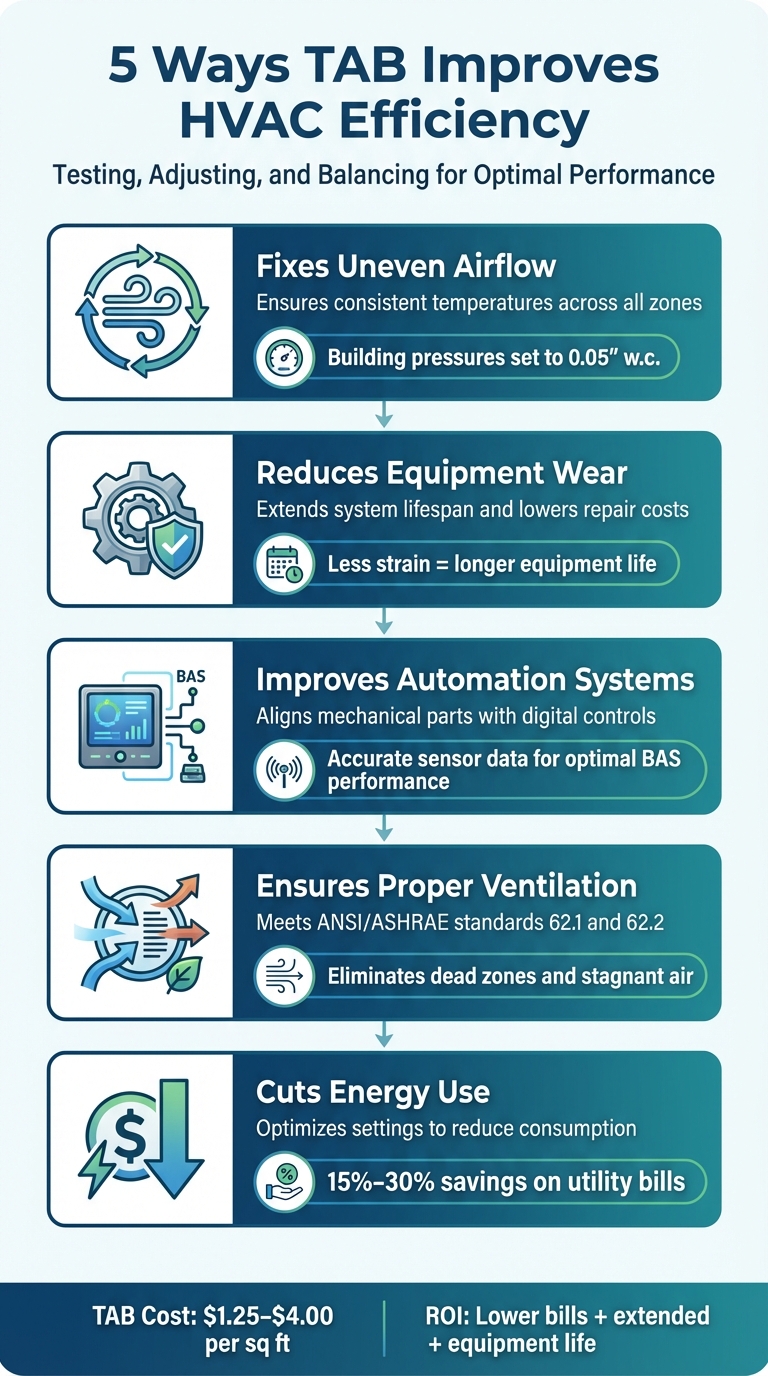
5 Ways TAB Improves HVAC Efficiency and Reduces Costs
How Do Building Owners Benefit from Test & Balance?
1. Fixes Uneven Airflow and Temperature Problems
In many commercial buildings, one of the most frequent complaints is inconsistent temperatures – some rooms feel uncomfortably warm, while others are excessively cold. This happens when airflow isn’t evenly distributed throughout the building, leading to zones that are either over-conditioned or neglected entirely. These imbalances can cause discomfort and inefficiencies in the system.
Impact on HVAC System Performance
To address these issues, Testing, Adjusting, and Balancing (TAB) ensures the system operates as it was designed. Uneven airflow forces HVAC components, like fans and motors, to work harder than necessary, which can strain the system and disrupt proper building pressurization. This imbalance not only impacts temperature control but also affects the building’s ability to maintain clean, conditioned air. As Rebecca T. Ellis, P.E., President of Questions & Solutions Engineering, Inc., explains:
"No amount of commissioning can make an unbalanced system work."
Technicians from Air Balance Masters use tools like manometers to measure airflow at each register. They make precise adjustments to damper positions, fan speeds, and variable frequency drives (VFDs) to bring the system back in line with its original design. By the end of the TAB process, building pressures are typically set to 0.05" w.c., creating the right conditions for proper air circulation and environmental control.
Energy Efficiency Improvements
Correcting airflow imbalances ensures that every zone receives the exact amount of conditioned air it needs. This fine-tuning allows the HVAC system to operate more efficiently, cutting down on energy waste. Improved efficiency not only reduces utility costs but also ensures that occupants in every area experience consistent comfort.
Contribution to Occupant Comfort and Health
Balanced airflow eliminates uncomfortable drafts and temperature fluctuations, creating a more stable indoor environment. It also improves indoor air quality by enhancing pollutant removal, which is particularly important in places like hospitals and laboratories. These environments depend on precise temperature control and clean air to ensure safety and productivity.
2. Reduces Equipment Wear and Extends System Life
TAB isn’t just about improving airflow – it plays a crucial role in protecting your HVAC system from unnecessary wear and tear, ultimately extending its lifespan.
When HVAC systems are out of balance, motors and fans have to work harder than they should. This overexertion leads to faster wear, frequent breakdowns, and costly repairs. TAB steps in to identify these inefficiencies and troubleshoot common HVAC problems before they escalate into major issues.
Impact on HVAC System Performance
A key part of the TAB process involves ensuring motors operate within their designed electrical capacity. This helps prevent burnout and electrical failures. Technicians fine-tune components like fan speeds, sheaves, belts, and dampers to meet the system’s design specifications, ensuring smooth and efficient operation.
Sound and vibration analysis is another essential tool in the TAB process. It identifies early signs of mechanical stress, allowing technicians to address potential issues before they lead to system failures.
Reduction in Maintenance or Repair Costs
A well-balanced HVAC system not only works more efficiently but also experiences less strain, which translates to lower maintenance needs. As Air Balance Masters explains:
"Properly balanced systems experience less wear and tear, reducing maintenance costs and prolonging equipment lifespan."
Additionally, TAB provides detailed reports on key operating conditions like airflow, pressure, and temperature. These reports serve as a benchmark for routine maintenance, helping to catch minor issues early. By addressing these problems proactively, TAB minimizes the risk of expensive emergency repairs and keeps the system running efficiently. This forward-thinking approach saves money and ensures long-term reliability.
3. Improves Building Automation System Function
Modern Building Automation Systems (BAS) depend heavily on accurate sensor data to function effectively. TAB plays a crucial role by bridging the gap between the physical HVAC components and the digital controls. By verifying that every sensor and control point is properly calibrated and transmitting accurate data to the BAS, TAB eliminates the risk of operators making decisions based on faulty readings. This step is essential for ensuring the BAS operates at its full potential.
Impact on HVAC System Performance
Through the TAB process, technicians ensure that your automation system performs as designed. They verify that the control systems follow the intended sequence of operations and fine-tune components like variable frequency drives to align with BAS setpoints. This alignment between hardware and software ensures the BAS reflects actual operating conditions, creating a reliable baseline for consistent performance over time.
Energy Efficiency Improvements
When the BAS receives accurate data from properly balanced equipment, the alignment between mechanical components and digital controls leads to measurable energy savings. Total system balancing ensures that HVAC components and the BAS work together seamlessly, optimizing temperature control and ventilation. This prevents the system from wasting energy by conditioning air unnecessarily – a common issue in systems that are not properly balanced.
For more insights on enhancing HVAC performance through TAB, trusted professionals like Air Balance Masters (https://airbalancemasters.com) offer thorough testing and certification to ensure your BAS and HVAC systems operate in harmony.
4. Ensures Proper Ventilation and Air Quality
TAB (Testing, Adjusting, and Balancing) professionals ensure that your HVAC system delivers the right amount of fresh air as outlined by ANSI/ASHRAE standards 62.1 and 62.2. This helps maintain healthy indoor air quality. Without proper TAB, your system might circulate stale air or waste energy by over-ventilating areas.
Impact on HVAC System Performance
During the TAB process, technicians fine-tune system pressures to optimize airflow, improving ventilation. Adjustments to dampers and fan speeds help remove "dead zones" where air might otherwise stagnate. In specialized spaces like cleanrooms or healthcare facilities, TAB professionals also calculate air changes per hour to ensure safe and sterile conditions are maintained.
Contribution to Occupant Comfort and Health
Proper ventilation directly enhances occupant comfort and productivity. By ensuring even air distribution, TAB eliminates temperature fluctuations and creates a more consistent indoor environment. This balance supports better task performance and overall well-being. As one industry expert highlighted:
"Air balancing is vital to keeping facilities not only comfortable but safe." – Environmental Air Balance Co. (EAB)
For critical environments like operating rooms or biosafety labs, TAB ensures the required air change rates and life safety protocols are met. Additionally, the process involves fine-tuning equipment to reduce noise and vibration, improving acoustic comfort.
Reduction in Maintenance or Repair Costs
When ventilation systems operate as designed, mechanical components endure less stress, which can lower maintenance and repair costs over time. Proper balancing can also address indoor air quality complaints, reducing the need for frequent troubleshooting.
For contractors in MD, VA, PA, NJ, NY, DE, and DC, Air Balance Masters (https://airbalancemasters.com) provides certified testing and reporting services to ensure your ventilation system complies with all design and regulatory standards.
These ventilation enhancements not only promote healthier indoor spaces but also lay the groundwork for energy savings and improved system performance, which will be explored further in the next section.
5. Cuts Energy Use and Utility Bills
Energy Efficiency Improvements
Testing, Adjusting, and Balancing (TAB) services play a crucial role in reducing wasted energy by ensuring HVAC systems operate efficiently and only when necessary. Technicians fine-tune components like variable frequency drives (VFDs), dampers, and valves to achieve precise airflow and distribution, preventing systems from overworking to compensate for imbalances.
"The true value TAB represents is energy optimization over the life of a building. When a building goes unbalanced, critical HVAC systems can run unchecked for years, conditioning air unnecessarily and wasting money." – APPA
When paired with proper commissioning, TAB can deliver energy savings of 15% to 30%. For residential systems, this could mean annual savings of $40 or more, while commercial buildings experience much larger reductions. Over time, these savings add up, making TAB a highly cost-effective way to enhance building performance. Beyond cutting energy use, it also improves overall system functionality.
Impact on HVAC System Performance
By improving airflow and calibrating systems, TAB directly reduces energy consumption. It eliminates hot and cold spots that often lead to unnecessary thermostat adjustments. Optimizing system pressure helps prevent conditioned air from leaking through the building envelope.
Additionally, TAB includes refining the Building Management System to ensure heating and cooling systems don’t operate simultaneously. This step also verifies that setback modes are properly activated during unoccupied hours. On average, 90% of HVAC systems undergo review by a TAB professional.
Reduction in Maintenance or Repair Costs
Beyond energy savings, routine TAB maintenance helps avoid 95% of major HVAC failures and can extend equipment life by 5 to 10 years. When systems are calibrated to their design specifications, components like motors and belts face less wear and tear, delaying costly replacements and improving long-term reliability.
For contractors operating in MD, VA, PA, NJ, NY, DE, and DC, Air Balance Masters (https://airbalancemasters.com) offers certified testing and reporting services. These reports document system performance and highlight areas for efficiency improvements. With TAB services typically costing between $1.25 and $4.00 per square foot, the investment quickly pays off through lower utility bills and reduced maintenance expenses.
What TAB does for HVAC efficiency
Testing, Adjusting, and Balancing (TAB) takes HVAC systems from theoretical design to real-world efficiency. Even the most sophisticated equipment can fall short without proper TAB, leading to missed climate control goals and wasted energy. This process underscores its importance in ensuring HVAC systems perform as intended.
The benefits of TAB go far beyond the initial setup. A properly balanced system operates more efficiently, cutting down on energy waste. It also experiences less wear and tear, which means fewer breakdowns and a longer lifespan. For building owners and contractors, this translates to lower utility bills and reduced maintenance expenses.
Routine audits are a key part of TAB. According to ASHRAE Standard 62.1-2019, outdoor air delivery should be verified at least every five years. Some buildings with robust maintenance programs opt for audits every three years, while others might need annual evaluations. These regular checkups catch performance issues caused by aging equipment, repairs, or shifts in building usage before they escalate into costly problems. This ties back to earlier discussions on energy efficiency and equipment durability, ensuring systems stay optimized.
Certified professionals play a critical role in maintaining system integrity. Using precise methodologies and calibrated tools, they can uncover installation errors, performance gaps, or design flaws that might go unnoticed during routine inspections. Agencies like AABC, NEBB, and TABB certify these experts, ensuring dependable results. For contractors in regions like MD, VA, PA, NJ, NY, DE, and DC, Air Balance Masters (https://airbalancemasters.com) provides certified testing and reporting services to document performance and ensure compliance with building codes.
The final TAB report serves as a valuable baseline for future troubleshooting. Over time, the investment in TAB pays off through energy savings, longer equipment life, and better overall building performance.
FAQs
How does TAB help make HVAC systems more energy efficient?
TAB, short for Testing, Adjusting, and Balancing, plays a key role in improving HVAC energy efficiency by ensuring the system functions as intended. By precisely measuring and fine-tuning factors like airflow, pressure, temperature, and water flow, TAB addresses inefficiencies such as excessive energy use or uneven distribution.
The benefits are twofold: it helps cut down on energy consumption – leading to lower utility bills – and ensures consistent comfort throughout a space. Additionally, this process can extend the lifespan of HVAC equipment by keeping all components working efficiently and in sync, boosting overall system performance.
What are the long-term cost savings of using TAB for HVAC systems?
Investing in Test, Adjust, and Balance (TAB) services for your HVAC system can translate into substantial savings over time. By fine-tuning your system for maximum energy efficiency, TAB helps cut down on utility costs while minimizing strain on your equipment. This not only keeps your energy bills in check but also extends the life of your HVAC system, reducing the need for frequent repairs or replacements.
On top of that, a properly balanced system ensures steady performance, helping to avoid inefficiencies and maintain comfortable indoor temperatures throughout the year.
How does TAB improve ventilation and indoor air quality?
TAB, which stands for Testing, Adjusting, and Balancing, plays a key role in improving ventilation and indoor air quality. By measuring and fine-tuning airflow rates, pinpointing duct leaks, and maintaining proper pressure levels, this process ensures that HVAC systems operate as intended. Certified professionals meticulously balance supply and exhaust air to align with design specifications and meet code requirements, fostering a healthier and more comfortable indoor environment.
Beyond meeting industry standards, TAB enhances the overall performance of HVAC systems. It improves air circulation, boosts energy efficiency, and supports the well-being of building occupants.


