


Regular Testing, Adjusting, and Balancing (TAB) services are key to keeping your HVAC system running efficiently and avoiding costly breakdowns. TAB ensures proper airflow, temperature balance, and system performance by fine-tuning components like fans, dampers, and valves. Without it, systems can become unbalanced, leading to:
- Uneven heating and cooling: Rooms with inconsistent temperatures and wasted energy.
- Increased wear on equipment: Overworked components that fail prematurely.
- Poor indoor air quality: Stale air, pollutants, and humidity issues.
Skipping TAB can result in higher energy bills, frequent repairs, and reduced equipment lifespan. Regular TAB services, typically costing $1.25–$4.00 per square foot, save energy, lower operating costs, and extend the life of your HVAC system. For optimal performance, experts recommend scheduling TAB every 2–3 years or after major repairs.
The Importance of Test and Air Balance (TAB) in HVAC Projects #sparky #automobile #diy
HVAC Failures Caused by System Imbalances
When HVAC systems fall out of balance, they can create a host of problems – everything from wasted energy and uncomfortable temperatures to health concerns for building occupants. These imbalances don’t just disrupt comfort; they also put unnecessary strain on system components and compromise air quality.
Uneven Heating and Cooling
One common sign of HVAC imbalance is uneven temperatures between rooms or floors, often exceeding 2°F in difference. This typically points to improper air distribution. You might notice weak airflow from certain vents, strange whistling sounds from registers, or even rattling noises in the ductwork caused by high-speed air squeezing through tight spaces.
These airflow inconsistencies make the system work harder and longer to maintain the thermostat’s set temperature in areas that aren’t getting enough air, which drives up energy use. According to the U.S. Department of Energy, households can lose 25% to 40% of heating and cooling energy through ductwork alone. When you add in issues like duct leakage and system imbalances, energy consumption can soar by as much as 40% beyond what’s necessary. Proper Testing, Adjusting, and Balancing (TAB) can help ensure even distribution of air and temperature, reducing wasted energy and keeping the system from overworking.
Increased Wear on Equipment Components
HVAC imbalances force key components like compressors, motors, and fans to work overtime to compensate for uneven airflow. This extra workload accelerates wear and tear. As HVAC.com notes:
Systems that constantly overwork to compensate for unbalanced airflow are more prone to breakdowns.
Excessive airflow speeds can also loosen screws, panels, and duct connections over time, leading to more frequent repairs. If these issues aren’t addressed, the strain can cause premature equipment failure, which often comes with hefty repair bills.
Poor Indoor Air Quality (IAQ)
Imbalanced systems often fail to bring in the correct amount of outside air, which can lead to higher CO2 levels and a buildup of indoor pollutants like allergens and volatile organic compounds (VOCs). Uneven airflow can create stagnant zones where these contaminants accumulate. Worse, improper pressure gradients can allow odors or pollutants from kitchens, restrooms, or labs to seep into occupied areas.
Humidity control is another issue. Imbalanced systems often struggle to maintain the ideal range of 30% to 50%, which is critical for preventing mold and other biological growth. Poor indoor air quality (IAQ) caused by these imbalances can lead to symptoms of Sick Building Syndrome, such as headaches, respiratory problems, and reduced productivity. Regular TAB services can mitigate these risks by ensuring the system meets its design specifications for ventilation and pressure management.
How Small Imbalances Lead to Major System Failures
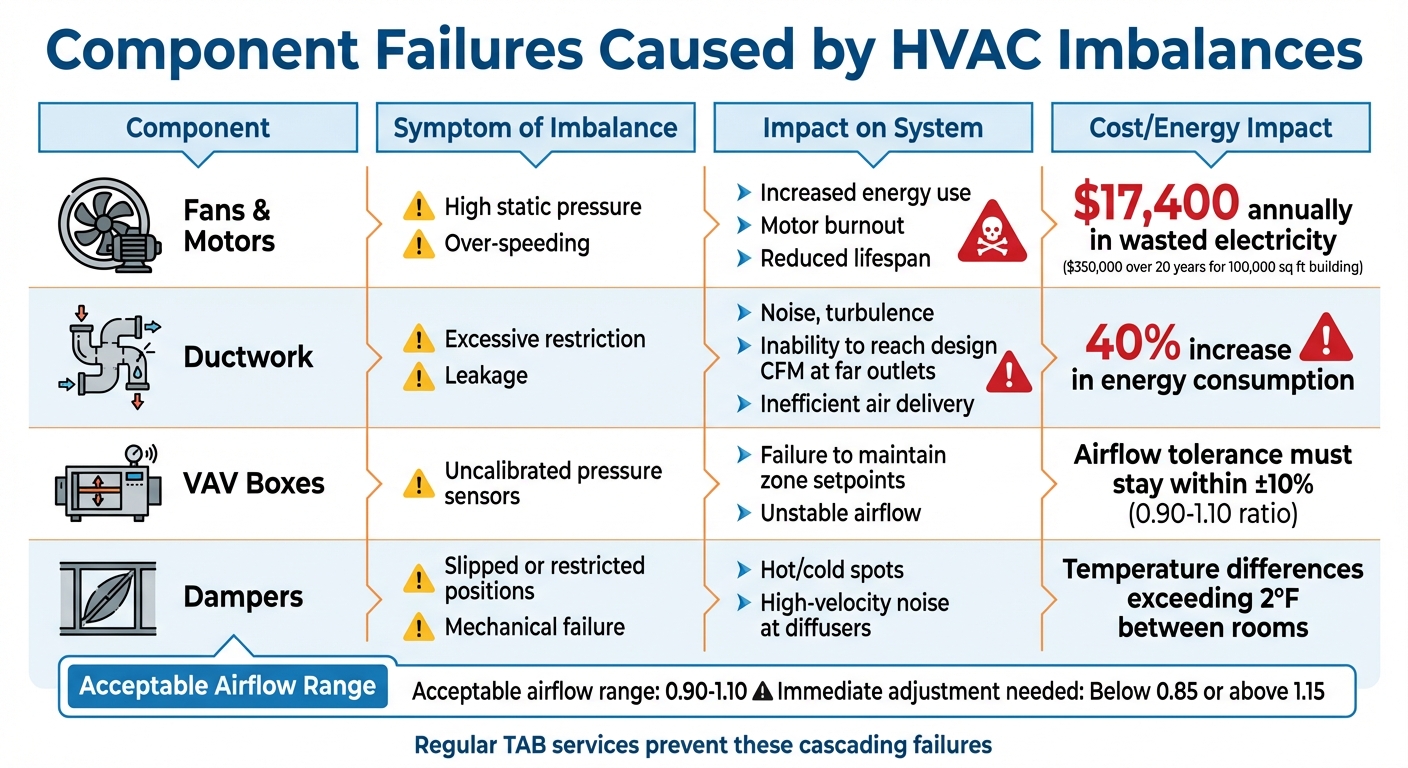
How HVAC Imbalances Cause System Failures and Component Damage
Even minor airflow discrepancies can snowball into costly breakdowns. Building design expert Ali Kriscenski puts it succinctly:
"Small issues like this can, over time, strain furnaces and electrical devices and reduce a system’s life span".
The real challenge isn’t just wear and tear – it’s the accelerated damage that occurs when components are forced to overcompensate for imbalances. When these deviations from design specifications go unchecked, they can spiral into larger, system-wide problems. Let’s break down how that happens, starting with individual components.
Overworked Fans and Pumps
When airflow dips below the required levels, technicians often try to compensate by speeding up the fan. While this might seem like a quick fix, it can backfire. Without verifying the electrical load, increasing fan speed can push the motor beyond its horsepower capacity, leading to early motor failure.
Pressure imbalances also force fans and pumps to battle higher static pressures. This not only consumes more energy but also reduces airflow efficiency. For example, in a 100,000 sq. ft. office building, delivering 130,000 CFM to meet a 110,000 CFM demand adds about 70 horsepower of motor load. The cost? Around $17,400 annually in wasted electricity – or a staggering $350,000 over 20 years.
These inefficiencies don’t stop at the fans; they ripple through the entire ductwork system.
Static Pressure and Ductwork Problems
In HVAC systems, supply duct static pressure is usually kept between 1.0 and 1.5 inches water column. When ductwork becomes unbalanced, static pressure increases, forcing the system to expend more energy just to move air. This not only wastes energy but also creates other issues like excessive noise and turbulence.
Brian Craig, an air balancing specialist, explains:
"High velocity noise at supply diffusers almost always means a damper upstream has been closed too far, creating high velocity through a reduced opening".
Additionally, duct leakage and restrictions can drive energy consumption up by 40% more than necessary. The result is a noisier, less efficient system that struggles to meet its design specifications.
Damper and Variable Air Volume (VAV) Malfunctions
Misaligned dampers or uncalibrated sensors in VAV boxes can wreak havoc on airflow patterns throughout a building. When pressure sensors in VAV boxes are off, the system can’t maintain zone airflow setpoints, leading to performance issues.
To avoid cascading failures, airflow tolerance should stay within ±10% of the target (0.90 to 1.10). Outlets measuring below 0.85 or above 1.15 need immediate adjustments. Regular Testing, Adjusting, and Balancing (TAB) services are critical to catch and correct these problems before they escalate.
| Component | Symptom of Imbalance | Impact on System |
|---|---|---|
| Fans & Motors | High static pressure / Over-speeding | Increased energy use; motor burnout; reduced lifespan |
| Ductwork | Excessive restriction / Leakage | Noise; turbulence; inability to reach design CFM at far outlets |
| VAV Boxes | Uncalibrated pressure sensors | Failure to maintain zone setpoints; unstable airflow |
| Dampers | Slipped or restricted positions | Hot/cold spots; high-velocity noise at diffusers |
The TAB Process: Finding and Fixing Imbalances
Once you grasp how imbalances can lead to system failures, the next logical step is addressing them. That’s where the TAB process comes in. This method pinpoints performance gaps and systematically corrects them, ensuring your system operates as it was designed to. Jonathan Lloyd, a NEBB Professional, puts it best:
"TAB is effectively and efficiently tuning building systems to perform optimally as per the engineer of record’s (EOR) design intent."
The TAB process – testing, adjusting, and balancing – restores struggling systems to their intended performance. Let’s break down how each phase works to achieve this precision.
Testing Airflow and Hydronic Systems
Testing is all about establishing a baseline. Technicians measure key variables like airflow, water flow, temperature, and pressure across critical components such as air handlers, fans, heat exchangers, water coils, motors, ducts, and registers. These measurements are compared to the system’s design specifications.
For example, if a zone is designed to deliver 2,500 CFM but only manages 1,800 CFM, this discrepancy is logged for correction. Additionally, technicians ensure the Building Automation System (BAS) is functioning properly and accurately labeled. By the end of the process, building pressures are typically fine-tuned to around 0.05" w.c..
Adjusting Dampers, Valves, and Fans
Once testing highlights the problem areas, the adjustment phase begins. Technicians tweak system components to match design requirements. This involves:
- Modifying damper blade angles to control airflow
- Adjusting control valves to ensure proper water distribution
- Calibrating fan speeds to meet the specified air volume
In Variable Air Volume (VAV) systems, technicians set the appropriate static pressure and fine-tune individual VAV boxes to deliver the correct airflow to each room. Adjustments are made incrementally, with the system allowed to stabilize between changes. After achieving the desired settings, components like dampers are locked in place to prevent shifts over time. As SALT Service Co. explains:
"When you adjust the damper, you’re controlling the airflow directed to specific parts of your home: Open position allows maximum airflow, closed position restricts airflow, and partial position balances airflow between extremes."
Balancing to Design Standards
The final phase focuses on ensuring even distribution across the entire system. Technicians balance air and water flows throughout all zones, creating consistent temperatures and maintaining optimal air quality. This step adheres to ANSI/ASHRAE standards 62.1 and 62.2 for outside air ventilation rates.
Balanced systems offer more than just comfort – they reduce wear and tear on equipment, extending the lifespan of HVAC components. Plus, they can lower energy consumption by as much as 30%. As APPA highlights:
"Without the efforts of a TAB firm, a design is just a concept, not a reality."
Finally, all adjustments are documented in a detailed TAB report, serving as a valuable reference for future maintenance .
Energy and Cost Savings From Regular TAB Services
When your HVAC system undergoes thorough testing, adjusting, and balancing (TAB), the benefits extend beyond comfort. Regular TAB services can lead to noticeable savings in three main areas: lower energy bills, reduced operating costs, and fewer maintenance headaches.
Energy Efficiency Improvements
A well-balanced HVAC system avoids wasting energy and minimizes the risk of system failures. Proper distribution of air and water flows ensures your system doesn’t have to work overtime to compensate for uneven heating or cooling. The payoff? Lower utility bills.
As APPA highlights:
The true value TAB represents is energy optimization over the life of a building.
Without regular balancing, HVAC systems can run inefficiently for years, conditioning air unnecessarily and driving up energy use. By improving efficiency, TAB services not only cut energy costs but also reduce overall operating expenses.
Lower Operating Costs
Energy savings are just the start. TAB services also reduce operating expenses by extending the life of your HVAC equipment. When your system operates efficiently, components like blowers, compressors, and furnaces experience less wear and tear, delaying expensive replacements.
Ali Kriscenski from Therma underscores this point, noting that optimized system performance leads to lower maintenance costs and longer equipment lifespans.
Reduced Maintenance Requirements
TAB services help you stay ahead of potential problems. Technicians can detect small issues – like airflow restrictions or pressure imbalances – before they turn into costly repairs. This proactive approach reduces emergency fixes and keeps your system running smoothly.
Long-Term HVAC Protection With Air Balance Masters
Keeping your HVAC system in top condition means tackling imbalances before they turn into costly problems. That’s where Air Balance Masters steps in. They provide certified testing and balancing (TAB) services designed to keep systems efficient and compliant with strict regulations across the Mid-Atlantic.
Meeting Industry Standards
Air Balance Masters ensures HVAC systems align with critical ASHRAE standards for ventilation and indoor air quality, including ASHRAE 170 for healthcare. They also meet requirements from The Joint Commission (TJC), Centers for Medicare & Medicaid Services (CMS), and New Jersey Energy Code for commercial and multifamily properties. These certifications are often critical for securing a Certificate of Occupancy and avoiding expensive delays. Their dedication to meeting these standards reflects their expertise in the region.
Regional Expertise in the Mid-Atlantic
Operating out of Elkridge, Maryland, Air Balance Masters serves contractors across Maryland, Washington, D.C., Virginia, Pennsylvania, Delaware, New Jersey, and New York. Their local focus allows them to deliver certified TAB reports within 48 hours, helping clients meet tight inspection deadlines. With a 5-star rating from 32 Google reviews, customers frequently highlight their ability to solve tricky airflow issues and maintain clear communication throughout the process. Beyond their regional knowledge, their scheduled TAB programs help ensure your HVAC system stays in peak condition for the long haul.
Scheduled TAB Service Programs
Routine TAB services are key to catching minor imbalances before they lead to system failures or energy waste. Air Balance Masters offers annual and semi-annual TAB programs that identify hidden inefficiencies in both air-side systems and hydronic components. These include chillers, boilers, and water source heat pumps. Pricing is customized based on factors like system count, duct complexity, and location, with quick turnaround times for estimates.
Conclusion: Protect Your HVAC Investment With Regular TAB
Your HVAC system represents a significant investment, and keeping it in top shape is essential. Regular TAB (Testing, Adjusting, and Balancing) services help prevent minor issues from turning into expensive problems by ensuring components are properly aligned with design specifications. Without TAB, your system may operate inefficiently for years, pushing parts like fans and pumps to work harder than they should. According to APPA, optimizing energy usage through TAB curbs unnecessary conditioning and saves money.
Experts recommend scheduling TAB services every 2–3 years or after major repairs. This schedule allows technicians to catch issues like airflow restrictions, pressure imbalances, or malfunctioning components before they escalate into full-blown system failures.
Choosing proactive TAB services is a smart move for building owners. Certified providers follow strict industry standards to deliver accurate calibrations. For example, Air Balance Masters offers certified TAB reports within 48 hours and provides tailored maintenance programs – either annually or semi-annually – to ensure your system stays balanced, efficient, and compliant with code requirements.
The cost of TAB services, typically between $1.25 and $4.00 per square foot, is a small price to pay compared to the expenses of emergency repairs, premature equipment replacement, or years of wasted energy. Regular TAB services are a reliable way to safeguard your HVAC system, reduce energy costs, and avoid unexpected breakdowns.
FAQs
How do I know my HVAC system is out of balance?
Uneven airflow, noticeable temperature differences between rooms, rising energy bills, or a drop in overall comfort are all signs your HVAC system might be out of balance. These problems typically point to poor air distribution and inefficiency in the system, which, if ignored, can cause further performance issues.
Will TAB help fix comfort issues without replacing equipment?
Testing, Adjusting, and Balancing (TAB) services can help tackle comfort problems by improving airflow and ensuring better temperature distribution. The best part? This can often be achieved without replacing your existing equipment. By making sure your HVAC system runs as it was intended, TAB services can boost performance and address issues like uneven heating or cooling with precision.
What’s the best time to schedule TAB for my building?
The best time to schedule TAB (Testing, Adjusting, and Balancing) services is right after your HVAC system has been installed or modified, but before the building is occupied. This timing ensures the system runs efficiently and avoids any performance issues down the line.


